How to Create Plans You’ll Stick To

There are two easy ways to create feasible plans:

  1. Pretend you have 30% the energy you usually have
  2. Copy a plan you’ve completed successfully before

Note that I’ve left out the most obvious way – looking at a calendar and the things you have to do then filling up the hours.

Why don’t we stick to plans?

I’m probably one of the biggest culprit of this which is what led me to figure out how to stop this from happening again as it was becoming a huge source of frustration.

It’s simply too difficult

For some reason, if we imagine a free day we imagine a lot of time. But we also assume our energy levels will match that. It often doesn’t.

Cramming the day with loads of activities is only going to make you tired quickly and far more likely to stop doing them even in the middle of the day. If it’s a long term plan it’s even less likely to continue.

We get distracted

Distractions are a huge problem. As research shows, after a distraction, it takes about 25 minutes to get back into work.

It makes our work far less efficient and moves everything in the plan forward. Therefore we work longer, become more tired and start putting things off.

We don’t give ourselves enough time

We might assume that we can get an essay done in 3 hours but sometimes we might get stuck which means we have to take a longer break. Or we can’t find the book we want.

Same with side projects you might want to do after work/studying. If we expect to do all of them in a minimal time then we’re either going to drop them completely or reduce them drastically and feel guilty about it.

We procrastinate

Looking at a large plan for the day can be intimidating and cause us to procrastinate. Therefore we don’t do anything we aim to. Here’s one simple way to stop it.

Making plans work

  1. Assume less energy than normal

This point relies on assuming you have less energy than your plan assumes

If we try being superhuman then get intimidated or worn out by our plan, it’s not a useful. On the other hand, if we’re more modest, we have a much easier starting point, procrastination is less likely and we will complete things.

Let’s take one of the plans I’ve had in the past (and I’ve had many):

Capture 4 Capture 3 Capture 1

This is actually a simplified version of a plan I had at one point in my first year of university.

Looking back on it, it’s surprising to think that I considered it then even more surprising is that I was annoyed when I couldn’t complete it! Nearly 9 hours of difficult (and unnecessary!) work I had planned. That’s on top of being social, dealing with chronic pain and you know, trying to not hate books after my first week.

The plan didn’t work for a variety of reasons:

  • I didn’t have the energy to complete them
  • I ignored other factors (like having friends and going outside)
  • It was boring
  • It wasn’t flexible

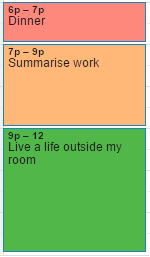
Creating the plan with the mind that you’ll have less energy means you plan to do fewer things, increase flexibility and still complete things. So the plan above might turn into this (assuming there’s a 9am start):
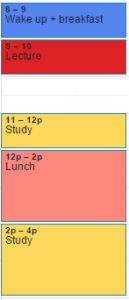
Capture 2

And that’d be it.

The first plan has nearly 9 hours of mentally tasking work while the second has 4 hours with large breaks in between. It’s much easier to start and I found I got more work done with the second plan overall.

  1. Copy a previous plan.

The second condition is easier to implement. If you’ve successfully created and completed a plan before, copy it and use it again.

However, it’s important to take into account new factors when doing this because your past plan might have been completed under much different conditions. For example, if you’ve caught a cold, your energy is going to be lower than it would be normally so you’ll complete less work or it’ll take longer to complete the same amount.

But remember to be reasonable. If you’ve planned an overnight stay at your library or a general rush till exams, you won’t be able to sustain it for a long period. To combat that, refer to point one.

An impromptu Q&A session

“But you’re doing so little work – you’re obviously doing a Philosophy degree this doesn’t apply to me!”

Fortunately, it still does. If you’ve ever planned anything and never completed it (although you feel you should have) then it applies. Creating unrealistic plans is normal and unless you actually have unlimited energy, it’s fine to plan less and complete more.

Dealing with chronic pain means I’ve had to change how I view plans and making my time more efficient. This is one way I’ve managed to stay with the crowd despite being in pain all the time.

“But what if I can’t plan less! I have so much more work to do than you”

That’s where the second condition comes into place.

Not every plan can work on such little energy. Deadlines and loads of work exist. If you’ve actually completed a plan that meets the demands of your current situation, mould it around that. As Scott Young says, you’re allowed to experiment.

If not, continue to assume you’ll have less energy when creating it. And stop procrastinating.

“What if I have scheduled commitments?”

If you have a variety of things you want to do (clubs, learning new things, blogging etc), reducing the amount of energy you’ll have to complete it seems ridiculous. It isn’t.

In this scenario, you have to exercise prioritising and say no to some commitments. If you don’t, there’s a good chance you won’t do them, get frustrated at the ‘little free time’ you have or burn out very quickly and blame yourself.

Admittedly, it is difficult saying no to things especially when you seem to have a lot of time for trying new things. Those things won’t disappear straight away and there’s no point in planning them if you’re too tired to complete them.

It’s alright to say no.

“Am I allowed to continue working past my smaller plan?”

Yes. A minimal plan makes it easier to start working. It doesn’t necessarily put a limit on how much you should continue working. Though, it should make you more efficient with the hours planned – reducing the need to continue working much more.

The next day, return to the minimal plan. A good plan is sustainable.

“I’m rubbish with times. What if I oversleep?”

Ignore times and focus on activities. Instead of planning the hours, aim to work on a project for an hour in the morning and an hour in the evening.

If that is too difficult, aim to do an hour of the project during the course of the day. The earlier the better of course as you don’t want tiredness to excuse you from working.

“Did you write these questions yourself?”

Some things are best kept secret.

Action Steps

The take away from this is to reduce the amount of energy you’ll need to finish a plan so it’s easier to start and easier to complete.

What can you do now?

  1. Create a plan for your ideal day
  2. Assume you’ll have less energy than normal
  3. Create a new plan.

A small amount of completed work is better than a large amount left wished to be completed.


Sign up to my fortnightly newsletter for free updates on my best posts.
If you found this helpful, share it on Facebook or Twitter!

Welcome, Lifehack readers!

For regular readers, I’ve written a post on lifehack titled: 8 Things to Remember If You Love Someone With Chronic Pain.

If you’re new, I post about once a week on personal development, mindful living and simple ways to create habits.

Here are some posts to start with:

  1. The One Phrase to Beat Procrastination
  2. 5 Reasons to Start Meditating
  3. Don’t Break the Chain
  4. Create Without Expectation
  5. How to be Happily Unproductive

As you may have guessed, I also suffer from chronic pain.

  1. Living with Chronic Pain
  2. Who Would I Be? 

I have a fortnightly newsletter which you can sign up to for free HERE. I post a summary of the posts I’ve done over the past 2 weeks and talk about anything else that might be of interest to you. Like my favourite guided meditations and articles around the web.

Sign up for the Newsletter. 

Look forward to talking to more of you in the future :)

The One Phrase to Beat Procrastination

Procrastination plagues all of us.

Whether it’s a writing an essay or cleaning the house – we have tasks we want (and need) to do and put them off anyway.

To combat this, we’ve probably read a number of useful things on stopping procrastination. Break down the goal into small and manageable tasks, plan your day, set deadlines, and work without distractions and so on.

They’re all helpful but we still put things off. When we think of the task, we begin to feel uncomfortable. Let’s delve into that feeling of resistance.

What do we feel when we procrastinate?

Should we actually spend time with these feelings, we might learn a few things.  We’ll split the tasks into the classic Eisenhower matrix.

If it’s important but not urgent, we’ll find comfort in procrastination because we don’t have to do it but feel guilty because we know it will be helpful. If our thinking continues, we might feel guilty for having these feelings at all.

If it’s urgent but not important, we might feel anxious or on the other hand, apathetic towards the task. The task’s urgency means we have to think about it but since it’s unimportant, the deadline might just zoom past without consequence.

If it’s urgent and important, the feelings  of guilt, dread and discomfort are multiplied. We’ll feel trapped within the confines of our own procrastination – like slaves to distraction and quick entertainment.

Depending on how bad the procrastination is, the task will remain undone and we’ll just deal with the consequences.

There are many feelings we have while procrastinating. A lot of it stems from the fear of discomfort and results in self-criticism that makes us feel bad rather than change action in a sustainable way.

How can we combat this?

The phrase to beat procrastination

“It’ll be better after I start”

Since all of our feelings from procrastination are born of inaction, using them it’s useless to gauge how well the task will be done. We often overestimate the difficulty or underestimate our ability to try.

Stop thinking about how you might feel during the task and quieten the internal monologue convincing us to give into instant gratification. Start the task then experience how you feel.

Starting something always feels better than not starting but wanting to.

I’ve never felt worse for starting something I’ve needed to. Of course, I’ve abandoned things or disliked them for a variety of reasons but it’s better to have justified reasons and progress under your belt rather than being guided by fear.

Conclusion

When you find yourself procrastinating, say “it’ll be better after I start”.

Because it will and you’ll be OK.


If you enjoyed this article, sign up to the fortnightly newsletter HERE. I provide free updates on the best posts I’ve written and other interesting things.

Share this article on Facebook or Twitter


Other helpful reminders for procrastination:

Create without expectation

What’s wrong with now?

Why Procrastinators Procrastinate

Make Your Bed

If you want to change the world, start off by making your bed

Admiral McRaven

Start the day with a simple and easy task – make your bed.

When I was younger, I ignored the command “make your bed” as many times as I was told to do it. I didn’t need to because I’m going to sleep in it later anyway. It was pointless.

But the point isn’t to prepare you for sleep at night. It’s to prepare you for the rest of the day.

Making your bed is easy. It takes a minute to do, it can be done every day and you’ll always have a reason to do it.

It is the perfect way to get started with changing bad habits and encouraging good ones.

I say this because it teaches us a lot about how habits are created and maintained. Habits require a trigger (a messy bed), a routine (making the bed) and a reward (first task of the day accomplished and a neater room).

It also gives us a small sense of pride. You can say ‘I’ve accomplished something today’ before you’ve brushed your teeth. Since it was so easy, you might be encouraged to complete other tasks such as cleaning your desk or open the book you’ve been meaning to read.

Should you have a bad day, a made bed can offer some calmness. Maybe you haven’t accomplished the things you wanted or something has bothered you. You’ve made your bed. It’s a small victory but one you can appreciate.

If we don’t appreciate the small things in our day, the bigger moments may pass by unnoticed.

Start the day simply and make your bed.

Sign up for fortnightly updates HERE

If you enjoyed this article, share it on Facebook or Twitter.

Stop Watching Motivational Videos (and what to do instead)

They fade from black with one person as the focal point. The music is starts calm but it’ll build up to something. It’s a Hans Zimmer score, after all.

You see a fit person running up some stairs or someone boxing. If you’re lucky, you get to see scenes from The Pursuit of Happiness again with a speech from Rocky Balboa layered over the top.

As the video progress, more stuff about getting up after a fall and dreaming big is shown. You’re told you’re worth it and can do anything you want if you put your mind to it. You’re reminded of all the rags-to-riches stories that exist like J. K. Rowling living in a council estate to earning millions a day and getting rejected a number of times before finally being accepted.

You feel good.

You’re motivated.

But motivated to do what? Finally start on your goals? But only after one more video…

Stop watching motivational videos

They’re akin to depending on sugary energy drinks rather than a good night’s sleep to combat tiredness.

Motivational videos (and images) feed procrastination in a special way.

They make us feel productive without all the work required in between. They might lift our mood temporarily but do nothing to combat the problem. The problem might be perfectionism. It could be that you’re simply trying too much and the goals need to be broken down. Or a number of other things that continues procrastination.

Motivational videos do nothing to solve these problems. It’s far too easy to continue doing nothing at all to further progress.

Hell, there’s even a chance you’ll feel guilty because you still haven’t done anything.

Since the improvement in mood is temporary, we always need to be motivated to even consider working. That in itself is unsustainable. After a while, they lose their desired effectiveness and become boring like any other entertainment.

It leads to only doing work when we feel like it and waiting for magical inspiration to strike us on the head. Such things don’t happen. To work consistently towards something, you’ll have to do it when you don’t feel like it.

Depending on how we feel in order to start working is a poor strategy. With all the quick entertainment and instant gratification at our fingertips, when will we ever feel like working if we haven’t already become disciplined enough to make it a habit?

In this case, dependence on motivational videos is actually detrimental.

Clichés, clichés and more clichés.

If you’ve watched many motivational videos, you’ll hear many of the same things over and over again. You might repeat them a few times but if it doesn’t result in any action, it’s literally just an empty chant. For example: “When you breathe as bad as you want to succeed, then you’ll be successful” is a reasonably new phrase that’s creeped its way into motivational diction.

I don’t want to say it’s useless but it is somewhat unhelpful. It hides the work actually needed to be done in order to achieve those levels of hard work.

Let’s say you want to exercise and embodied that phrase.

Does it inspire feelings of moderation or extremes?

After hearing that, do you want to aim for a huge personal best every gym session? Or do you want to start running for a few minutes and try a few more the next day?

The first choice is inspired by these motivational videos. It’s unrealistic for a beginner and unsustainable. The second is achievable but doesn’t fit too well in a catchy phrase.

Small starts and consistent work isn’t shown in such videos because their nature isn’t to show you the hard work. They show the end result and say ‘just do it’.

Small starts and consistent progress is how we actually achieve our goals.

But of course, that isn’t as romantic. Discipline is rarely romantic. But it works.

What should I do instead?

Start small – Make the goal so small you can’t say no. Or work for 3 minutes and decide if you want to stop afterwards. For example, this article was started by simply writing the title.

Be kind – Don’t berate yourself with hatred and negative thoughts for not doing something. It only serves to make you feel bad and does nothing to further progress. It actually makes you less likely to do anything. If you feel like you’re worthless, why bother starting anything?

Be specific – A huge reason why we procrastinate is because we don’t know what to do. Saying ‘get fit’, ‘read more’ or ‘write essay’ doesn’t mean much. Saying you want to write 500 words by the end of the day or lose 10kg in 3 months makes the goal much more real and attainable.

Conclusion

Motivational videos aren’t helpful unless what we’re looking for is to feel good for a few minutes. If that’s the case, we should admit we watch them for entertainment rather than their life-changing abilities.

We simply don’t need to be intensely motivated for everything. It’s fine to just go for a run or write some words without becoming your own personal cheerleader in the process. It’s called being normal.

Consistent progress will beat motivational videos every time. That’s what self-discipline grants us.

Sign up for the fortnightly newsletter HERE.

Do you find motivational videos helpful? If so, how often do you watch them?

If you enjoyed the article, share it on Facebook or Twitter.


Thank You, Oliver Sacks

Above all, I have been a sentient being, a thinking animal, on this beautiful planet, and that in itself has been an enormous privilege and adventure.

Only 6 months ago Oliver Sacks wrote those words when he announced he has terminal cancer.

Now, he has passed.

It’s difficult to express my sadness for an inspiration of this magnitude. The Man Who Mistook His Wife for a Hat was special in many ways. For one, it was penned by the brilliant hand of Mr Sacks so its prose was impeccable and rhythmic. More importantly, he focused on the humanity of his patients more than any one I’ve ever read or spoken too. I felt a connection with many of them and their condition somehow became less important the more I read.

They weren’t freak-shows, idiot savants or the terribly unlucky who society can do nothing for. They were people with interests, motivations and personality. Sacks spent time with the person rather than just their condition.

In his announcement of terminal cancer, he wrote that he feels intensely alive and feels sudden focus and clarity. The distractions have fallen away as he hopes to focus on himself, his friends and his work. An amazing thing for some one who is face to face with death.

Now he is gone, I want to say thank you once more. Thank you for your writings. Thank you for your crystal clear humanity. Thank you for giving your readers strength during your most difficult time.

Thank you, Oliver Sacks. It’s been an enormous privilege.


My Own Life – Oliver Sacks on Learning he has terminal cancer 

Oliver Sacks dies aged 82


The Excuse not to Try

An excuse not to try is needlessly self-limiting.

It takes a desire, bathes it in fear and tells you ‘no, don’t bother. Your efforts will be wasted’. Evidence is non-existent but your belief in it is high.

What is an excuse not to try?

It’s a weak rationalisation for not doing something you want to do. They usually take a very general form that can be applied to anything rather than specific to your personal situation.

For example:

“I don’t have time…”

“I’m going to do poorly…”

“I haven’t planned anything yet…”

There are many others of this form and there’s a reason for that. They are quite lazy and don’t assess the situation properly.

Here’s an example:

Emily wants to join her university’s football society but chooses not to because she’s never played before and doesn’t want to make a fool of herself.

We have some facts: she wants to join and she’s new to football.

However, she’s made some suspicions that are wrongly taken as fact.

Firstly, that she’ll make a fool of herself. Secondly, that making a fool of yourself is going to be bad. Nothing says she can’t continue to enjoy it. Thirdly, other people won’t be in a similar situation.

The reasons for believing these things are powerful. The image of herself running, falling and getting hit on the head with the ball are potent. They replay in her head many times becoming more powerful each time. She’s already embarrassed before even looking at the sign-up sheet.

If these things aren’t true, what other reason does she have to not try for something she wants?

None.

She can try, overcome the fear and hopefully have fun. If it doesn’t turn out the way she desires, at least she knows why rather than living with ‘what ifs’.

Excuses and Reasons

If we take these excuses seriously and put pressure on them, we find out two things.

  1. They shouldn’t stop us from trying; or
  2. They are justified as actual reasons rather than excuses

Both can be very valuable.

The first is liberating. It gives us the power to follow the things we want rather than being crippled with fear.

To end the excuses we can do a few things:

  1. Find a solution

Want to write more? Set aside 10 minutes every day.

Eat too many biscuits? Simply stop buying them.

  1. Be aware of the excuse

Knowing you’re making an excuse rather than giving a valid reason is useful. Excuses can be so automatic we never put pressure on them.

  1. Ignore the excuse and do it regardless

Put the excuse in a bubble, label it as an annoying pest and do it. There have been times when I’m writing while telling myself I don’t have the energy. Then I realise how silly that sounds.

The second is useful. It puts us in the position to assess our priorities and admit that some things are more important than others. We then put our attention towards fewer things and do a better job in the process. If your justification for not doing it becomes more specific, then it becomes a valid reason rather than an excuse thrown at a problem to avoid slight discomfort.

In short, we actually think about whether we’re being honest to ourselves.

Excuses not to try stop us from achieving things we actually want.

Thankfully, it doesn’t need to be that way.

We can rid ourselves of the excuse not to try and finally start making some progress.

Is there a big difference between an excuse and a reason? Are you making an excuses not to try something?

Share this on Facebook or Twitter.


This shouldn’t be taken as a manifesto to do everything.

There are good reasons for not doing things. For example, not wanting to smoke because of the poor health implications is not a flimsy excuse. Finding these reasons can even start us on the path to actually achieving the things we want. Being unable to travel because of money problems gives us the opportunity to start saving for it in the future.

Excuses in general are a slightly different problem. The excuse not to try prevent us from doing things we want. Excuses can also cover things we should probably do but want to avoid (like exercise). I’ll get to that another time.


In other news, I’ve rid myself of the excuse not to try a newsletter. So I made one.

You can subscribe HERE.

To start with, it’ll be about once a fortnight if I keep up my writing. I hate spam too, don’t worry.


Other stuff to read:

99 reasons for NOT making ideas happen

Let the Fear Pass

How to Kill your Excuses

Again, newsletter subscription HERE.

When Your Confidence is Low

Currently, my confidence is low.

I use a walking stick and have been for a long time. My doctor said a large issue is lack of confidence rather than being solely a physical issue. So over the past few months, I’ve practised walking without it.

I’ve made progress and a few of my friends have seen me walking without it more often. A lovely feeling, I must admit.

However, over the past week, I developed a very bad limp. Suddenly, I’m so dependent on it hurts to use and I actively avoid walking if I can.

I spent some time thinking about whether I was being melancholic and concluded I wasn’t. Walking normally is bound to be very important to me.

I don’t want this hiccup to affect my future progress so I thought of a few things to help get back on the confidence train.

What is confidence?

I’ll save the philosophy for later and settle on this definition: ‘A justified demonstration of your ability’. It’s probably too simple but we can go into more depth another time. I want to focus on the ‘justified demonstration’ part.

This means that confidence can be gained. When you start something, the chances are that you won’t be great or even good. Practising will help you get better and because you’re better, your confidence in your ability increases. When I started writing, I started with the intention of becoming better. I’m not sure when I’ll say I’m good but at least my confidence is improving the more I practice.

When people lose confidence in the things they either used to enjoy or something they knew they were making progress in, it’s rarely because they’re suddenly terrible and will stay that way. They’ve lost their reasons in believing they’re good or can get better.

When I lost confidence in my walking, I kept on saying to myself that this is the beginning of the end and I’ll have to start all over again. More damning is that I’ve suddenly lost the ability to improve completely.

Rarely these things are so true to the point where we have to throw self-compassion completely out the window.

So what do we do?

Remember these 3 things:

Progress is rarely smooth

This is unfortunately easily forgotten.

It’s also too easy to believe the opposite.

Whether it’s writing an essay, losing weight, running faster or talking to more people, progress with such things have their ups and downs. That’s OK. It’s very normal.

Don’t con yourself into believing that everything needs to be moving perfectly in order to be right. As with my walking, there were always going to be times when I find it more difficult than others.

Fake it ‘til you become it

I’ve watched this Amy Cuddy talk on Body Language and confidence a number of times. The main take away for me was to fake it ‘til you become it.

At times, it can just feel false pretending to be a person who’s comfortable in with their abilities and so on but it is very helpful. It helps to justify being with happy your abilities and progress.

If you don’t know where to start, adopting what you think a confident person might do is helpful. And watch the TED talk by Amy Cuddy. Toe the line between arrogance and confidence carefully but being comfortable with yourself is valuable and worth the effort.

Keep being active

This is closely linked to the previous point.

The low confidence elephant will tell you to stop trying because you’re bad. You won’t do anything and have more reasons think you’re bad – precisely because you’re not doing anything.

The elephant wins but doesn’t give a victory speech due to lack of confidence.

It’s important to keep working towards your goal even if there’s a hit to your progress. Low confidence is a difficult circle to break out of. Forcing yourself to continue practising can feel fake. Almost like you’re always acting.

That feeling will subside and you’ll feel good about your efforts. You won’t be acting as a character you want to be. You’ll become that person.

I don’t have all the answers and this is a surprisingly difficult topic (e.g. when giving up, what’s the difference between having low confidence and being realistic?). I’m far from the most confident person in my friendship group let alone an authority on the topic. Sometimes, I feel like I’m still in the act of faking rather than being a confident person. Nonetheless, I found these reminders helpful and hopefully they will be for you too.

Why do you think confidence is valuable? How can you become more confident? I’d love to know what you think.

As always, thanks for reading.

Some other things to read:

  1. Let the Fear Pass
  2. The Highlight Reel
  3. Mindy Kaling On Confidence

Share on Facebook or Twitter


Let the Fear Pass

Fear is like a cloud.

It hovers over your head and the tasks you want to complete. But after a while, it passes and the sky becomes clear again.

When I notice myself putting something off and ask why, I tend to feel uncomfortable. Usually because there’s not much reason other than  ‘I don’t want to’. Appealing to laziness is the same thing.

Usually, the bigger the task, the greater the uncomfortable feeling. This, and generally poor energy management, is probably why students tend to leave big essays until they begin to panic about the deadlines.

I experience this feeling a lot. It often leads to potent self-criticism that only serves to make me feel bad.

One thing I’ve found helpful is to meditate on this feeling. It takes less than a minute.

What am I experiencing right now? Am I worried about what’s going to happen if I try?

More often than not, it’s fear. Either the fear of discomfort or fear of failure. Every time I catch myself experiencing these feelings, the less powerful they become.

We don’t have to fear the discomfort of trying something new because it can signal a challenge that fosters some personal growth. It’s important not to diminish this growth even if you think it’s tiny. If your challenge was to pick up dirty clothes from the floor and you surpassed it, that’s a cleaner room you didn’t have yesterday.

Neither should we fear failure to the point where it stops us from moving forward because we can only succeed at something if we try and the joy of succeeding is greater than the pain of failure.  Giving ourselves the excuse not to try is only a disservice to our abilities and passions.

Once permission is given not to be consumed by fear and not influence our actions, it passes. Just like a cloud.

As with many things, observing fear and letting it pass takes practice. I still fall victim to putting things off due to these fears as they will always pop up somewhere. It’s a normal thing and it’d be silly to expect everyone to be fearless all the time.

The goal is to move forward despite its existence.

At first, even noticing you’re afraid of something is difficult then moving past it can be a small battle. But don’t get discouraged if you notice its been victorious. Next time you’ll focus on the feeling again and it’ll become easier.

With time and practise, the fear will weaken and you will be immersed in the present moment.

***

Further Reading: 

  1. Create without expectation
  2. On Productivity and Presence
  3. What’s wrong with now?

Share on Facebook or Twitter

Black Authors Don’t Exist

I was looking through my reading list and saw there were no black or ethnic minority authors. But more importantly, there was no reason for there to be any. Why would they be if they just don’t pop up anywhere unless I look for them specifically?

Maybe they don’t exist.

Of course, that initial thought has to be false. Maybe they’re just very rare.

I did some research to find out whether I’m mistaken and simply haven’t been exposed to them. Perhaps they are much more visible than I thought.

I used two sources – Brainpickings.org and the New York Best seller list. There are brief notes on my method and the strength of possible conclusions at the end. For now, we’ll look at the demographic breakdown from these sites.

Before I continue: I’m definitely not calling anyone racist. Again: I’m not calling anyone racist.

We move on.

Brainpickings.org

One of my favourite sites ever. Maria Popova, the author, can be described as the ‘discovery engine for interestingness’. She focuses on things related to creativity, how to live the good life and much more from the large wealth of books she reads and writes about on a daily basis.

She’s probably one of the most well-read people in the world, and has a close eye to include female authors to combat what she calls “male intellectuals’ tendency to extoll almost exclusively the work of other male intellectuals”. Given this, I thought she’d offer the best chance at seeing authors who are black or ethnic minorities.

Fortunately I was correct. From the brief research done, she did provide the best chance.

Unfortunately, the number was still very low.

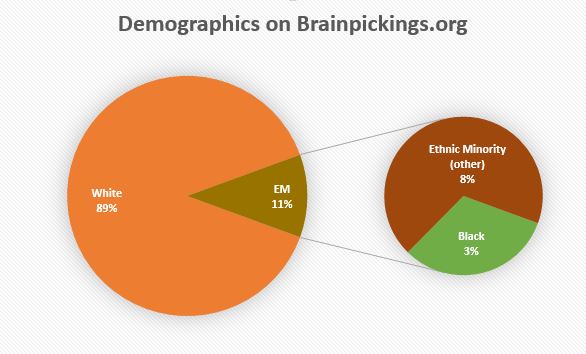
brainpickings demographic

Of 197 unique authors, illustrators and a few other professions, I found over 30 articles from 14th August (a very small sample size given how much she produces!), there were 21 ethnic minorities. Included in that were 7 black authors.

Those authors were: Elizabeth Alexander, China Keitetsi, Angélique Kidjo, Nikki Giovanni, Toni Morrison, Chinua Achebe, and David Blair.

The male/female divide fared slightly better with 138 males and 59 females. This may seem very unequal but if you’re a regular reader of her work, you’ll find that she writes about female authors with admirable frequency. You’ll also know that she’s a great fan of Susan Sontag’s work as she came up with the most repeated mentions at 5.

Before we continue, can we sit and awe at the number of authors mentioned?

New York Best Seller List

This was more disheartening.

It is important to note it’s a simple list of books that sell the best over the course of the week. There could be 1000 black authors who sell 1 copy each and 15 non-black authors that sell 3 copies each and they’d dominate the best seller list.

The scope was from the 12th July to 23rd August.

With that being said, here are the results.

In the fiction list, there were 64 authors with 41 females and 23 males. No black authors. I broadened it to ethnic minorities and the result was still zero.

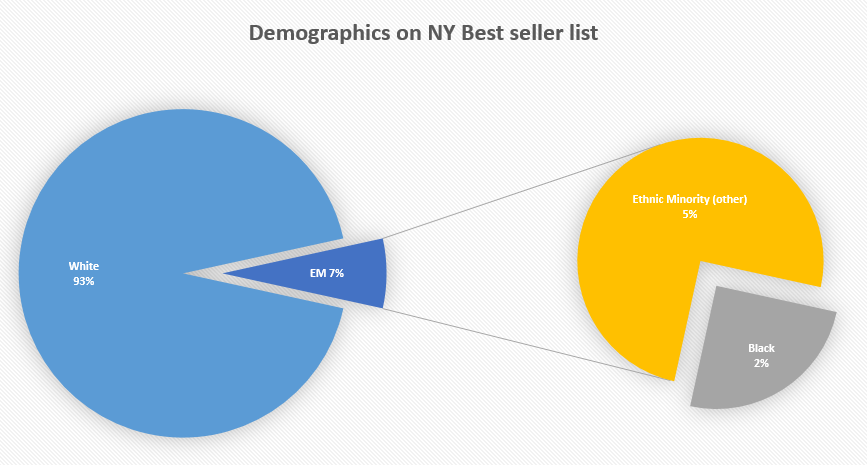
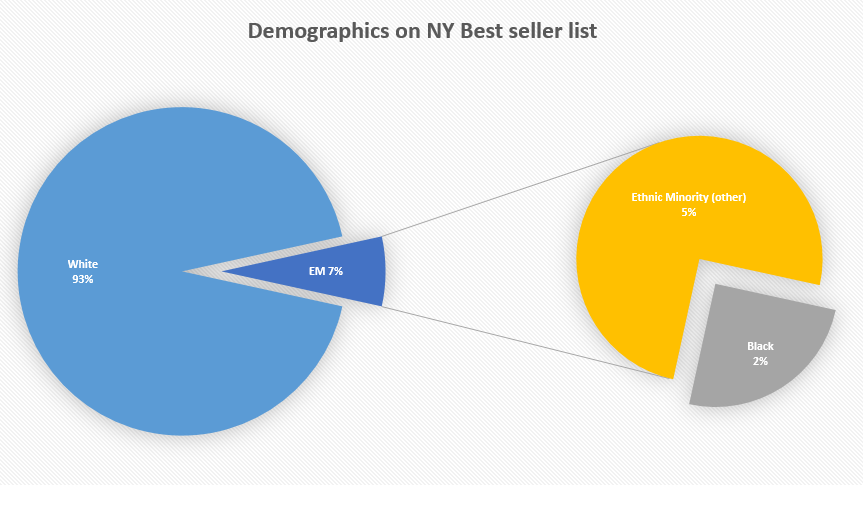
Non-fiction was slightly better. From 53 authors there were 31 males, 22 females, 8 ethnic minorities and from that 2 black authors (Ta-Nehisi Coates and Ishmael Beah).

Here is the total breakdown:

NY list demographics


From over 300 authors there were 29 ethnic minorities and 9 black authors.

Can’t I read whatever I want?

Yes.

I think it’s important to rid ourselves of the stigma of having to read certain types of books. Although helpful at times, I dislike lists of the type, “10 books every intelligent/smart/successful person should read” because if a person simply doesn’t want to read those books, they needn’t be deemed stupid in any sense.

I read children’s books from time to time and that doesn’t mean I’m childish. If it did, so what?

So I don’t want this to be construed as an article demanding you read black authors because they’re pushed to the side but as an invitation to extend your reading list. Some standard suggestions are:

The Colour Purple by Alice Walker

Things fall apart by Chinua Achebe

I Know Why the Caged Bird Sings by Maya Angelou

If you’ve read these books in secondary school and found you disliked them, it might be helpful to try again without the pressure of having to analyse the fun out of them.

What can I conclude?

Given the scope of the research, small sample size and great complexity surrounding issues behind race, the answer is ‘not much’. Though, it does lead to useful points of discussion.

Firstly, it’s clear that black authors don’t tend to be in regular reading lists and because of that, it’s very difficult for their work to spread further compounding the problem. Black authors are definitely not in any kind of limelight when it comes to published writing. I feel this is enough to confirm suspicions that you could easily go many years without picking up a book written by an author of ethnic minority without having to look for one specifically.

When I decided to start this small amount of research, I was inspired by my own reading list. So you can ask yourself two questions:

  1. Have you read or plan to read a book by an author of any ethnic minority?
  2. Of those books, how many do not contain a theme about race?

The second question leads to more speculative territory. That being we tend to read such authors, not because they’re just regular writers but because they write important things about race. Whether that’s good or bad, I’m unsure but I’d rather it wasn’t the only reason we were drawn to them.

From the evidence here, I can’t conclude anything about why there is such a great imbalance nor can I say anything about how it can be changed or whether it needs to be. So I won’t.

What I do want from this is to draw attention to the imbalance as I think it’s worthy of discussion.

A few notes on the method.

This is the boring part.

My method wasn’t particularly precise or efficient but after reviewing it, I don’t think it takes away from my core point. Both lists were so heavily dominated by white authors that a few mistakes won’t weaken my point.

  1. Ethnic minority was modelled around the US and UK so Non-hispanic whites and White British were classed as majorities with 63.7% (2012) and 87.2% (2011) respectively.
  2. I’m not sure what I did with the Jewish population. It’s confusing as proved by this great answer on Quora.

There are bound to have been a few mistakes and there were also a few people I wasn’t sure to include as an ethnic minority. I decided to include them anyway.

Finally…

What do you think about black and ethnic minority authors? Is the lack of publicity a problem? Is there any problem here?

I’ll return to my normal personal development-esque writing later.


Share on Facebook or Twitter