5 lessons from writing every day for 3 years

January 28th 2014, I challenged myself to write every day for a month. I wanted to improve my writing and thought the best was to write more.

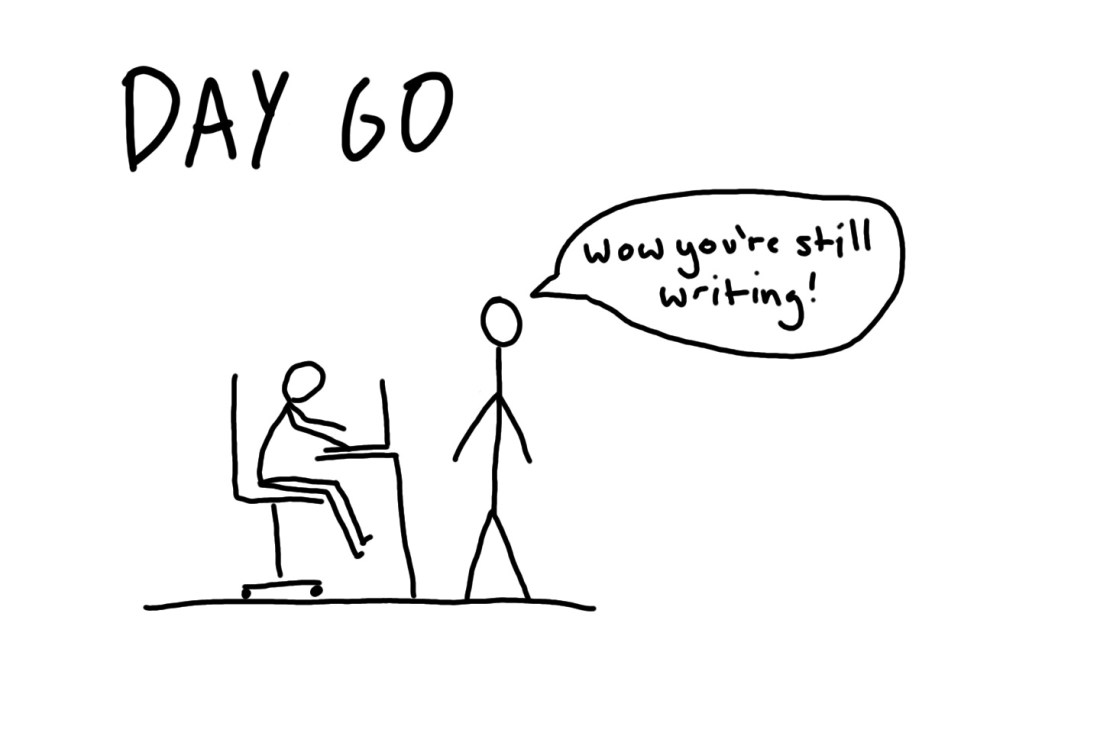
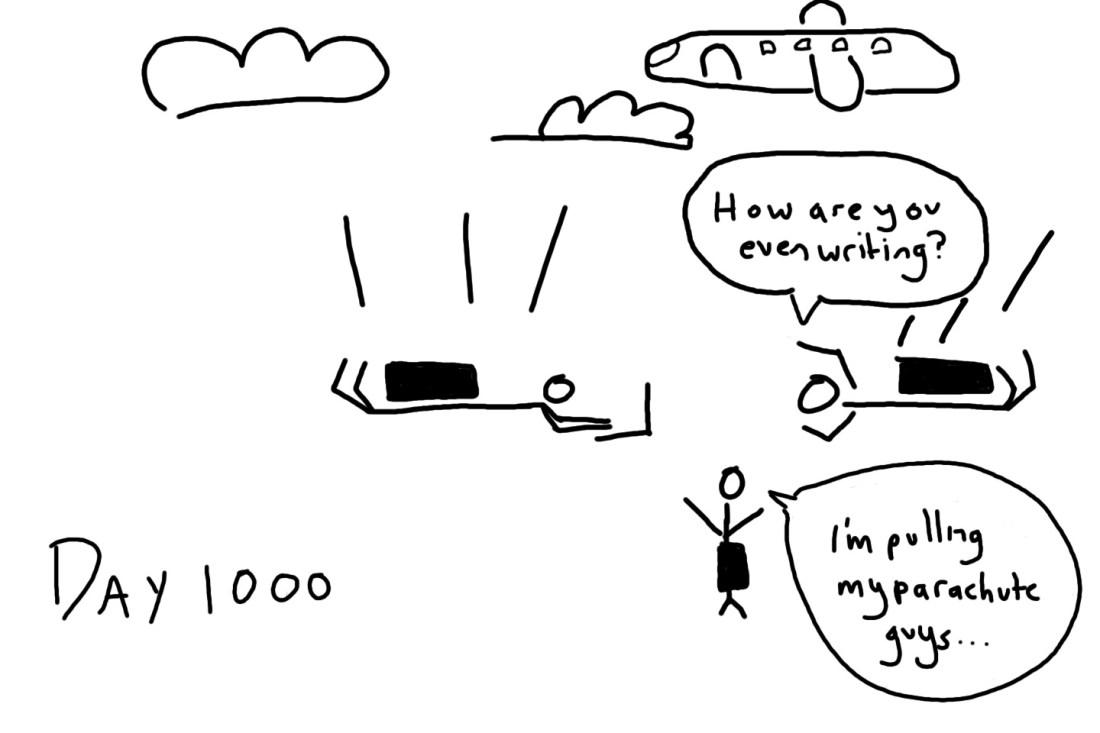
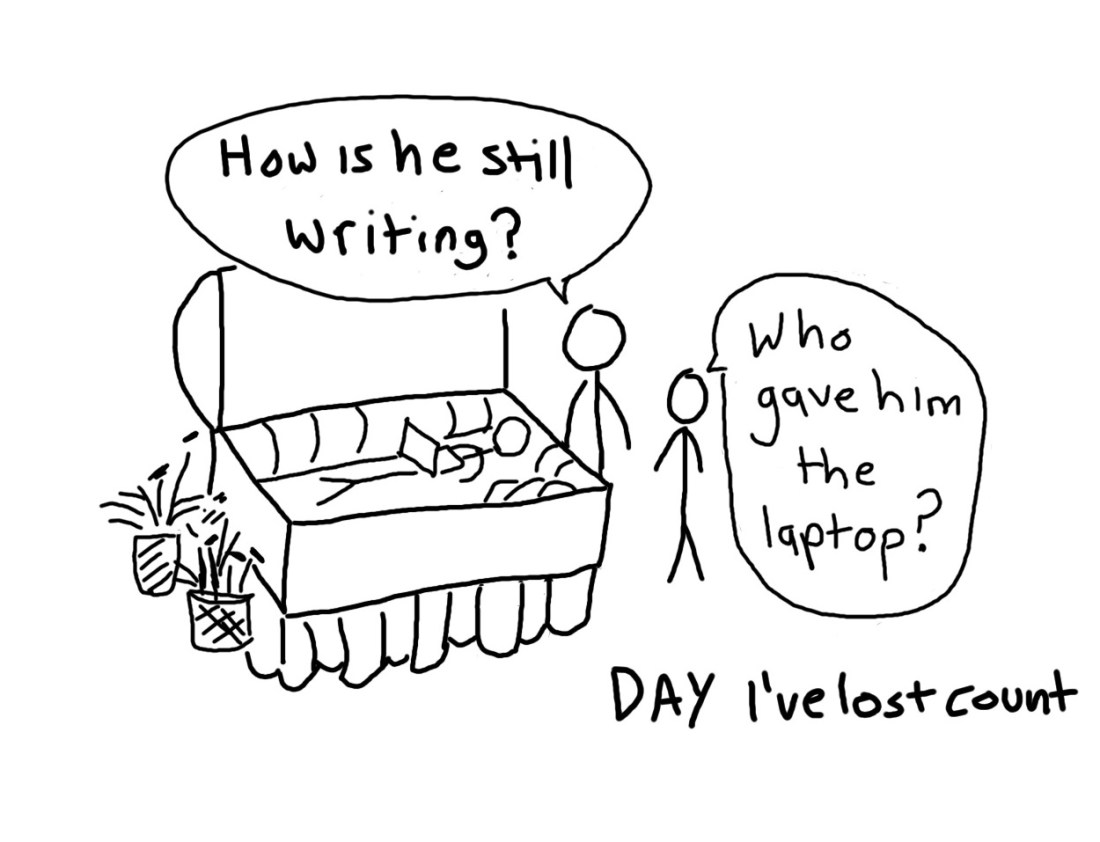
Over 1000 days and 1 million words later, I’m still going and have no temptation to stop.

I want to share a few things I’ve learned from writing consistently for three years.

  1. It’s possible.

After my 30 day challenge, I realised  it was something I enjoyed it and decided to continue. The streak was still young so I wasn’t concerned about breaking the streak.

Without noticing, it slowly evolved into something much bigger that I could have expected. I’d wake up, and want to write. I’d think about my day and make sure that I could find the time for writing. I’d tell friends while on holiday that I’m going to disappear for 15 minutes and write a bit.

I’d carve out time instead of just hoping that I’d be able to get round to it. As the streak grew and grew, I became more attached to it.

Did I aim for 3 years? Never. If I did, I don’t think I would have achieved it.

Thankfully, this applies to other habits as well. With some persistence, the habit eventually grows into something you can’t not do instead of something you try to do.

Created with Microsoft Fresh Paint

2. It’s OK to write bullshit.

So much of me is glad that I haven’t sat down to just publish everything in the journal. Half of it doesn’t make sense and the other half just repeats the same thing.

You can dance like no one is watching and you can write like no one is reading. It’s yours.

Surprisingly enough this gave me the confidence to write work then publish it because the first draft of your work is yours and hidden away. Write like no one is reading then edit the life into it. It doesn’t matter how repetitive, boring, and verbose it is.

Good writing comes from writing loads then editing the rubbish away.

Write. Write. Then edit a bit more.

3. It’ll pass.

For those who don’t know, I deal with chronic pain. I’ve written a lot about it in my journal (and much of that led to me writing Living With Chronic Pain) but I’ve also noticed that in the darkest times I’ve experienced, I’ve felt that it’s going to go on forever. It doesn’t.

Emotions pass with time. Especially if you give yourself permission not to latch onto them and see what it’s like to let them go.

This doesn’t mean the depression will just leave or the anxiety will turn into comfort but I do have a greater appreciation of myself and the problems I see myself experiencing. There’s a lot of shit that comes with disability or just living life in general. Having a log of some emotions is somewhat nice.

With time things pass. And that is comforting.

Created with Microsoft Fresh Paint

4. You learn more about yourself.

Occasionally, I’d just spend time writing about my day. Maybe I had a particularly good day and I wanted more time to experience it and relive it as best I can.

Then I moved onto writing more about myself and the values that I hold. It’d take some struggle and time because I often didn’t know what I believed about myself and the world. It was something I’d studied but never really taken the time to reflect and learn.

It took a lot of time but the value in being slightly more reflective, even if it is 15 minutes every week or month, is remarkable. It showed me that there’s still so much for me to learn and improve upon as a person. How to treat other people better and with more respect or even how to treat yourself with more respect.

Taking time to reflect is important. Writing about it occasionally is helpful and better yet gives you a log of how your views have changed over time.

5. It’s OK to change your mind.

When I would sit down and write about something substantial, I’d occasionally find myself just changing my mind. Sometimes I’d dislike it.

But changing your mind is vital to being able to assess the world honestly. It’s uncomfortable. But worthwhile. Most worthwhile things are difficult.

And those are some of the things I’ve learned. It’s been enjoyable and something I hope to continue. As the streak grew, I gained more and more confidence in my ability to keep long streaks like this going. When I reached 2.5 years, getting to 3 years felt easy. When I was at 30 days, getting to 60 seemed impossible.

Start one day at a time. Ignore the end goal and focus solely on creating.

Created with Microsoft Fresh Paint

Now if only I could apply this to the blog…


As always, thanks for reading :)

I have facebook and twitter. You should totally love me on facebook and start twittering at me pleaseandthanks.

Have you ever tried maintaining a journal?

Care About The Important, Intensely

Create more. Consume less. Add value.

I live by these values because I believe they help me contribute to the world in an important way. Everyone is in this world together, and there’s something special about helping others without retreating to malice or hatred. Adding joy multiplies happiness but adding darkness only subtracts.

Of course, I ask myself (probably too often) for the point of living by these specific values. I haven’t been moved far beyond finding it helpful with creating a better world. Why spend my time creating instead of consuming? Why care about people other than myself?

Perhaps these values aren’t necessary but they are important, to me and I think extremely helpful for many others. So, I’ll keep them up and live my life accordingly. That’s the aim at the end of the day. To be a person of integrity.

Having this conversation reminded me of the book I recently finished. When Breath Becomes Air.

Paul Kalanithi, an upcoming neuroscientist-neurosurgeon who found he had terminal lung cancer, wrote a book. He spent his time in his life trying to understand what makes life meaningful. To do that, he wanted to wrestle with death and the mind. And he did so with grace and did so with quality. That alone is special. Just caring intensely about your craft because you think that it’s a moral duty. He didn’t view his work as a job but he viewed it as a calling. Even while he had cancer.

From all the pain he suffered, a question arose. Can you live with integrity while visiting the doorstep of death?

He answered that question with a resounding yes. Not with his words but with his actions. He never once said that he was going to fight cancer and beat it. For it’s somewhat of an unhelpful metaphor. To beat cancer. What if you lose? Does that mean you lost a battle? Apparently. But were you really participating in it in the first place? It does seem like something that just happens to you rather than something you engage with. The same seems to follow for many illnesses.

Despite the decision to not use such metaphors, the book showed me you can be a bit more generous here. Perhaps the focus of beating cancer or suffering in pain isn’t on whether you survive or the suffering ends. This way, your actions aren’t defined by something you may not control. Rather, it is on finding your values and making sure that you live in accordance with them as best you can. It means spending your time thinking about what is important to you and following these things intensely.

By living your life as such and always pursuing the good, by caring about people around you and never letting them out of your mind, by finding yourself and living as yourself the best you can, that is when you ‘beat’ whatever it is you’re facing.

It’s difficult to say that when you fail to live as yourself, as the values you care for, as a person who does good, you lose. Some things you simply cannot control and for those things, you should not be blamed for. In some cases, you can’t even control your efforts to do so.

But with the things you can control and hold dear to yourself, it is those things which define you. Don’t let illness or negative life events make you malicious or cynical. Don’t let it tear you away from the values you hold dear and most definitely don’t let it steal integrity from you and throw it into the night.

As the poem goes: “Do not go quietly into that good night / Rage, rage against the dying of the light.”

I’ve found that ‘rage’ doesn’t have to mean anger. There are always going to be many moments of pain, suffering and death but this does not mean we must lose our will to care. I’ve found there can be so much more to the day if we try to care about it. Whether that’s talking to a friend and enjoying their smile, finding your favourite spot in the library, walking to work and hearing friends enjoy a joke or waking up and thanking yourself for trying to just get by for another day. These are small and my desire to care more isn’t accelerated by the fear of death. Kalanithi’s work is a helpful reminder that it is possible to live with integrity in good and poor health. And for that, I thank him.

We start with finding what is important to us and caring about it intensely.


I haven’t written in a while. I apologise – I’ll be back at it soon enough.

If you enjoyed the post, feel free to share :)

@improvingslowly

Why we sabotage our goals (and how to stop it)

 “The best plan is only good intentions unless it degenerates into work.” – Peter Drucker

We all have good intentions. Whether it’s intending to lose weight or intending to donate to charity, they exist but as we’ve probably experienced, our intentions don’t always translate to action. Some studies argue that up to 50% of our intentions are never realised through action.[1]

To put that into perspective, let’s say that your doctor wrote a prescription and intended to sign it the next day for you to pick up. Would you think they’re good at their job if there was a 50% chance it was never completed?

Of course not.

Yet, we do it to ourselves all the time.

Intending and only intending to complete personal projects is a great recipe for guilt and lowers the credibility we think ourselves as having. Good intentions – without any action to follow – have much less value than they otherwise should have.

Failing to follow through on things reluctantly is understandable. Sometimes things that are out of our control prevent us from doing things.

But why, with all the best intentions in the world, do we wilfully sabotage our own goals?

 “I deserve a treat!”

This phrase pops up in a variety of different forms and it turns out that this thinking is what explains why we happily put our goals on hold for a “treat”. Even though it probably isn’t warranted, helpful or even wanted.

Cat Taylor, Thomas L. Webb and Paschal Sheeran decided to find out the different justifications we use to undermine our intentions.

99 university students were asked to nominate an unhealthy snack they ate too much of and record how much they ate during a week. At the end of the week, they asked how often they used certain justifications just before eating it.[2]

There were six groups of justifications:

  • It’s available
  • It can be compensated for
  • It’s different
  • I deserve it
  • I’m curious
  • It’s irresistible

These are all very familiar. Red Velvet milkshakes are rarely available but different, irresistible and pique my curiosity. I certainly believe that I can compensate for it later even though it’s quite difficult to do so.

The justifications above explain our tendency to indulgence and undermine our intentions.

The final part of this questionnaire asked them to rate how much they intended to halve their consumption of the unhealthy snack on a scale.

Four weeks later, they answered how much they ate of the nominated snack. Thankfully, they ate much less.

However, after some fancy stats work, I don’t need to (and can’t…) explain right now, their findings became very interesting.

Firstly, if you used one justification, you were far more likely to use more.

Secondly, the stronger the intention to not eat food, the greater the effect of these justifications on how much they ate. For those with weak intentions, justifications mattered much less.

“The more people justified indulgence, the more snacks they consumed despite holding strong intentions to avoid doing so”

Even if you hold strong intentions to not eat certain snacks, it’s extremely easy to run away from that intention. Simply use a justification that melts away all potential guilt.

How do we stop the self-sabotage?

For one, realise that it’s happening. I didn’t make much sense of the categories before I had read this study but now I notice it happening all the time.

They just creep up on you and can happen quite quickly. It’s even worse when you’re with other people who come up with random justifications on your behalf. Does this sound familiar to you?

self sabotage


Tell your friends to help you stick to your goals instead of enabling the opposite. It might require some tough love and you might dislike them for not allowing you to do something briefly. But you’ll benefit from it.

These justifications appear because there is a clash between short term and long term desires.

Should you have the cake now or not? You want to have the cake but also lose weight. You can’t do both at the same time so the justifications come out of the woodworks to make choosing the short term desire easier.

Of course, in the long term, it’s unhelpful and you’ll have to pay for it later.

Let the urge pass.

Urge surfing is one of the most helpful concepts I’ve ever come across. In short, you notice an urge and just stay with it. You don’t act on it as soon as it happens – you just watch it. Notice how it feels. Does it make you feel anxious? Angry? Worried?

Whatever it is, it passes with time. And usually quite quickly – they don’t tend to last for longer than half an hour.

Yes, it’s difficult. However, it helps you understand that you don’t need to act on every want that pops into your head. Many of these wants are caused on purpose by advertising but understanding that they don’t need to control your every action is liberating.

You can focus on the goals you truly want, at your own pace.

Daily takeaway

When you notice yourself wanting to procrastinate, eat too much, lie in bed all day or anything that might stop you from achieving your very important goals be sure to ask yourself:

  1. Is this what I really want?
    1. Is it part of the big picture for me?
  2. Does my justification make sense?
    1. It’s unlikely you’ll compensate for a big mac by walking up an extra flight of stairs

Then:

Let the urge pass.

You’ll slowly stop sabotaging your own goals and finally follow through with your personal intentions.


[1] Sheeran, P., Intention-Behaviour Relations: A Conceptual and Empirical Review, 2002

[2] These justifications were found during their first study – they weren’t forced upon the participants. Otherwise that would be a huge framing problem.

[3] Study used: ‘I deserve a treat!’: Justifications for indulgence undermine the translation of intentions into action by Cat Taylor, Thomas L. Webb and Paschal Sheeran

[4] Interestingly enough, there was a third study which showed that the justifications weren’t just ad hoc explanations for their behaviour. They can be primed to appear again. If you spend your time justifying your actions in a completely unrelated activity, you’ll be more likely to do the same in future activities.


As always, thanks for reading.

I have social media! Follow them if you want. It’s pretty great occasionally.

Twitter Facebook

twitter and facebook mascots :D

Celebrate Your Effort – The Outcome is Less Important

“If a problem is fixable, if a situation is such that you can do something about it, then there is no need to worry. If it’s not fixable, then there is no help in worrying.”

Dalai Lama XIV

Many of us, at some point in our lives have been obsessed with accomplishments and what it takes to get there. We have goals that we really want to achieve and then say that we’re going to do as much as we can in order to get there.

What happens when we don’t?

Do we blame ourselves for not doing enough or just accept what happened and become proud of our efforts?

It’s likely the former and that is a problem.

The end is all that matters

There is an unfair emphasis on the outcome of the work rather than the work itself.

For example:

“If we don’t win, what’s the point in trying?”

“If I didn’t get an A on the paper, why did I bother working so hard on it?”

“Since didn’t get that internship, I’m not trying for something so competitive next time.”

When we make the outcome of our efforts the only important part of the goal we have or project we try to complete, we become disappointed. This discourages to trying again in the future due to fear of simply being disappointed again.

The obsession with outcomes is a problem.

It’s can important cause of anxiety (what if I don’t get to where I want to be?), strong self-criticism (I’m terrible for not getting to where I want to be), anger, sadness and the like[1].  Failure is far more likely to be ego shattering:

It hurts a lot


As a result, we will be better off slowly removing our stringent attachment to the outcome of our actions and simply experiencing things as they are and as they come.

The Myth of Control

In a very American Dream fashion, many of us believe that if we work hard, we will be successful. For all the Olympic swimmers, thriving business women and award-winning students, the reason for their success is because they worked hard. Clearly, a part of that is that if you don’t work hard you won’t be “successful”.

Are both sayings true? Let’s think about them.

  • “If you don’t work hard, you won’t be successful”.

If we think of success as accomplishing something by yourself, it’s unlikely you’ll accomplish anything if you do nothing. It would be like saying you want to write a book but never sitting down to write. In The Aspiring Writer, we can see two writers having the intentions to write but continually avoiding it.

Of course there are a few outliers who can get extremely lucky. Donald Trump. To a number of people, he is a successful businessman who owns a number of luxurious real estates. However, lest we forget that he was given a very generous small start of $1 million. No one picks where they were born and as many philosophers say, it is a “lottery of birth”.

Onto the next one:

  • “If you work hard, you will be successful”

By saying this, we argue that hard work is the sole cause of success. It’s short and snappy but runs very close to telling the future[2]. There is no guarantee that working hard will lead to success especially if we take extremely risky ventures.

For some events, you have more direct control over them. Losing weight is an example. If we work hard to expend more calories than we consume, we will lose weight. The path to the goal is clear and laid out for you – though not easy to achieve.

For others, you have much less control over what happens even if you think you have a lot. Academic grades are an example. They do not reward effort, but content. You may work hard on an essay (or inefficiently and make the work very hard to do), and still produce a poor essay. Or you could work hard, but have a particularly harsh marker who allows their personal bias to affect their grading. You couldn’t have controlled that at all.

Or you apply for a job, spend ages on the application, but have your desired job taken by a personal friend of the CEO.

Or you could train for years in a sport, only to get injured or beaten by people who are have genetic advantages.

A large number of hidden factors affect the outcome of events in ways you cannot control. Blaming yourself for something that you cannot control is a great recipe for near uncontrollable self-loathing because there is no path for action. Only a path for thinking about your apparent short-comings.

This isn’t to say that we should say if you’re successful you were only lucky. That’s going from one extreme to the other. Rather, it is saying that success definitely comes with some good fortune and it ignore that influence is unfair on those who haven’t received similar luck.

Allowing yourself to commit to something and working at it consistently is likely to open yourself up to more opportunities. Those opportunities, you might view as lucky but it would be you who put yourself in the right place at the right time.

A helpful way to put it is this:

Your hard work makes your desired outcome more likely but never guaranteed.

Because of this, we should celebrate and assess the effort that we put into achieving things without hating ourselves if we fall short.

After some calm reflection, perhaps you realise there is more you can do. Slow down, assess the things you can improve upon and pledge to take action. Then do so.

If there isn’t, then there isn’t anything to do apart from accept things as they are and as they come.

Defining yourself by the outcome of your actions is unnecessary. It regularly leads to an over-inflated ego or excessive self-criticism.

Spend time celebrating your effort and your actions. It’s the one thing you have the most control over.


[1] I asked my GP who in turn asked a psychologist – I don’t know how to reference this otherwise. One method for identifying this was bad events or failures tend to become personal (this is my fault) and permanent (this because of who I am).

[2] Which none of us can do.


More reading:

Create without expectation

Let go of your attachment to the outcome

Zen habits – attachments


As always, thanks for reading.

I have social media! Follow them if you want. It’s pretty great occasionally.

Twitter Facebook

twitter and facebook mascots :D

You Are Stronger Than Your Pain

“The obstacle in the path becomes the path. Never forget, within every obstacle is an opportunity to improve our condition”

Adversity is a reasonably simple concept. It’s an event, situation or thing that challenges you and makes life more difficult. It can vary in length, intensity or unpleasantness.

For some, it’s losing a parent. For others, it’s struggling with maths. Whatever it is, let’s start off by refusing to compare our situations to other people’s. It’s a pointless exercise. 

I want to show you that you are stronger than your pain. You are greater than it. For two main reasons.

  1. You are more than your pain.
  2. You can become better because of your pain.

My goal is to show you that this needn’t be a silly platitude. It is not about reading a quote about overcoming adversity, feel invigorated for a fleeting moment, then continue to feel defeated by the misfortune life has offered.

I want you to believe this because it’s true.

I

First, let’s admit that painful challenges life throws at us can really really suck. Ignoring that fact would be stupid. Yes, some things “aren’t that bad” when you put them into the perspective of other people or place them into the grandness of the universe. However, this misses an important point.

Some events are challenges and important ones because you’re experiencing them. Adversity might be the villain in your personal story. Does the existence of millions of other stories invalidate your own? Of course not. Continually dismissing problems as insignificant just prevents us from approaching them head on.

Adversity can not only feel like they’ve consumed you completely but actually consume you. They can be the only things on your mind for hours, days and weeks on end. Anyone who has faced a significant challenge knows exactly what this is like. Everything you do in your life comes back to this pain.

The pain just seems to last forever.

However, the first step to understanding why you are stronger than your pain is to understand that you are more than your pain.

What does this mean?

Pain is not the only part of our lives. Our pain plays a marvelous trick on all of us – it convinces us that the good in our day does not matter. Or worse yet, that good doesn’t exist at all.

This forces us to create unhelpful thinking habits which skew our ideas of reality negatively and create a vicious cycle of catastrophic thinking. An example of this is disqualifying the positive and over-generalising.

Let’s say you struggle with maths. You fail a maths test, try again and fail again. When you have the habit of dishonestly assessing your own efforts, you’ll miss that trying again at something you currently suck at is a positive step. You can be proud of the things you control and your effort is one of those things.

There are also aspects of your life that aren’t related to your problem.

If you wake up and have a good breakfast or see a friend smile, that’s an example of experiencing something other than your pain. The catastrophizer in you will continue to say nothing is good in life and everything sucks without ever pausing to catch the good in the day. Of course, the good things can be so small they’re easy to miss but with practice, it becomes easier.

For me, it’s making my bed once a day. It’s a very small thing but it shows me two things.

First, I’ve experienced something other than just being in pain.

Second, it is me who has demonstrated control over something in my day. Not the pain.

Putting our days into context helps show us that there’s more to our lives than pain. This cannot be misinterpreted as purposefully ignoring pain or believing in good things just because for the sake of it.

Pain, adversity, challenges, difficulty. Many events can be tough or extremely limiting but we must remember:

We are more than our pain.

II

“The obstacle in the path becomes the path. Never forget, within every obstacle is an opportunity to improve our condition”

In the dark depths of adversity, it can almost be insulting to suggest life can improve not only despite the challenge but because of it.

To understand this, it is helpful to return to the idea of adversity. It is something that prevents us from continuing in the path we are currently walking down. Adversity makes life more difficult.

In order to move past this obstacle, we either wait for it to pass or resolve to do something about it.

Choosing to wait is the easiest option but completely removes the autonomy that we have over our own lives. It also guarantees nothing.

Resolving to do something about it is difficult but at least opens the option for having some control over the problem.

Let’s assume we’re going to take some action. We’ll return to the struggling mathematician. You want to get better but understand that you don’t currently have the skills to tackle certain maths problems. Your teacher isn’t helpful because she doesn’t care.

Struggling mathematician then decides to go online and use a large variety of resources to get better at certain problems. In the process, she begins to focus harder and with fewer distractions. She takes the test again and passes.

Did she succeed in spite of her disinterested teacher or because of her?

Both. Her rubbish teacher did nothing to help but her absence also showed the student that she is capable of getting better at maths even if it required a harder route. This route also helped her improve her focus and confidence. As a result, she has become better because of her adversity.

As Ryan Halliday says in The Obstacle is the Way:

Blessings and burdens aren’t mutually exclusive terms.

This is a very simplified example but it is meant to show that with some honest self-assessment, we can find skills that we’ve developed because of adversity. Even if that is slowly building up your mental resilience when something goes wrong.

Adversity offers us a challenge. To get past the challenge, we have to develop certain skills, mindsets or habits to get through. Without the challenge in the first place, we will be perfectly fine walking an easy but less satisfying path.

We can become better because of our pain.

III

How you can help others.

Earlier, I lied. There are three sections not two.

Adversity is also not simple. The statement “you are stronger than your pain” is, to me, true because there are many reasons to believe we are not solely defined by adversity and we can often get through it if we plan our approach, let fear pass and occasionally utilise some Sisu.

There is one thing I haven’t mentioned.

Other people.

“You” don’t have to be alone when it comes to facing pain. A lot of the time, the help of other people is much more beneficial than anything you can expect from trying to force your way through life with brute willpower.

With this in mind, you can also be the helping hand for others too.

One of the mantras I try to inject into my day is to add value to other people’s lives. Sometimes that comes from writing these blog posts. Most of the time, it comes from being absolutely hilarious.

Screenshot (30)

Whatever help you give, it will be valued. Sometimes not explicitly but that’s OK. The aim isn’t to help others in order to be congratulated.

And that brings me to the end.

I want you to sincerely believe that you are stronger than your pain because you are.

You are more than your pain.

You are not solely defined by pain.

You can become better because of your pain.

You are stronger than your pain.

I promise.


Are there any challenges you’re currently facing?

As always, thanks for reading.

I have social media! Follow them if you want. It’s pretty great occassionally.

Twitter Facebook

twitter and facebook mascots :D

The Sunday Monday Post | I Can Swim

I thought I’d start the Sunday Monday Post so I can to talk more loosely about the things I’ve enjoyed within the self-improvement sphere and how I think I’ve improved in the past week (or since the time of the last edition).

It won’t be a very structured article and will probably involve more jokes than  are necessary. However, you probably won’t notice them because I’m not very funny. If I say I’ve told a joke then you need to laugh to make sure I don’t cry.

Thanks.

Nonetheless, let me think about what’s happened to me this week

I have great amazing unbelievable news.

I can swim.

As in, when I go into the water and try to move forward I don’t begin to drown straight away or wonder why I decided to ever even think about getting wet with chlorine in the first place. I actually move forward (or backwards because I can do the backstroke too. Just saying.) It’s fascinating.

When I first moved through the water without touching the floor, I nearly punched the pool wall because I was so excited that it happened. I’ve only had four lessons so I didn’t expect it to happen as quickly as it did.  Then I tried again but drank far too much pool water. Then I tried again, made a few changes, then I stopped drinking an excessive amount of pool water. But then I might make a different mistake like not actually kicking my legs. Then I’d go again.

But at least I’d be making small changes every time I came to stop. It made the whole swimming thing much easier to manage than trying to complete everything at once. Nonetheless, at the end of the session, I was swimming a decent amount. I can’t do it very far or for very long but it’s much better than the way I was like 15 years ago.

Any time I’d try to get into the water, I’d just flail around, it’d take me forever to progress onto the floats but as soon as I had to support the majority of my body weight, it’d be like my body mass tripled and rather than moving forward through the water, I’d just move down.

Let’s forget the general idea that humans actually float in the water or the fact that you can stand up in training pools. I couldn’t do either. I’d just be dead for the most part.

But now, I don’t die. I just swim for a bit and die a bit later.

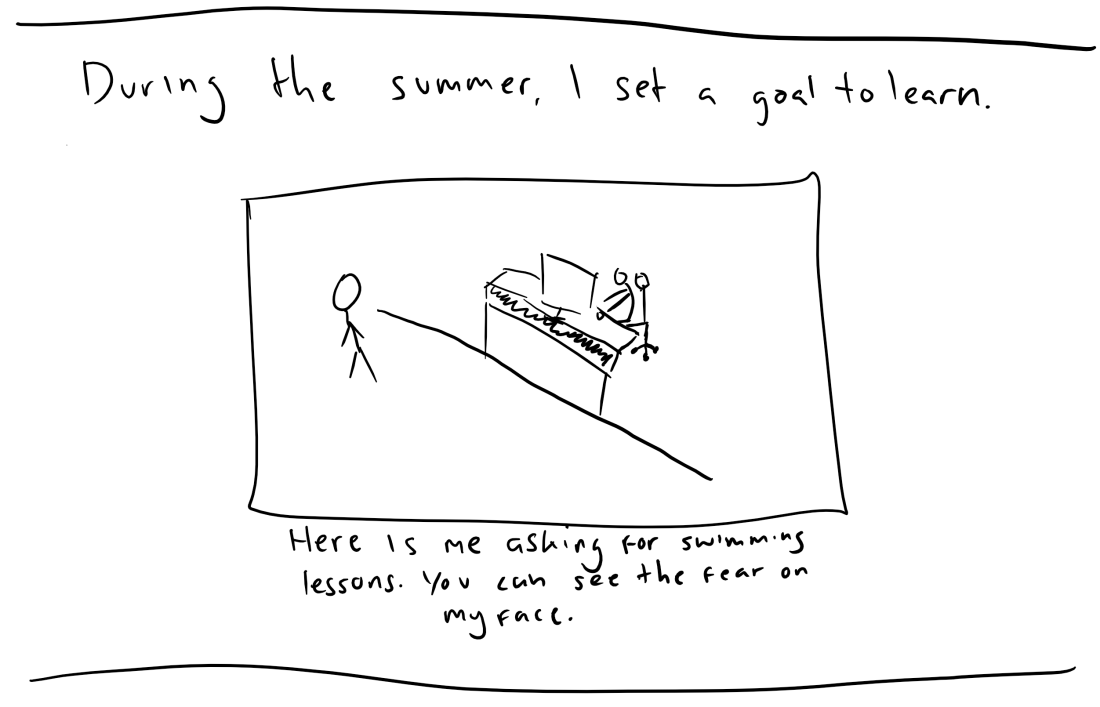
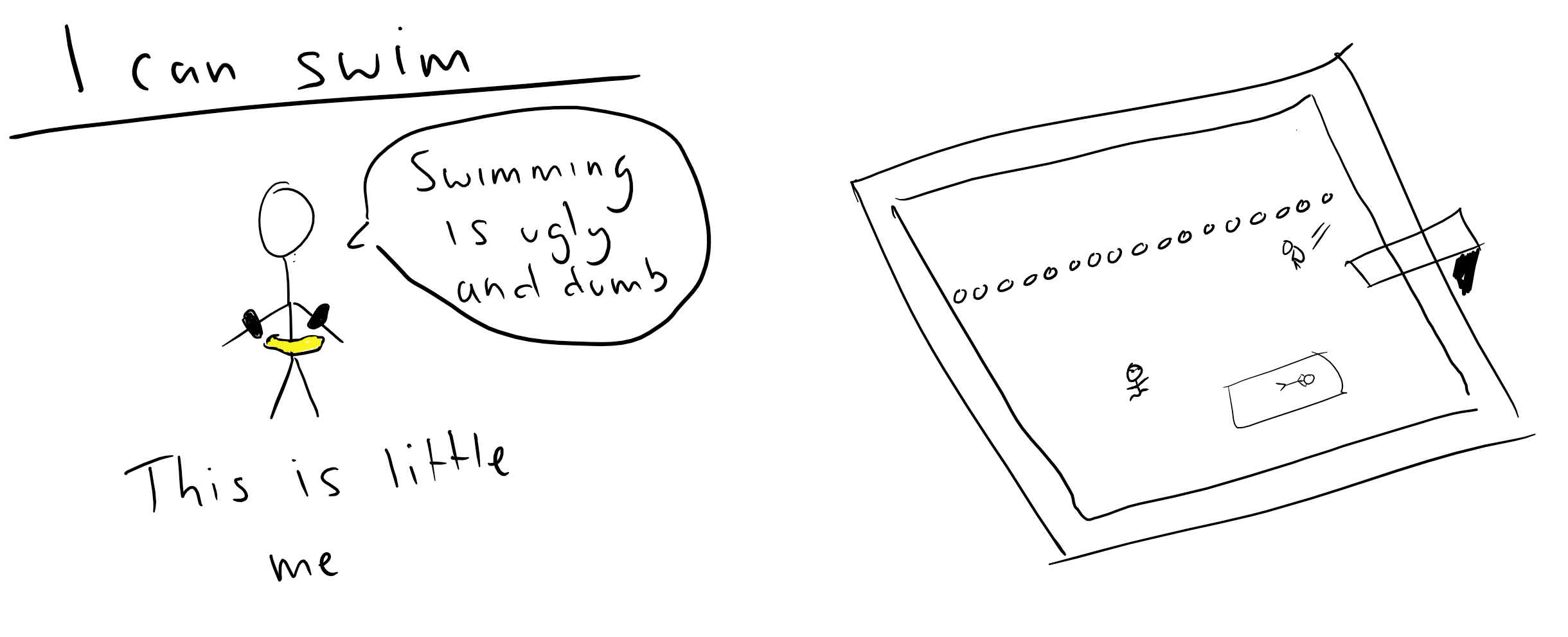
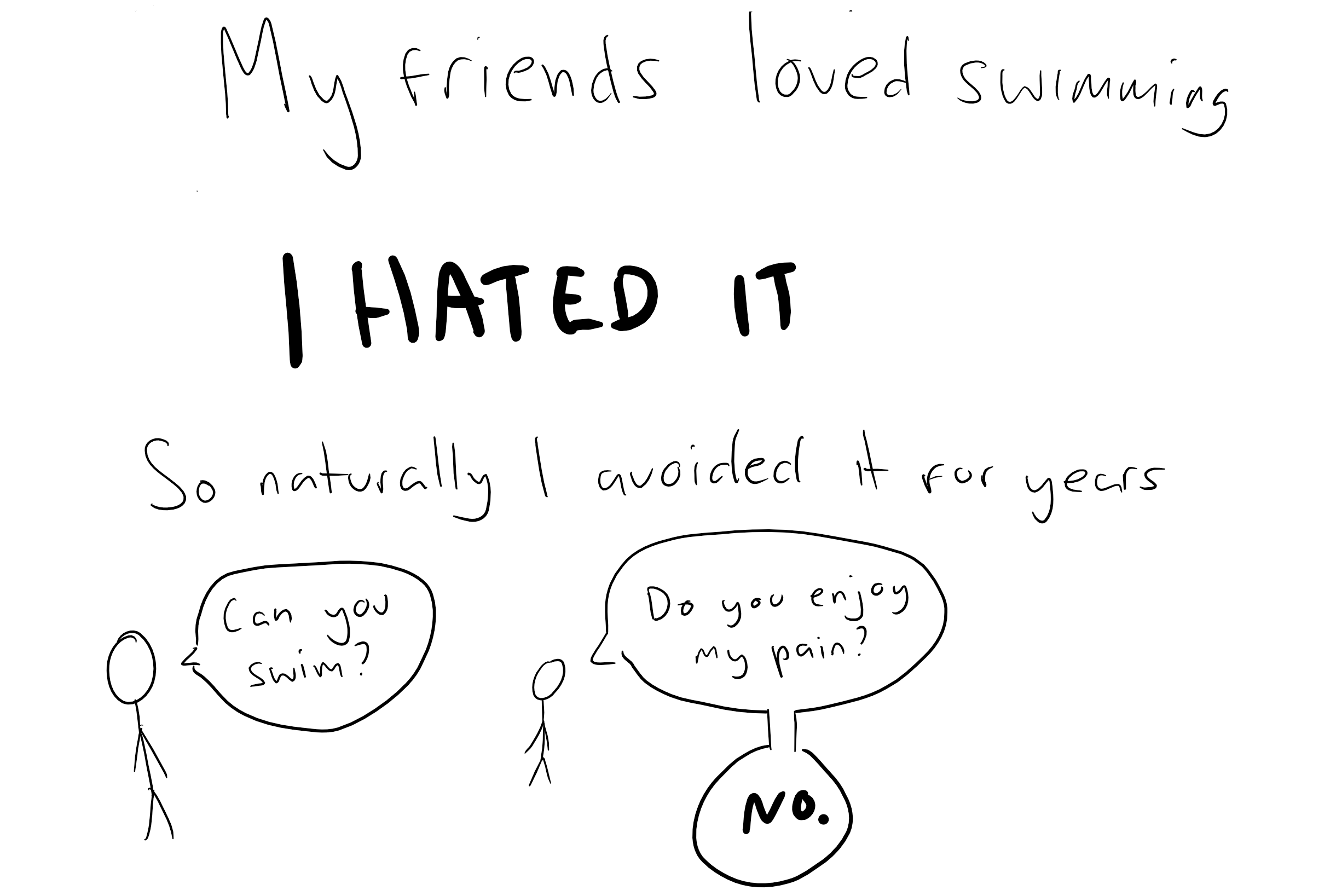
To commemorate this moment, I drew a bunch of pictures: Screenshot (20)Screenshot (21)Screenshot (23)Screenshot (24)

Before my swimming lessons, I found a few different swimming tutorials which gave a few pointers on how to get over the fear of water.

Screenshot (25)

I started to break down the different parts of swimming practiced them individually (though, I always tried to breathe). It made swimming much more manageable.

Screenshot (26)

I’ve conquered years and years of fears by learning how to swim. I’m not very good but that’s OK. I’ve taken the first step. Now I can continue working on swimming and improving slowly in the process.

And dammit I’m proud.


As always, thanks for reading :)

I have facebook and twitter. Check them out @improvingslowly

Yes this is on a Tuesday. No, I don’t know why. 

twitter and facebook mascots :D


October Reading List

Here’s the next edition of my reading list.

It’s a short list of the books I’ve been reading with my first impressions attached to them. I prefer first impressions to reviews because I don’t know how to do reviews without making them sound forced.

If my reading stays regular, it’ll be every two months. I like it.

Here’s the August Reading List.

  • Gone Girl by Gillian Flynn

This book is a thriller. 

A “how on earth is she manipulating my feelings like this?” thriller.

The characters were crafted extremely well and their relationships were even better. I could dislike them without disliking the author for making them that way. Which is surprisingly difficult given how many times I’ve stopped reading a book because I didn’t like the main character (It happened with Dark Places by Flynn. I stopped reading that to start Gone Girl). My only wish was that Nick was as nuanced as Amy.

It’s the type of book I’d recommend to someone who wants to pick up the reading habit again but hasn’t found anything engaging to read.

Slightly relevant but mostly irrelevant story: I was in Subway with the book and the woman taking my order started talking to me about it saying it’s the next book on her list. I said it was great, she said it’s great I’m enjoying it. I finished paying. She said “enjoy your food”. I said “you too”.

We’re getting married next summer.

Amazon.

  • Complications by Atul Gawande

It’s remarkably easy to assume that doctors know best and more importantly that they won’t make mistakes. If a mistake is made, it’s a national horror and doctors should shriek at any patient even named Sue.

The veil of perfection is taken down but not in a way that makes me fear going to hospital. If I just looked at the statistics given in the book, I’d assume that medicine is doomed forever because so many mistakes are made. The surrounding discussion about why they happen and how we can work on decreasing their number and importance turns it into a textured exploration of the surgical profession.

Some doctors are bad apples and fully deserving of their malpractice lawsuits but the vast majority aren’t. Many mistakes are a consequence of simply being humans who work under pressure.

The discussions in the book were all very helpful and entertaining (the whole book isn’t about mistakes). The ones I found most useful were about chronic pain (for obvious reasons) and the doctor/patient relationship.

There’s a similar book I’ve read about errors called Being Wrong: Adventures in the Margin of Error by Kathryn Schulz. It’s more to do with error than Complications but it’s still a very good read.

Amazon.

  • The Checklist Manifesto by Atul Gawande

A book literally about checklists.

How does a topic like this end up being so interesting? I don’t know. But it is.

He surveyed the success of checklists over different professions starting with the aviation industry to construction to finance – It’s crammed with examples of their successes. Pilots begin to work as teams rather than depending on one pilot and avert disasters because they don’t need to rely purely on memory in an environment primed for panic. Construction workers solve problems with greater efficiency and success. Finance experts can make better decisions about what to invest in and what to avoid.

A simple checklist clears up cognitive space and catches avoidable mistakes.

Gawande talks about this because he aimed to increase their use within medicine and surgery. We find that, although checklists are simple, creating them can be complicated. They need to be tested frequently and updated. They need to hold vital information yet be easy to read. A lot of work goes into creating an efficient checklist so, for me, there was a lot to learn.

It was an entertaining and helpful read. About bloody checklists!

Amazon.

  • Being Mortal by Atul Gawande

What matters at the end of life?

Often asked in the context of ethical discussions about euthanasia but Gawande’s focus here differs wildly from such discussions.

For the person in the final stages of their life, what matters to them? 

Being Mortal focuses on these final stages of life and explains that we’ve been viewing it as a medical problem for too long. Medicine has progressed to the stage where we can keep people alive for much longer but whether that is needed or even important is rarely asked. It’s generally assumed that, unless one is in extreme pain, people want to live longer so why even discuss any alternatives?

Do we have to trade personal fulfilment for safety? The first answer that comes to your head is probably no. But it happens frequently when we send our parents to nursing homes and assisted living centres. This isn’t an attack on people who send their parents to places like this because assuming large care responsibilities at an age, where many have children themselves, is incredibly difficult. Rather, it brings light on how we can keep people safe without making them feel like slaves who aren’t allowed cookies and effectively ending the control they have over their lives. Health clearly isn’t the most important thing for most people, nor does it need to be.

If people are to keep control of their own lives, their endings matter.

There’s a lot to take from this book and I can’t do justice to it here. If you enjoyed The Man Who Mistook His Wife For a Hat, pick up Being Mortal. Dr. Gawande expresses the same care for his patients as Dr. Sacks did.

If you’re to read one book from this list, start with this one.

Amazon.

Honourable mentions:

Armageddon in Retrospect by Kurt Vonnegut (Favourites: Vonnegut’s speech, Great Day, Happy Birthday 1951, Just You and Me, Sonny, The Commandant’s Desk)

Into Thin Air by Jon Krakauer

A Final Note: 

Yes, I love Atul Gawande.

Yes, I want to read Better by Atul Gawande.

No, I’m not actually getting married.

If you have any books to recommend, please share your recommendations :)


Sign up to my fortnightly newsletter for free updates on my best posts.

How to Prioritise like Warren Buffett

Here’s the oft cited story*

Buffett was talking to his pilot and asked him to write down the top 25 things he wanted to accomplish either in a few years or his lifetime.

“What 5 are the most important?” he asked.

This is a terribly difficult task and he took some time trying to decide his top 5 priorities – the accomplishments he wanted the most.

“But what about the other 20? What will you do with them?”

The pilot said that the other 20 aren’t as important but they’re a close second and he’ll work on them when he has time.

Warren then said that he’s made a mistake. Everything he didn’t pick as his top five gets no attention at all until his top five priorities have been accomplished.

No prioritisation = nothing gets done

If we don’t assign any kind of importance to our tasks, everything is of equal importance and urgency. You have a lot of choice but no way to determine which one you should start on first. Therefore, you spend a lot of time trying to decide rather than working on something important.

If you do happen to choose, without clear priorities, it’s easy to abandon the project because we wish to start a different one.

This useless dabbling can’t be taken too literally because we all prioritise some way simply by virtue of doing something. If I watch videos, at that time, my behaviour is indicates that videos is what deserves my attention.

While our behaviour seems to point towards our actual priorities, our actions doesn’t always match our desires. Meaning, we don’t prioritise too well.

Although I spend my time watching videos, it doesn’t mean I want to spend my time that way.

Ruthless Prioritisation

Prioritisation should be ruthless.

It involves saying no to tasks you don’t need to complete and some things you want to complete. It asks you to close the door to things you hold dear so you can spend more time with the most important things. Saying no to yourself when the tasks seem so important almost feels like you’re not giving yourself the best chance possible.

Why not do everything instead?

It increases our chance of doing less. Doing everything means we spread our focus and energy very thin. It leads to incomplete to-do lists and accompanying feelings of guilt.

So why does this technique work?

It emphasises simplicity.

By removing the things we don’t need to do and the activities which fall under the category of ‘it would be nice to do some day’, we free up a lot of mental space and reduce our levels of stress considerably.

It’s much more satisfying than blaming the lack of time because it isn’t a great excuse.

You can’t get more time in a day by asking the clock gods to make one hour 100 minutes long rather than 60 minutes. You make more time by removing the inessential and focusing on the important stuff in life.

I mentioned the term ruthless prioritisation because it involves closing the door to some things you have a desire to do and focusing as much as you can on a smaller number of important tasks.

In theory, this is difficult. In practice, it’s even more so.

Here are a few practical tips:

  1. “If I don’t do it, so what?”

What’s the worst thing that could happen if you didn’t make this a top priority?

What happens if it’s not completed?

For the vast majority of things, nothing significant happens. Otherwise, they’d be urgent priorities we’d devote a lot of time and energy to anyway.

I’ve said, along with millions of others that I want to learn a language. It was one of those ‘terribly important things I must do’ but somehow never devoted any time to.

“I should really get round to that”

“I’ll do it someday”

Have you said any of these things before?

Useless statements. They didn’t inspire action because they created an obligation that didn’t have any criteria for completion. They did, however, make me angry at my inaction.

What was I really saying? “I should really get round to it but I won’t”.

Admit it isn’t a priority or make it one. Let the self-imposed guilt will fall away.

  1. Stars, asterisks and scribbles

On your to-do list, write out a list of tasks you want to complete and put an asterisk next to the task you deem most important.

What does important mean in this context?

If you completed this and nothing else, the day is still a success. Everything else is just a bonus.

I found it helpful to be generous when doing this. Writing a long list and making everything a priority increases the standard for success very high but is often unhelpful. It increases self-criticism rather than your ability to complete more.

  1. Priorities change

After hearing about prioritisation and saying no to things, it might be tempting to think priorities can’t change.

They can and probably will.

Focusing on a task and deciding you don’t want to continue is a much better way of making choices than dabbling in a lot of things and never giving yourself the chance say no.

Here’s an example: Reading part of one book and choosing to stop reading is much better than skimming the pages and never understanding if you like the book or not.

Finding what is most important is difficult. And that’s normal.

I frequently find myself having too many options and needing to reassess what is important to me. Sometimes the list stays the same. Sometimes, it changes. It doesn’t always mean something is going wrong.

It’s often a simple indication that I’m changing my mind – which, admittedly, can be uncomfortable.

Letting go of fake obligations and priorities made handling feelings of guilt and indecisiveness much easier. I stopped being pulled in different directions and I could focus on the things I really wanted to do.

Proper prioritisation takes time. Often you’ll need a small reminder of your priorities rather than resorting back to spreading yourself too thin.

Prioritise the important and remove the distractions.

Find peace in focus.

What will you decide not to do?


Sign up to my fortnightly newsletter for free updates on my best posts.


* As with a lot of stories about famous people, they aren’t sourced very well at all. I have no reason to believe that it actually happened any more than the Einstein story. Luckily, this story is merely a way to make the value of prioritisation more personal.

The story is from Live Your Legend.

Quiet Courage

My sister recently started university and seems to be having a good time. She has friends and made a good effort to meet new people.

The person most surprised at this is probably her.

Weeks prior to starting university she came into my room many times, sometimes at night, to say:

“What if I won’t make friends?”

“What if no one likes me?”

And so on.

The thing is, she’s very friendly and when she wants to be, she has a higher than 50% chance at being funny. When she does finally talk to people, the conversations don’t end in one person on fire and the other in tears. They’re fairly normal.

This, she didn’t believe. Even up to the point when we were saying goodbye, she voiced doubts about making friends and having a good time. Before she walked away, my mum started pointing out people she could talk to as if she planted people in the crowd to make the start of university easier.

Goodbyes were said and she walked away. But she didn’t dart to her right and run upstairs into her room. She joined a group of people and started talking.

Quiet courage

This probably doesn’t seem like a big deal. All she did was say hello and not fall on the floor. She probably doesn’t think it’s a big deal but that doesn’t take away from what happened.

She had a small fear: she’s not going to make friends. It was at the forefront of her mind up until she said hello.

She stepped over this barrier and continued forward despite of the fear hanging around in the back of her head.

Not all courage needs to be loud.

Courage isn’t limited to those who have faced great adversity such as overcoming cancer, giving a speech in front of thousands of people or charging into battle in the front line. Nor is it limited to firefighters, surgeons or police officers. It’s something all of us exhibit.

It involves facing small fears we may have such as talking to new people, asking for help even if you think pride stops you or remaining persistent with something even though you’re not too good.

Since this courage doesn’t demand great attention from others, it’s easy to go unnoticed. Even to the person who exhibits it. It might be dismissed as something too small to be proud of.

Such dismissal might take the form of: “If Mary did [enter grand event here] why should I be proud of talking to a new person?”

Thankfully, there are many examples of quiet courage that we should take time to appreciate. Here are some examples I’ve seen in a few of my own friends.

  • She used to be overly critical about herself and university grades. Now she practises much more compassion.
  • He joined a group to help with weight-loss.
  • She started sharing her work with friends.
  • She told her business idea to non-friends and admitted it’s something she wants to pursue.

There are more examples of this that can very easily swim around unnoticed and you can probably find examples like this among your own friends. Hopefully, you’ll be able to find it in yourself too.

Why is it important?

It’s remarkably easy to be harsh on ourselves.

If we do something wrong, it’s because of our flawed character. If a friend does the same thing, we don’t subject them to the same criticism. Not just because we don’t want to lose a friend but because that criticism wouldn’t be true.

Noticing and appreciating quiet courage helps remove us from the negative and often exaggerated thoughts we might have of ourselves. Doing so moves us closer to self-compassion and further from self-criticism.

It’s a welcome change noticing a small thing you can be proud of. Even if we aren’t bothered by self-criticism, it’s a good exercise in catching the good in ourselves and other people. If we do find ourselves in tough times, appreciating the good in small things is an unbelievably valuable thing to do.

It’s OK to appreciate our own examples of quiet courage.

You don’t need to scream from the top of our lungs “I spoke to someone new!” every time you make steps to beating social anxiety but you can congratulate yourself. It acts as small encouragement to keep trying. Which is, of course, the best we can do.

But if you do want to scream your encouragements to the world, please do. Just not in my ear.


Sign up to my fortnightly newsletter for free updates on my best posts.

Share this post on Facebook or Twitter!

The Low Information Diet

I used to read the news every morning and thought this was a good thing. I’m sure that at some point, I thought more people should do it because it’s important to be an ‘informed citizen’. It wasn’t just a thing I did, it was a duty.

I’m sure I got this habit from my dad. He’s woken up by the news with his radio and continues listening to it on his way to work. He’s an extremely informed person and can probably tell you anything about politics on demand.

However, as I’ve grown up, I’ve strayed from my dad in this respect. I no longer read the news every morning and don’t think it’s necessary for anything.

In fact, I want to read the news less.

This is what this post is about. Reading less news and reducing the needless amount of information we consume every day for greater clarity, focus and more happiness.

Most of the links supporting my argument will be at the end (so you don’t have an endless number of tabs open at the end).

What is the Low Information Diet?

Consuming less information.

Mainly the news but it can also include blogs, internet forums and, email and so on.

There are a number of reasons for this and I think they support the aim to consume less information on a daily basis so we can pursue other interests and be more involved in our own lives through active engagement rather than passive participation.

Removing the passive aspect of news consumption means we’ll make a more deliberate effort with the information we consume and become more likely to consume higher quality information.

Why bother?

I want to highlight a few important reasons why we should consume less news and information. I will also address a few problems people might have.

A lot of this is inspired by the essay Avoid News: Towards a Healthy News Diet by Rolf Dobelli. I don’t agree with everything he says but that’s not terribly important.

News is harmful

It is sometimes beyond useless.

The overwhelming majority of news is negative. Studies have shown the average ratio is 17:1 or 95% negative news!

You may come to the conclusion that it’s just the way the world is.

I was part of a lecture given by two BBC News journalists where they taught us how to create compelling headlines and write stories. There was a Q&A session at the end and I asked one of the women what she thought about the lack of positive news in the media.

“Positive news doesn’t really go anywhere.”

You can create stories from a murder investigation but stories about literacy rates increasing or cured diseases tend to stop after one news reel. It may be true that positive stories and tend to lack new developments the same way a negative one would but that doesn’t mean they don’t exist. Since news stations (even government-funded ones like the BBC) require views, they’re far more likely to include prolonged negative stories rather than standalone positives.

This attitude is compounded at times. Myself included. The attitude of ‘positive news isn’t real news’ pervades our thinking far too often. If we hear about an explosion that’s killed 30 people but see the news reporting about plastic bag use decreasing (which has important consequences for our environment) we might think to ourselves ‘This isn’t news. Why are they wasting my time?’

It’s unfortunate because it hides the good in the world using the excuse of ‘I want truth’ which is really a veil covering needless cynicism.

Assuming the world is bad and wanting the news to confirm that belief that is not truth-seeking. It’s ego-stroking.

Being bombarded with negative news is very good at causing anxiety.

We get facts about some disaster and feel bad about it. It doesn’t affect us directly so we don’t do anything to help apart from say ‘that’s really sad’. Then we feel bad about something we can’t change.

For a lot of people, the news doesn’t inspire the amount of action that’s proportionate to the news we watch every day. So a lot of the time, we’re entertaining feelings of depressed helplessness.

It’s rarely substantial

Most of the news we read or watch isn’t substantial. They’re bound to be very short articles without much investigation. That’s the nature of first-then-fact news. These pieces are bound to just make us feel bad about an event without discussions (not assertions) about why the event happened or what progress is being made on the problem.

There are many brilliant articles and journalistic pieces out there. They take time and effort to both create and digest. The feelings they create whether positive or negative are a result of active engagement rather than a simple fact devoid of proper discussion.

You can test this yourself. Think about the number of articles and news pieces you’ve read today and count the number of things that have made a substantial effect on your day. The number is probably low. Unfortunately, if you haven’t already spent time curating your sources of information, then the ratio of useless to engaging will be skewed in the wrong direction.

Not everything you read or watch needs to be life-changing. That’s a high ask.

The aim here is to focus our attention to sources of information or activities that improve the quality of our lives and the time we spend taking part in the activity. A trip in the 24 hour news cycle is unlikely to do that.

Dobelli’s point here is important. He says it’s difficult to recognize what’s relevant but much easier to recognise what’s new. The news always offers us new things but can’t always be relevant to our own lives on a consistently enough to justify following it every day.

If something is relevant, the chances are we’ll hear about it from someone else who follows the news or from more specialised sources.

If we miss out, the world will keep on spinning and your day will keep on moving forward.

No, you won’t be boring

A fear I’ve heard expressed is that we’ll become boring if we don’t stay up to date with the news because we’ll have nothing to talk about.

It’s true that some small talk focuses on current events but I don’t think this is particularly important. There are two reasons for this:

  • News isn’t much to bond over.

It’s much more useful to take interest in the person you’re talking to rather than a news event that has a high chance of just creating pity.

  • Consuming higher quality information leads to higher quality conversation.

This does not mean academic information. If we focus on things we find really engaging (that can be reading a comic, book or watching a film etc.), we’ll be happier talking about them to other people and others will be happier to learn about them.

I’m confident that the best conversations you’ve had did not revolve around the most recent news event at the time.

If current events do come up, it means you’ll learn something new.

Don’t worry if it’s daunting to always say ‘I didn’t hear about that’ (not that there’s anything wrong with it). This information diet does not necessarily require no news at all but a deliberate reduction.

Too much information ruins our attention  

While I think the other points are important, I find this is particularly potent because it expands beyond the problems of the news.

There’s only so much time and energy we have every day to focus our attention on certain things. Bombarding ourselves with more information day every forces us to make many decisions about small things.

Nicholas Carr wrote an article expanding on this problem. A study was completed in 2007 analysing what happens to brain activity when novices to the internet begin browsing the internet for prolonged times. Their brain activity increased significantly but that didn’t automatically mean better brain activity. They were more likely to skim articles, and become more shallow thinkers.

This doesn’t mean skimming is bad. It’s a vital skill but clearly cannot become the only way we consume information. If not for the fact that slower and deeper reading leads to better comprehension, keep in mind that being engaged with activities is a key ingredient to being happy.

What can you do instead?

One complaint about the low information diet is that you might not have anything else to do. Another is that being fully engaged with activities is often tiring. Here are a few suggestions:

  • Read a good book/article
  • Talk to people
  • Write a journal about your day
  • Look around and take in your surroundings (I’m serious)
  • Listen to music
  • Watch a movie or enjoyable videos (stand-up comedy is an example)

There are many things you can do which don’t require a lot of mental energy which are still enjoyable and remove us from anxiety-inducing news.

The Low Information Challenge

You might not be convinced by this.

I wasn’t at first and feared that I would lose my privilege as an informed citizen. None of that happened. I’ve strayed from this and wish to go back. Here’s a challenge that we can do:

  • No news for one day. Then a week. If you can keep on going, even better.

It will require a deliberate effort since checking the news tends to be an ingrained habit nowadays. That’s why we’re starting off small rather than diving into never reading the news again.

If that sounds too difficult or simply absurd try the softer version.

  • Restrict news consumption to 10 minutes at the end of the day

Rather than welcoming endless streams of information, we limit it on purpose.

I recommend trying going cold turkey first though. There are benefits to just not reading the news at all.

In a month, I’ll report back about how the low information challenge went. I hope you join in too!

‘til next time.


Sign up to my fortnightly newsletter for free updates on my best posts.

Share this post on Facebook or Twitter!


Further Reading:

Avoid News: Towards a Healthy News Diet by Rolf Dobelli [PDF]

A short objection to Dobelli’s article (highlights some of the disagreements I have with Dobelli)

The Low Information Diet (Mr Money Moustache)

News is 17:1 negative – Studies like this tend to be he-said-she-said where they’re repeated ad nauseam without a source. I found one in Democracy Under Attack: How the Media Distort Policy and Politics by Malcolm Dean p.415 (he actually has it at 18:1)

Why We Love Bad News More Than Good News

Why Bad News Dominates Headlines (very good discussion about our tendency to say we want good news but read bad news)

The Power of Ignoring Mainstream News

Some Great Articles:

The Blind Man Who Taught Himself to See

Lionel Messi is Impossible

How David Hume Helped Me through my Midlife Crisis

This blog I found is full of them…

If you have any recommendations, feel free to mention them below!