Resist Apathy and Cynicism

The problem of apathy has been on my mind for years. Especially during the times when I don’t care about anything including myself.

The almost chronic absence of care towards others, events in the world and yourself – apathy. But it often does not dance alone. Its partner – cynicism – usually takes the lead.

It’s a state that we’ve all experienced at one point or another for varying lengths of time and during the longer stretches of time where apathy was at its strongest, I started to think more about just how damaging it can be for how we view the world, other people and ourselves.

Maria Popova puts it well. Apathy is a “symptom of resignation” and cynicism is a convincing self-protection mechanism against it.

The problem with cynicism is its ability to convince us of truth where none is to be found. “oh the world is complete shit”, “it’s never going to work out anyway” “There’s no point in trying”. Tired phrases yet we’re enticed to believe them because we no longer have to try or care if they are true. Of caring. We no longer have to spend energy on finding the good or changing the world for the better because our efforts will be futile.

Cynicism becomes tempting when we surround ourselves with negativity and as a result “prove” to ourselves that the world is shit and can never get better. It becomes believable because it is based on something even if that is a very skewed and narrow perception of the world. Often, if we lose ourselves in the news without the understanding that negative news sells better than the positive, we mistake it as the only way to view the world and other people. From this we utter misguided statements like “being positive is presenting a false perspective of the world” when it could be making it more balanced. It would be a grave mistake to assume that the only facts in the world are presented in newspapers and 24 hour news cycles.

However, this mustn’t be mistaken as a plea for blind optimism. Such mindsets can be as harmful as blind pessimism as hope for a good world without any critical eye is naïve. This is a reminder that examining the world honestly does not mean we should examine the world negatively. It is very possible to be rationally optimistic about the world or at least not assume everything is so bad that there’s no point in caring about it.

We shouldn’t fall into the trap of normalising the bad because we assume that’s all there is then convince ourselves to stop caring. This becomes particularly pronounced in the world we live in at the moment. Western politics seems to be growing more divisive at the front line of things and also within personal discussions. It creates barriers (figurative ones, President Trump) and these needn’t be strengthened by the simple fact that they’re allowed to stand in the first place.

We can afford to care. We can afford to be optimistic when the facts allow it. We can afford to ensure that bad doesn’t prevail over good by allowing the bad to become normal.

It’s unhelpful to think that we’re powerless for that does not grant enough credit to the good that we can do to each other and on smaller scales. We we allow for good acts to become a habit rather than the rare accomplishment, they can also become as common as we say please and thank you.

It requires we keep people other than ourselves in mind. Whether it’s as simple as not interrupting the other person or buying them a coffee for no reason other than you want to, you can do good for others in way that’s appreciated greatly.

It’s something I’ve tried to include more in my personal days and I believe it has paid off. Not because I’m waiting for a special thanks at the end of the year. It’s a valuable habit that fights and actively resists against the prey of cynicism, apathy and hate.

These do not need to fill my day. Nor do I need to drag others down. For I want others to care. To appreciate the world and the helpful people in it. It helps keep us away from darkness and cold. We move closer to warmth, appreciation for the small and a desire to change things on a bigger scale.

To end, I quote Maria Popova directly:

Yes, people sometimes do horrible things, and we can speculate about why they do them until we run out of words and sanity. But evil only prevails when we mistake it for the norm. There is so much goodness in the world — all we have to do is remind one another of it, show up for it, and refuse to leave.


As always, thanks for reading :)

I have Facebook and Twitter if you want to follow those.


Simply Be.

This is my birds and the b talk

We sit, stand, lie and stay still. We close our eyes, relax our face and breathe in deeply to the slow count of three. Hold it and notice how everything stopped, if only for this moment, for you to focus on this one breath.

Now the time to breathe out begins. Again to the count of three.

We notice how the calm air feels on our upper lip or how our chest falls as our lungs slowly empty.

The world has slowed to the beat of One. Two. Three. One. Two. Three.

That’s what it means to simply be.

Taking the time to find pockets of stillness in your day is important for it is one of the few times where we cannot be consumed by the anxiety of the future or beaten up by regrets of the past. No longer living at the pace of other people’s agendas or taking the frequent journey into our negative thoughts.

The thoughts that bombard us and attempt to dictate how we feel are allowed to pass for what they are. Unimportant.

As with many people, I’ve had multiple moments when I begin to worry nearly endlessly about what the future holds and my inability to control what’s ahead of me. It drags me away from the good things that I’m probably experiencing right now, no matter how small. But sitting down to meditate reminds me to notice the present. To enjoy it for what it is.

It does not force calmness onto any person but it begins to cultivate a habit of staying calm in the face of stressful moments. The act of remembering to appreciate the present instead of getting lost in the future. Taking time to be instead of imagining the worst.

The worrying slows because we don’t attach judgements to the thoughts that fly through our heads, nor do we linger and follow them. When we are still, the thoughts leave our minds with the same speed they joined us with.

Observing this is remarkable. It separates us from the thoughts we have about ourselves and the other things out there in the world. Ever so slowly I begin to understand why there’s so much joy in being as still as possible. There are many really convincing thoughts that fly through our heads – usually about how bad we are at something or a flaw that’s “obviously” irreparable. Spending more time building pockets of stillness into our day forces us to slow down. And more importantly, it doesn’t mean that we analyse the thought in order to determine whether the thought it true for that is a battle easily lost.

We can let it pass. Attach nothing to it. No judgement, no reaction just acknowledgement.

By doing this, we come to better understand that so many of the thoughts which plague us leave our heads then join us again. Then leave again. They aren’t stitched into the fabric of our minds.

This isn’t easy. Stillness doesn’t cure depression or anxiety. It builds appreciation of slowing down and experiencing the day more on our own terms.

We Simply Be. We do not live for the future nor dwell in the past. We experience how we are at the present moment.

simply-be-web

Pockets of stillness can be difficult to make and difficult to sustain. Especially if you can’t find an immediate reward to the practice. To that I say, simply keep trying – it’s worthwhile.

Meditation is a practice not a solution. It’s something you do and keep doing. In the process, you appreciate its rewards. The journey doesn’t end when you’ve reached your first “moment of stillness” – these pass too. With stillness, you won’t find perfection every day. What you can find is a separation from hectic thoughts and negative judgements. For all you do is be.

How can you build more pockets of stillness in your day?

  • Meditate for 2 minutes in the morning.
  • Slow down when you eat, appreciate the flavours and smells of your food.
  • Take 15 minutes of your morning and make it yours. No time for emails, messages, or mindless web browsing.

And so on.

Remember, to simply be, we…

…sit, stand, lie and stay still. We close our eyes, relax our face and breathe in deeply to the slow count of three. Hold it and notice how everything stops, if only for this moment, for you to focus on this one breath.

Now we breathe out. Again to the count of three.

We notice how the calm air feels on our upper lip or how our chest falls as our lungs slowly empty.

The world slows to the beat of One. Two. Three. One. Two. Three.


As always, thanks for reading :)

I have Facebook and Twitter if you want to follow those.

I’ve written more on this topic:

Have the most wonderful day! If you enjoyed the post, please share!

Care About The Important, Intensely

Create more. Consume less. Add value.

I live by these values because I believe they help me contribute to the world in an important way. Everyone is in this world together, and there’s something special about helping others without retreating to malice or hatred. Adding joy multiplies happiness but adding darkness only subtracts.

Of course, I ask myself (probably too often) for the point of living by these specific values. I haven’t been moved far beyond finding it helpful with creating a better world. Why spend my time creating instead of consuming? Why care about people other than myself?

Perhaps these values aren’t necessary but they are important, to me and I think extremely helpful for many others. So, I’ll keep them up and live my life accordingly. That’s the aim at the end of the day. To be a person of integrity.

Having this conversation reminded me of the book I recently finished. When Breath Becomes Air.

Paul Kalanithi, an upcoming neuroscientist-neurosurgeon who found he had terminal lung cancer, wrote a book. He spent his time in his life trying to understand what makes life meaningful. To do that, he wanted to wrestle with death and the mind. And he did so with grace and did so with quality. That alone is special. Just caring intensely about your craft because you think that it’s a moral duty. He didn’t view his work as a job but he viewed it as a calling. Even while he had cancer.

From all the pain he suffered, a question arose. Can you live with integrity while visiting the doorstep of death?

He answered that question with a resounding yes. Not with his words but with his actions. He never once said that he was going to fight cancer and beat it. For it’s somewhat of an unhelpful metaphor. To beat cancer. What if you lose? Does that mean you lost a battle? Apparently. But were you really participating in it in the first place? It does seem like something that just happens to you rather than something you engage with. The same seems to follow for many illnesses.

Despite the decision to not use such metaphors, the book showed me you can be a bit more generous here. Perhaps the focus of beating cancer or suffering in pain isn’t on whether you survive or the suffering ends. This way, your actions aren’t defined by something you may not control. Rather, it is on finding your values and making sure that you live in accordance with them as best you can. It means spending your time thinking about what is important to you and following these things intensely.

By living your life as such and always pursuing the good, by caring about people around you and never letting them out of your mind, by finding yourself and living as yourself the best you can, that is when you ‘beat’ whatever it is you’re facing.

It’s difficult to say that when you fail to live as yourself, as the values you care for, as a person who does good, you lose. Some things you simply cannot control and for those things, you should not be blamed for. In some cases, you can’t even control your efforts to do so.

But with the things you can control and hold dear to yourself, it is those things which define you. Don’t let illness or negative life events make you malicious or cynical. Don’t let it tear you away from the values you hold dear and most definitely don’t let it steal integrity from you and throw it into the night.

As the poem goes: “Do not go quietly into that good night / Rage, rage against the dying of the light.”

I’ve found that ‘rage’ doesn’t have to mean anger. There are always going to be many moments of pain, suffering and death but this does not mean we must lose our will to care. I’ve found there can be so much more to the day if we try to care about it. Whether that’s talking to a friend and enjoying their smile, finding your favourite spot in the library, walking to work and hearing friends enjoy a joke or waking up and thanking yourself for trying to just get by for another day. These are small and my desire to care more isn’t accelerated by the fear of death. Kalanithi’s work is a helpful reminder that it is possible to live with integrity in good and poor health. And for that, I thank him.

We start with finding what is important to us and caring about it intensely.


I haven’t written in a while. I apologise – I’ll be back at it soon enough.

If you enjoyed the post, feel free to share :)

@improvingslowly

October Reading List

Hi again. More books.

Most of the books I’ve read over the past few months have been fiction. As you can probably guess from my previous lists, I read a lot of non-fiction. I enjoy it but haven’t lost myself in a lot of good stories for a while.

Naturally, during the last few months, nearly all of my books have been fiction.

Ego is the Enemy by Ryan Holiday 

A book about the problems our ego presents to us.

An easy way to explain this is like so: our ego makes us extremely interested and concerned about our personal image and how we’re viewed to others. As a result, we tend to focus less on the important tasks we have to focus on and more on how to protect the image we’ve built of ourselves.

It took me a while to get round to this book. I didn’t agree with a lot of it at first because I felt that he argued ego causes more problems than it actually does. However, after re-reading sections, I came to understand the book better and thought his argument was interesting.

It is when we care less for ego and more for the important things in life that we produce valuable work. Instead of always thinking about how feel. How can improve the lives of others?

Amazon.

Child 44 by Tom Rob Smith

Brilliant.

I’m very late to get to this book but damn. I loved all of it.

Towards the end of Stalin’s regime, there is a killer who targets children and murders them in horrific ways. Leo, a secret police officer, changes his ways completely in search for this person and risks his career, his life and his wife in the process.

I suck at describing books but read it. Please? Thanks.

Amazon.

One by One by Chris Carter 

Another thriller. Another great ride.

A man calls Detective Robert Hunter’s desk and asks him to go to a website. He sees a man in a glass box, restrained against a chair. The caller asks Hunter, “Fire or water? How do you want him to die?”

The whole book had me on edge and the ending was… interesting.

I also love Robert Hunter now. He’s one of those Jason Bourne type guys. Chris Carter can write a damn good crime thriller. I’ll definitely read more (thankfully, there are about 7 in the series).

Amazon.

Grit: The Power of Passion and Perseverance by Angela Duckworth

Duckworth’s work has been getting a lot of praise among the self-improvement sphere for a while now. And for very good reason.

She studies grit. The combination of passion and perseverance. Continuing with tasks even if they get difficult or boring. In the book, she wants to understand why certain people are more ‘successful’ than others in a variety of tasks ranging from completing the brutal Beast Barracks training in the United States Military Academy to university students getting top grades. It’s not intelligence, wealth, height or any physical attribute that is the best predictor of success. It’s grit.

Her work is entertaining to read and every point she makes is well supported. However, I also admire that she’s open to admitting the shortcomings of her research and questions that can be explored further.

There’s a lot of valuable information to gain from it. Including why perseverance with goals is very helpful but less common than you’d imagine and how to foster grit in other people. I want to explore it in more detail as I think the ideas are worthy of much more consideration.

And Emilia Lahti is her student and she’s the nicest person ever.

Amazon. 


As always, thanks for reading!

Follow me on twitter @improvingslowly and like my Facebook page: Improving Slowly!

Why we sabotage our goals (and how to stop it)

 “The best plan is only good intentions unless it degenerates into work.” – Peter Drucker

We all have good intentions. Whether it’s intending to lose weight or intending to donate to charity, they exist but as we’ve probably experienced, our intentions don’t always translate to action. Some studies argue that up to 50% of our intentions are never realised through action.[1]

To put that into perspective, let’s say that your doctor wrote a prescription and intended to sign it the next day for you to pick up. Would you think they’re good at their job if there was a 50% chance it was never completed?

Of course not.

Yet, we do it to ourselves all the time.

Intending and only intending to complete personal projects is a great recipe for guilt and lowers the credibility we think ourselves as having. Good intentions – without any action to follow – have much less value than they otherwise should have.

Failing to follow through on things reluctantly is understandable. Sometimes things that are out of our control prevent us from doing things.

But why, with all the best intentions in the world, do we wilfully sabotage our own goals?

 “I deserve a treat!”

This phrase pops up in a variety of different forms and it turns out that this thinking is what explains why we happily put our goals on hold for a “treat”. Even though it probably isn’t warranted, helpful or even wanted.

Cat Taylor, Thomas L. Webb and Paschal Sheeran decided to find out the different justifications we use to undermine our intentions.

99 university students were asked to nominate an unhealthy snack they ate too much of and record how much they ate during a week. At the end of the week, they asked how often they used certain justifications just before eating it.[2]

There were six groups of justifications:

  • It’s available
  • It can be compensated for
  • It’s different
  • I deserve it
  • I’m curious
  • It’s irresistible

These are all very familiar. Red Velvet milkshakes are rarely available but different, irresistible and pique my curiosity. I certainly believe that I can compensate for it later even though it’s quite difficult to do so.

The justifications above explain our tendency to indulgence and undermine our intentions.

The final part of this questionnaire asked them to rate how much they intended to halve their consumption of the unhealthy snack on a scale.

Four weeks later, they answered how much they ate of the nominated snack. Thankfully, they ate much less.

However, after some fancy stats work, I don’t need to (and can’t…) explain right now, their findings became very interesting.

Firstly, if you used one justification, you were far more likely to use more.

Secondly, the stronger the intention to not eat food, the greater the effect of these justifications on how much they ate. For those with weak intentions, justifications mattered much less.

“The more people justified indulgence, the more snacks they consumed despite holding strong intentions to avoid doing so”

Even if you hold strong intentions to not eat certain snacks, it’s extremely easy to run away from that intention. Simply use a justification that melts away all potential guilt.

How do we stop the self-sabotage?

For one, realise that it’s happening. I didn’t make much sense of the categories before I had read this study but now I notice it happening all the time.

They just creep up on you and can happen quite quickly. It’s even worse when you’re with other people who come up with random justifications on your behalf. Does this sound familiar to you?

self sabotage


Tell your friends to help you stick to your goals instead of enabling the opposite. It might require some tough love and you might dislike them for not allowing you to do something briefly. But you’ll benefit from it.

These justifications appear because there is a clash between short term and long term desires.

Should you have the cake now or not? You want to have the cake but also lose weight. You can’t do both at the same time so the justifications come out of the woodworks to make choosing the short term desire easier.

Of course, in the long term, it’s unhelpful and you’ll have to pay for it later.

Let the urge pass.

Urge surfing is one of the most helpful concepts I’ve ever come across. In short, you notice an urge and just stay with it. You don’t act on it as soon as it happens – you just watch it. Notice how it feels. Does it make you feel anxious? Angry? Worried?

Whatever it is, it passes with time. And usually quite quickly – they don’t tend to last for longer than half an hour.

Yes, it’s difficult. However, it helps you understand that you don’t need to act on every want that pops into your head. Many of these wants are caused on purpose by advertising but understanding that they don’t need to control your every action is liberating.

You can focus on the goals you truly want, at your own pace.

Daily takeaway

When you notice yourself wanting to procrastinate, eat too much, lie in bed all day or anything that might stop you from achieving your very important goals be sure to ask yourself:

  1. Is this what I really want?
    1. Is it part of the big picture for me?
  2. Does my justification make sense?
    1. It’s unlikely you’ll compensate for a big mac by walking up an extra flight of stairs

Then:

Let the urge pass.

You’ll slowly stop sabotaging your own goals and finally follow through with your personal intentions.


[1] Sheeran, P., Intention-Behaviour Relations: A Conceptual and Empirical Review, 2002

[2] These justifications were found during their first study – they weren’t forced upon the participants. Otherwise that would be a huge framing problem.

[3] Study used: ‘I deserve a treat!’: Justifications for indulgence undermine the translation of intentions into action by Cat Taylor, Thomas L. Webb and Paschal Sheeran

[4] Interestingly enough, there was a third study which showed that the justifications weren’t just ad hoc explanations for their behaviour. They can be primed to appear again. If you spend your time justifying your actions in a completely unrelated activity, you’ll be more likely to do the same in future activities.


As always, thanks for reading.

I have social media! Follow them if you want. It’s pretty great occasionally.

Twitter Facebook

twitter and facebook mascots :D

Celebrate Your Effort – The Outcome is Less Important

“If a problem is fixable, if a situation is such that you can do something about it, then there is no need to worry. If it’s not fixable, then there is no help in worrying.”

Dalai Lama XIV

Many of us, at some point in our lives have been obsessed with accomplishments and what it takes to get there. We have goals that we really want to achieve and then say that we’re going to do as much as we can in order to get there.

What happens when we don’t?

Do we blame ourselves for not doing enough or just accept what happened and become proud of our efforts?

It’s likely the former and that is a problem.

The end is all that matters

There is an unfair emphasis on the outcome of the work rather than the work itself.

For example:

“If we don’t win, what’s the point in trying?”

“If I didn’t get an A on the paper, why did I bother working so hard on it?”

“Since didn’t get that internship, I’m not trying for something so competitive next time.”

When we make the outcome of our efforts the only important part of the goal we have or project we try to complete, we become disappointed. This discourages to trying again in the future due to fear of simply being disappointed again.

The obsession with outcomes is a problem.

It’s can important cause of anxiety (what if I don’t get to where I want to be?), strong self-criticism (I’m terrible for not getting to where I want to be), anger, sadness and the like[1].  Failure is far more likely to be ego shattering:

It hurts a lot


As a result, we will be better off slowly removing our stringent attachment to the outcome of our actions and simply experiencing things as they are and as they come.

The Myth of Control

In a very American Dream fashion, many of us believe that if we work hard, we will be successful. For all the Olympic swimmers, thriving business women and award-winning students, the reason for their success is because they worked hard. Clearly, a part of that is that if you don’t work hard you won’t be “successful”.

Are both sayings true? Let’s think about them.

  • “If you don’t work hard, you won’t be successful”.

If we think of success as accomplishing something by yourself, it’s unlikely you’ll accomplish anything if you do nothing. It would be like saying you want to write a book but never sitting down to write. In The Aspiring Writer, we can see two writers having the intentions to write but continually avoiding it.

Of course there are a few outliers who can get extremely lucky. Donald Trump. To a number of people, he is a successful businessman who owns a number of luxurious real estates. However, lest we forget that he was given a very generous small start of $1 million. No one picks where they were born and as many philosophers say, it is a “lottery of birth”.

Onto the next one:

  • “If you work hard, you will be successful”

By saying this, we argue that hard work is the sole cause of success. It’s short and snappy but runs very close to telling the future[2]. There is no guarantee that working hard will lead to success especially if we take extremely risky ventures.

For some events, you have more direct control over them. Losing weight is an example. If we work hard to expend more calories than we consume, we will lose weight. The path to the goal is clear and laid out for you – though not easy to achieve.

For others, you have much less control over what happens even if you think you have a lot. Academic grades are an example. They do not reward effort, but content. You may work hard on an essay (or inefficiently and make the work very hard to do), and still produce a poor essay. Or you could work hard, but have a particularly harsh marker who allows their personal bias to affect their grading. You couldn’t have controlled that at all.

Or you apply for a job, spend ages on the application, but have your desired job taken by a personal friend of the CEO.

Or you could train for years in a sport, only to get injured or beaten by people who are have genetic advantages.

A large number of hidden factors affect the outcome of events in ways you cannot control. Blaming yourself for something that you cannot control is a great recipe for near uncontrollable self-loathing because there is no path for action. Only a path for thinking about your apparent short-comings.

This isn’t to say that we should say if you’re successful you were only lucky. That’s going from one extreme to the other. Rather, it is saying that success definitely comes with some good fortune and it ignore that influence is unfair on those who haven’t received similar luck.

Allowing yourself to commit to something and working at it consistently is likely to open yourself up to more opportunities. Those opportunities, you might view as lucky but it would be you who put yourself in the right place at the right time.

A helpful way to put it is this:

Your hard work makes your desired outcome more likely but never guaranteed.

Because of this, we should celebrate and assess the effort that we put into achieving things without hating ourselves if we fall short.

After some calm reflection, perhaps you realise there is more you can do. Slow down, assess the things you can improve upon and pledge to take action. Then do so.

If there isn’t, then there isn’t anything to do apart from accept things as they are and as they come.

Defining yourself by the outcome of your actions is unnecessary. It regularly leads to an over-inflated ego or excessive self-criticism.

Spend time celebrating your effort and your actions. It’s the one thing you have the most control over.


[1] I asked my GP who in turn asked a psychologist – I don’t know how to reference this otherwise. One method for identifying this was bad events or failures tend to become personal (this is my fault) and permanent (this because of who I am).

[2] Which none of us can do.


More reading:

Create without expectation

Let go of your attachment to the outcome

Zen habits – attachments


As always, thanks for reading.

I have social media! Follow them if you want. It’s pretty great occasionally.

Twitter Facebook

twitter and facebook mascots :D

The Sunday Monday Post | I Can Swim

I thought I’d start the Sunday Monday Post so I can to talk more loosely about the things I’ve enjoyed within the self-improvement sphere and how I think I’ve improved in the past week (or since the time of the last edition).

It won’t be a very structured article and will probably involve more jokes than  are necessary. However, you probably won’t notice them because I’m not very funny. If I say I’ve told a joke then you need to laugh to make sure I don’t cry.

Thanks.

Nonetheless, let me think about what’s happened to me this week

I have great amazing unbelievable news.

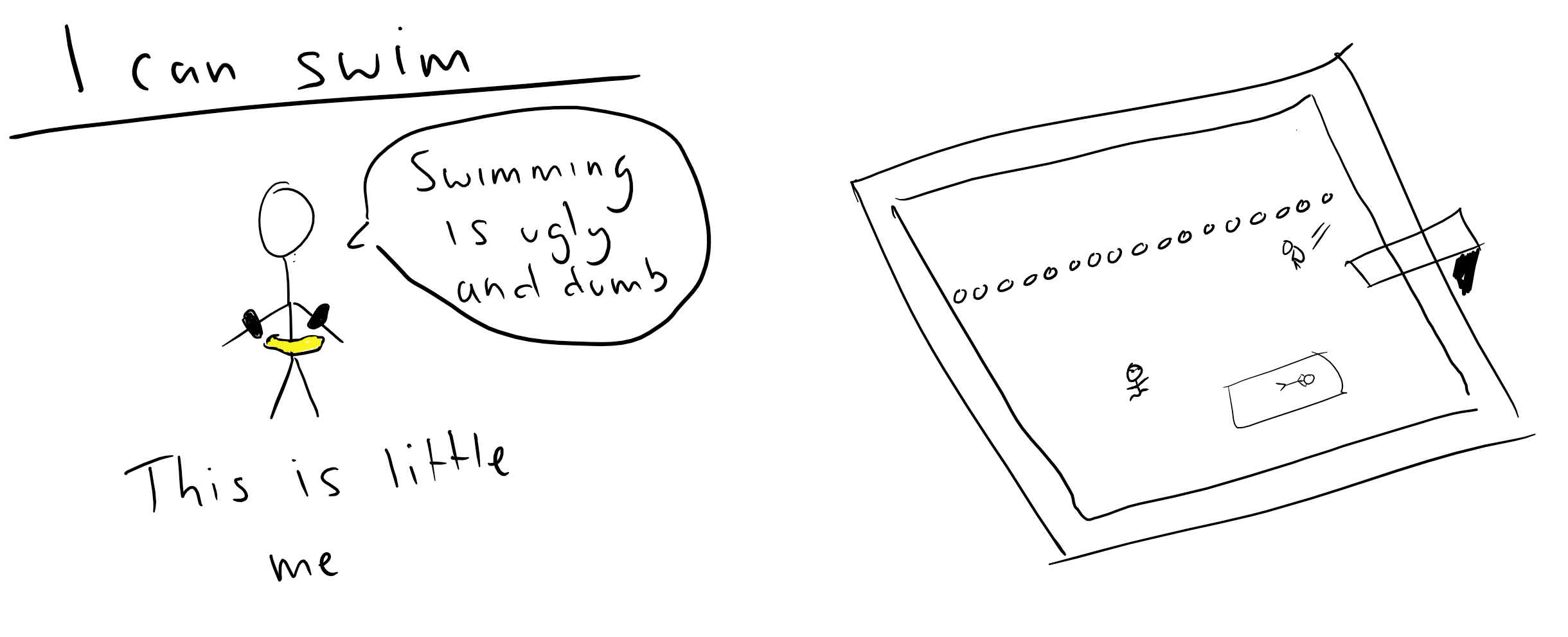
I can swim.

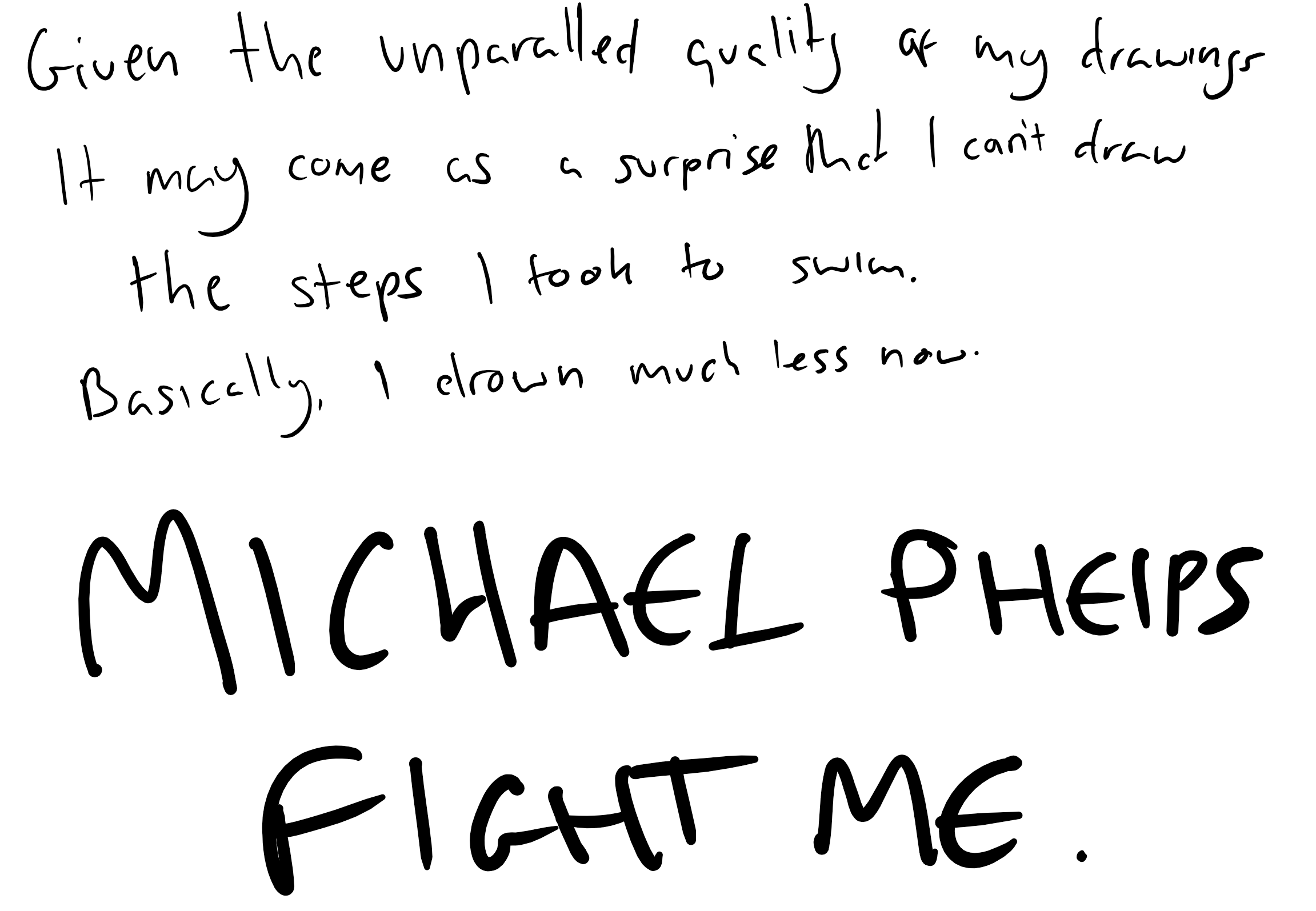
As in, when I go into the water and try to move forward I don’t begin to drown straight away or wonder why I decided to ever even think about getting wet with chlorine in the first place. I actually move forward (or backwards because I can do the backstroke too. Just saying.) It’s fascinating.

When I first moved through the water without touching the floor, I nearly punched the pool wall because I was so excited that it happened. I’ve only had four lessons so I didn’t expect it to happen as quickly as it did.  Then I tried again but drank far too much pool water. Then I tried again, made a few changes, then I stopped drinking an excessive amount of pool water. But then I might make a different mistake like not actually kicking my legs. Then I’d go again.

But at least I’d be making small changes every time I came to stop. It made the whole swimming thing much easier to manage than trying to complete everything at once. Nonetheless, at the end of the session, I was swimming a decent amount. I can’t do it very far or for very long but it’s much better than the way I was like 15 years ago.

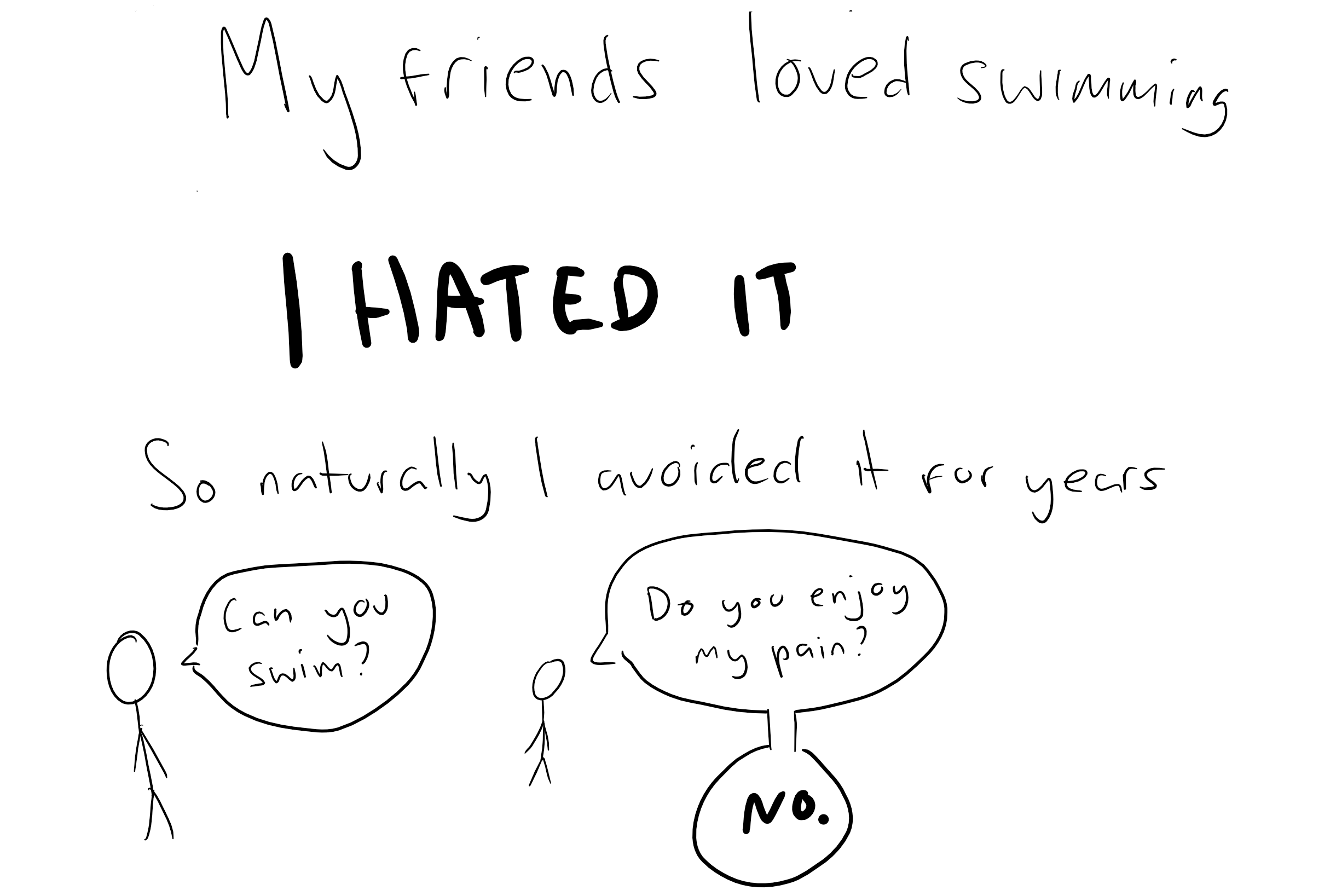
Any time I’d try to get into the water, I’d just flail around, it’d take me forever to progress onto the floats but as soon as I had to support the majority of my body weight, it’d be like my body mass tripled and rather than moving forward through the water, I’d just move down.

Let’s forget the general idea that humans actually float in the water or the fact that you can stand up in training pools. I couldn’t do either. I’d just be dead for the most part.

But now, I don’t die. I just swim for a bit and die a bit later.

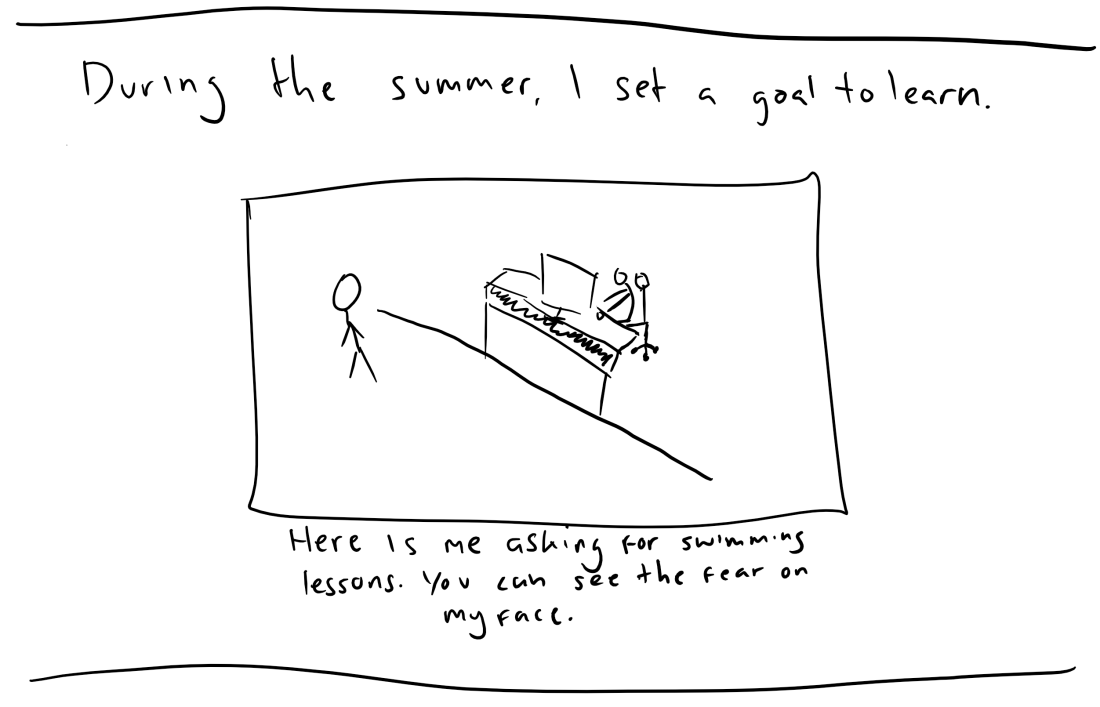
To commemorate this moment, I drew a bunch of pictures: Screenshot (20)Screenshot (21)Screenshot (23)Screenshot (24)

Before my swimming lessons, I found a few different swimming tutorials which gave a few pointers on how to get over the fear of water.

Screenshot (25)

I started to break down the different parts of swimming practiced them individually (though, I always tried to breathe). It made swimming much more manageable.

Screenshot (26)

I’ve conquered years and years of fears by learning how to swim. I’m not very good but that’s OK. I’ve taken the first step. Now I can continue working on swimming and improving slowly in the process.

And dammit I’m proud.


As always, thanks for reading :)

I have facebook and twitter. Check them out @improvingslowly

Yes this is on a Tuesday. No, I don’t know why. 

twitter and facebook mascots :D


Disconnect

It’s a friendly silence.

The silence that lets you think. That lets you create. That lets you enjoy peace.

In the journey of trying to design an enjoyable life, I started thinking back to some of the times that I’ve felt most satisfied or happiest.

I noticed, as did Derek Sivers, that they are the times when I’m not consumed by needless distractions. During these times of peace, I am completely engaged with whatever I’m doing. I allow myself the privilege of not dividing my attention all over the place because I want to focus completely on one task.

You can pick out these moments in your days too.

When your friend tells a joke, do you stop laughing to check your phone? Or when you’re writing an essay and you feel everything just fall into place, do you want to go onto twitter or continue working?

Peace is valuable

The peace found from disconnecting from social media, from people, from mindless consumption simply gives us a mental break and allows us to spend more time focusing on single things.

Given that we have a limited amount of time and energy each day, why not spend that time trying our best to become immersed in things that we truly enjoy. An example of what not to become immersed in is social media.

While Twitter and Facebook can be enjoyable, I’ve found in my own experience, talking to friends, and researching why we should spend less time on things like the news, spending too long on them is rarely satisfying. I see as something that stops us from being bored instead of keeping us engaged.

This is not my crusade against social media (you’ll understand why at the end). What is important here is to understand the problem with living with distractions all throughout the day.

The solution is to disconnect.


How to disconnect

Thankfully this is quite simple. Unfortunately, it isn’t always easy given how tempting distractions are.

  1. Be mindful

Throughout the day, be aware of the times that you’re entering a distraction-rich environment. This can be as simple as sitting down and having all your social media profiles open at the same time to being at work and finding yourself just talking to coworkers and friends throughout the day.

Being aware that you’re simply floating on the surface of something engaging rather than diving in is the first step to removing needless distractions from your day. It’s easy to become consumed by distractions without realising you’re doing so until you’ve already wasted valuable energy and time.

Ask yourself, is what you’re doing actually increasing your well-being? Does it bring you any joy?

  1. Retreat

Sometimes it’s best to completely cut off from social media, other people and whatever takes you away from what you’re enjoying. This doesn’t mean tell all your friends you’re never talking to them again. Well, if you do, that wasn’t inspired by me.

Set times for when you’re going to enter states of complete focus or for when you will not check distraction heavy places like twitter and emails. 

If you want, you can choose to go into complete solace where there is no internet, no other people. There’s just you and your desire to live an engaging day. These “internet-free” retreats have become more popular but you can just design your environment that way by turning off your internet and disabling data on your phone.


Screenshot (13)

  1. Find engaging things to do.

The newfound peace is helpful without anything else added to it. Simply sitting in the park or going for a calm walk has benefits when they’re distraction free. However, it might be difficult to maintain if your free time involves a lot of nothing. That’s why it’s helpful to use this calm to engage your creativity.

Spend time creating. Whether that is through writing, drawing, singing, gaming, whatever. Let go of the useless idea that you’re “not creative”.

You cannot get better at creating without creating. Nor does anyone start their day as the perfect creator. You practice. You suck at first. Then you suck a bit less. Then you start to think “Well, I’m not terrible”. Then you build more confidence and continue.

It’s more difficult to create than it is to consume. Thankfully, creating comes with much more intense benefits than mindless consumption does.

Creating is not the only way to be mindfully engaged with your days. You can watch films, read good books or go for a run. All without distraction. A time when you can enter the flow.


The friendly silence…

… is found through disconnecting from distractions and mindless noise that takes you away from being engaged with your own day. It might expose difficulties you purposefully chose to avoid but at least you can now confront the fear and defeat it.

It’s rare to focus but it gives much better rewards.


Thanks to Derek Sivers for the blog post on disconnecting. It reminded me how valuable it can be.

Similar reading:

The Low Information Diet

A very Short Guide to Meditation

Ok, this is probably quite ironic but I have some social media you can follow me on. Please don’t hate me. I just heard it’s a good thing. Still, don’t spend all day on it. Not even mine.

Like me on facebook and follow me on twitter. Here are my mascots:

twitter and facebook mascots :D

Sisu – Developing mental toughness in the face of adversity


World War Two. 30th November 1939.

The Finnish had a slight problem.

The Soviet Union invaded Finland with a total of one million troops to the fins’ 300 thousand. 4000 planes to their 114. 2500 tanks to their 32. Being outnumbered 3 to 1 in war isn’t only near insurmountable, it is guaranteed death.  

Seeing no silver lining – they jumped into the storm anyway.

Sisu

This term, Sisu, doesn’t have a direct translation into English. Emilia Lahti, in her remarkable TED-talk, explains that it can be seen as “extraordinary determination and resoluteness in the face of extreme adversity”.

Sisu is an interesting term because it is almost like the final boost we have when we feel like we’re breaking down in front of a problem. I’d liken it to getting a blue shell in Mario Kart but that’s disgraceful – Sisu is not. It’s remarkable.

And much like those Finnish warriors, we all have it.

The Winter War presented the Finnish soldiers with the biggest challenge they will ever have to face. A Goliath knocked on their door and demanded they surrender. Finland refused. The Goliath barged in and chose to take it by force. Again, Finland stood its ground.

How do you approach such problems with high morale instead of feeling defeated?

How do you keep on going when failure is the only thing inviting itself in?

What do you do when you’ve reached the end of your capabilities?

Sisu.

Extraordinary determination in the face of extreme adversity

How do we utilise Sisu?

Stay in the present moment – Don’t create extra problems that don’t exist yet by looking into the future or mulling on past regrets. Staying in the present means we focus on the problem as it is rather than how we think it might be.

As a result, we don’t needlessly exaggerate problems. Doing so rarely helps and instead paralyses our desire to take action.

Of course, this does not mean problems can’t be horrendous or extremely tough to manage. We’ll grieve, cry, become angry and curse the gods for leaving us here.

However, this cannot be the only thing we do.

Make a choice to take action. When the Finnish were fighting, they had to make the conscious decision that they were going to do something about it. This is important. While we’re likely to think we’re going to do something, often times, we do just that. Think about it and never move forward.

It’s much easier to think about how you’re going to handle something difficult indefinitely by getting stuck in the loop of justifying yourself. Never facing the fear of completing what you set out to do. Sometimes it’s best to let the fear pass but in these difficult situations when Sisu is needed, the cloud of fear may never leave you reveal a clear sky. You jump into the storm anyway.

Becoming a person of action when faced with problems fills us with great confidence and shows us that we’re often able to handle it much more than we could have ever imagined.

If you do these two things, a few benefits follow.

  1. We limit complaining.

Life can seriously suck sometimes. There are a multitude of barriers we might face. It ranges from eating spicy food, wiping your eyes with chili covered hands, crying then realising you have no tissues to being in a violent spiral of debt.

Endless complaining, no matter how justified it seems, prevents anything from happening and gives us reasons to complain even more. Much like venting our anger, complaining might become an enjoyable thing to do even if we can’t admit that to ourselves.

Screenshot (10)

  1. We regain confidence.

Remembering Sisu helps us realise that we have more power over our problems than at first thought. When our intense effort and determination pays off, we’ll only have ourselves to thank.

  1. We remember that these are very human problems.

This is one of those things that’s easier to understand than it is to explain.

Everyone struggles at some point in their lives. Sometimes it lasts longer with greater intensity than others.

The idea isn’t to compare your problems to others. Nor is it to think you’re solely unique. It’s extremely helpful to find strength in the fact that others have suffered similar fates and made it through.

You might feel alone.

You might feel lost.

You might feel hopeless.

You can make it through the storm. No doubt it’ll be difficult and frustrating. But we’re stronger than we think.

Life without any adversity will be a life without any progress. We have this idea that we become better despite our problems but what if we become better because of them?

The obstacle in the path becomes the path. Never forget, within every obstacle is an opportunity to improve our condition”

This doesn’t mean we can’t dislike the adversity. I hate being in pain for example. However, that isn’t to say that I haven’t learned anything at all. I don’t think I would have started this blog or learned how to study effectively without it.

Sometimes, we owe our strengths to the problems that forced us to develop them.

Remember Sisu when you’re writing essays and revising for exams but feel like you have no more left.

Remember Sisu when you’re in pain and the only goal you have is to get out of bed.

Remember Sisu when everything in front of you seems to fall apart and blocks the light at the end of the tunnel.

If the tunnel caves in, Sisu reminds us that there’s one more option – break the wall down and create the light at the end of the tunnel yourself.


Thanks to James Clear and Emilia Lahti (TEDx talk) for introducing this idea to me.

I have a poorly used twitter account. Follow it. Thanks. You the best. @ImprovingSlowly


What Is Left For The Social Model of Disability? – Dissertation pt. 5

And we’re reaching the end – this and one more part to go.

So far, I have explained the different models of disability, laid a framework for how we can understand emotions then established that we can be angry at an impairment for being disabling.

I don’t believe the social model allows this and as a result, it is wrong. Now I ask, what else can be done to save the social model? Does this conclusion affect other emotions?

Previous parts:

The Two Models of Disability (part 1)

Martha Nussbaum on Emotions and Flourishing (part 2)

Here’s What It Means to be Angry (part 3)

Should I be so angry? (part 4)


Does the social model of disability exclude any other emotions?

The discussion on anger and the social model has some wider implications for when emotions are appropriate. It seems to lead to the conclusion that the social model rejects more emotions than anger. Again, how does the social model reject anger?

1) The conception of disability has an external direction. Only society disables people with impairments.
2) Therefore, impairments are not disabling.
3) One can be angry at an impairment because it is disabling.
4) If 2 is true, 3 cannot also be true.
5) You cannot be angry at an impairment because it is disabling.

As we can see, if the emotion is directed towards the impairment rather than society, then the social model must conclude that the emotion is misguided or misattributed. Can other emotions fit this model? I believe so. That is, if the emotion has an object which can be non-agent centred. I will briefly assess sadness to see whether the social model would be forced to reject it given my argument.

Sadness: a reasonably similar emotion to anger in the sense that it is often a reaction to an unpleasant object or event in the world. I might be sad that I did not get a good grade in an essay or angry, either at myself or the people marking it, and claim I should have received a good grade. This sadness has a particular object which can be triggered by not being able to have something you cared about (Callard, 2010). Can you be sad about an impairment independent of what society is doing to disable you? It seems very possible. For similar reasons for why a person who is going blind might be angry because they cannot see what they want to see, she could also be sad she wants to see and cannot. This is in contrast to wanting to continue with her everyday activities with relative ease despite being blind and society prevents that from happening due to its poor arrangement. In this case, the social model would also have to reject sadness as an appropriate reaction to impairments being disabling.

How can the social model of disability survive?

With what has been argued so far, it is difficult to see how the social model of disability can move forward. Especially since it is opposed to the idea that impairments are disabling. A modification which comes to mind is that rather that society being the only cause for disability, we can soften the definition and say society is the primary reason for disability. Therefore, we can still include bodily experience as a reason for disability. However, while appealing and I definitely view this as a better version of the social model, it still falls short. This is because it would not allow for the body and its impairments to be a primary factor in disability. In the process, it would continue to reject the emotional reaction towards impairment as justified because of it would not accept disabilities which have no societal cause.

Another route is to deny that it is a definition of disability and claim it is merely a ‘tool’ for ending discrimination. Doing this means all explanatory power is lost. Rather than answering the question of what it means for a person to have a disability or be disabled, it can only answer the question pertaining to whether disabled people suffer any oppressions. To which the answer is yes. However, because it does not aim to define disability it would be tenuous to claim that society can cause disability for people with impairments.

These suggestions, in conjunction with the detailed discussion above, lead us to the direction that the social model cannot survive the problems I have presented. For a model of disability to be successful, it needs to include the bodily experience of impairment as a route for understanding disability.


Does the social model of disability fail? Or is there another way to incorporate bodily experience into its definition? 

Thanks for reading!