You Are Stronger Than Your Pain

“The obstacle in the path becomes the path. Never forget, within every obstacle is an opportunity to improve our condition”

Adversity is a reasonably simple concept. It’s an event, situation or thing that challenges you and makes life more difficult. It can vary in length, intensity or unpleasantness.

For some, it’s losing a parent. For others, it’s struggling with maths. Whatever it is, let’s start off by refusing to compare our situations to other people’s. It’s a pointless exercise. 

I want to show you that you are stronger than your pain. You are greater than it. For two main reasons.

  1. You are more than your pain.
  2. You can become better because of your pain.

My goal is to show you that this needn’t be a silly platitude. It is not about reading a quote about overcoming adversity, feel invigorated for a fleeting moment, then continue to feel defeated by the misfortune life has offered.

I want you to believe this because it’s true.

I

First, let’s admit that painful challenges life throws at us can really really suck. Ignoring that fact would be stupid. Yes, some things “aren’t that bad” when you put them into the perspective of other people or place them into the grandness of the universe. However, this misses an important point.

Some events are challenges and important ones because you’re experiencing them. Adversity might be the villain in your personal story. Does the existence of millions of other stories invalidate your own? Of course not. Continually dismissing problems as insignificant just prevents us from approaching them head on.

Adversity can not only feel like they’ve consumed you completely but actually consume you. They can be the only things on your mind for hours, days and weeks on end. Anyone who has faced a significant challenge knows exactly what this is like. Everything you do in your life comes back to this pain.

The pain just seems to last forever.

However, the first step to understanding why you are stronger than your pain is to understand that you are more than your pain.

What does this mean?

Pain is not the only part of our lives. Our pain plays a marvelous trick on all of us – it convinces us that the good in our day does not matter. Or worse yet, that good doesn’t exist at all.

This forces us to create unhelpful thinking habits which skew our ideas of reality negatively and create a vicious cycle of catastrophic thinking. An example of this is disqualifying the positive and over-generalising.

Let’s say you struggle with maths. You fail a maths test, try again and fail again. When you have the habit of dishonestly assessing your own efforts, you’ll miss that trying again at something you currently suck at is a positive step. You can be proud of the things you control and your effort is one of those things.

There are also aspects of your life that aren’t related to your problem.

If you wake up and have a good breakfast or see a friend smile, that’s an example of experiencing something other than your pain. The catastrophizer in you will continue to say nothing is good in life and everything sucks without ever pausing to catch the good in the day. Of course, the good things can be so small they’re easy to miss but with practice, it becomes easier.

For me, it’s making my bed once a day. It’s a very small thing but it shows me two things.

First, I’ve experienced something other than just being in pain.

Second, it is me who has demonstrated control over something in my day. Not the pain.

Putting our days into context helps show us that there’s more to our lives than pain. This cannot be misinterpreted as purposefully ignoring pain or believing in good things just because for the sake of it.

Pain, adversity, challenges, difficulty. Many events can be tough or extremely limiting but we must remember:

We are more than our pain.

II

“The obstacle in the path becomes the path. Never forget, within every obstacle is an opportunity to improve our condition”

In the dark depths of adversity, it can almost be insulting to suggest life can improve not only despite the challenge but because of it.

To understand this, it is helpful to return to the idea of adversity. It is something that prevents us from continuing in the path we are currently walking down. Adversity makes life more difficult.

In order to move past this obstacle, we either wait for it to pass or resolve to do something about it.

Choosing to wait is the easiest option but completely removes the autonomy that we have over our own lives. It also guarantees nothing.

Resolving to do something about it is difficult but at least opens the option for having some control over the problem.

Let’s assume we’re going to take some action. We’ll return to the struggling mathematician. You want to get better but understand that you don’t currently have the skills to tackle certain maths problems. Your teacher isn’t helpful because she doesn’t care.

Struggling mathematician then decides to go online and use a large variety of resources to get better at certain problems. In the process, she begins to focus harder and with fewer distractions. She takes the test again and passes.

Did she succeed in spite of her disinterested teacher or because of her?

Both. Her rubbish teacher did nothing to help but her absence also showed the student that she is capable of getting better at maths even if it required a harder route. This route also helped her improve her focus and confidence. As a result, she has become better because of her adversity.

As Ryan Halliday says in The Obstacle is the Way:

Blessings and burdens aren’t mutually exclusive terms.

This is a very simplified example but it is meant to show that with some honest self-assessment, we can find skills that we’ve developed because of adversity. Even if that is slowly building up your mental resilience when something goes wrong.

Adversity offers us a challenge. To get past the challenge, we have to develop certain skills, mindsets or habits to get through. Without the challenge in the first place, we will be perfectly fine walking an easy but less satisfying path.

We can become better because of our pain.

III

How you can help others.

Earlier, I lied. There are three sections not two.

Adversity is also not simple. The statement “you are stronger than your pain” is, to me, true because there are many reasons to believe we are not solely defined by adversity and we can often get through it if we plan our approach, let fear pass and occasionally utilise some Sisu.

There is one thing I haven’t mentioned.

Other people.

“You” don’t have to be alone when it comes to facing pain. A lot of the time, the help of other people is much more beneficial than anything you can expect from trying to force your way through life with brute willpower.

With this in mind, you can also be the helping hand for others too.

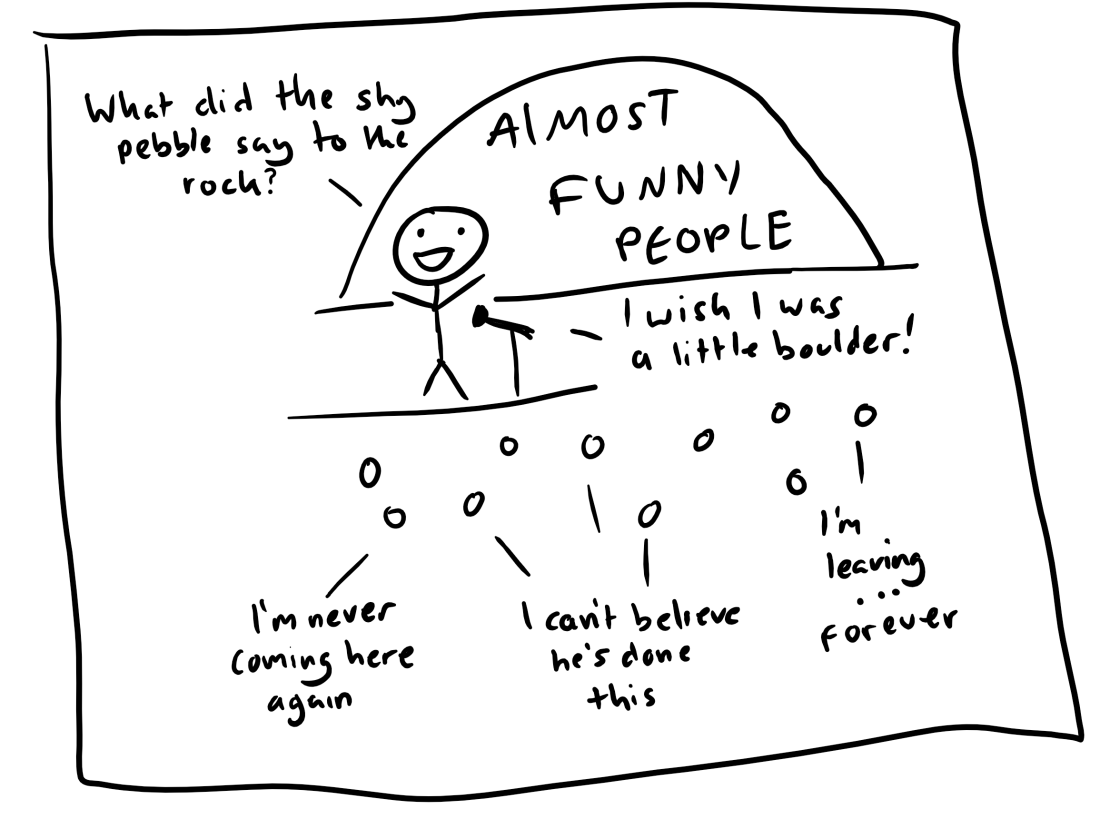
One of the mantras I try to inject into my day is to add value to other people’s lives. Sometimes that comes from writing these blog posts. Most of the time, it comes from being absolutely hilarious.
Screenshot (30)

Whatever help you give, it will be valued. Sometimes not explicitly but that’s OK. The aim isn’t to help others in order to be congratulated.

And that brings me to the end.

I want you to sincerely believe that you are stronger than your pain because you are.

You are more than your pain.

You are not solely defined by pain.

You can become better because of your pain.

You are stronger than your pain.

I promise.


Are there any challenges you’re currently facing?

As always, thanks for reading.

I have social media! Follow them if you want. It’s pretty great occassionally.
Twitter Facebook

twitter and facebook mascots :D

How to Create Plans You’ll Stick To

There are two easy ways to create feasible plans:

  1. Pretend you have 30% the energy you usually have
  2. Copy a plan you’ve completed successfully before

Note that I’ve left out the most obvious way – looking at a calendar and the things you have to do then filling up the hours.

Why don’t we stick to plans?

I’m probably one of the biggest culprit of this which is what led me to figure out how to stop this from happening again as it was becoming a huge source of frustration.

It’s simply too difficult

For some reason, if we imagine a free day we imagine a lot of time. But we also assume our energy levels will match that. It often doesn’t.

Cramming the day with loads of activities is only going to make you tired quickly and far more likely to stop doing them even in the middle of the day. If it’s a long term plan it’s even less likely to continue.

We get distracted

Distractions are a huge problem. As research shows, after a distraction, it takes about 25 minutes to get back into work.

It makes our work far less efficient and moves everything in the plan forward. Therefore we work longer, become more tired and start putting things off.

We don’t give ourselves enough time

We might assume that we can get an essay done in 3 hours but sometimes we might get stuck which means we have to take a longer break. Or we can’t find the book we want.

Same with side projects you might want to do after work/studying. If we expect to do all of them in a minimal time then we’re either going to drop them completely or reduce them drastically and feel guilty about it.

We procrastinate

Looking at a large plan for the day can be intimidating and cause us to procrastinate. Therefore we don’t do anything we aim to. Here’s one simple way to stop it.

Making plans work

  1. Assume less energy than normal

This point relies on assuming you have less energy than your plan assumes

If we try being superhuman then get intimidated or worn out by our plan, it’s not a useful. On the other hand, if we’re more modest, we have a much easier starting point, procrastination is less likely and we will complete things.

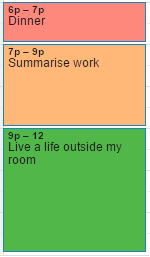
Let’s take one of the plans I’ve had in the past (and I’ve had many):

Capture 4 Capture 3 Capture 1

This is actually a simplified version of a plan I had at one point in my first year of university.

Looking back on it, it’s surprising to think that I considered it then even more surprising is that I was annoyed when I couldn’t complete it! Nearly 9 hours of difficult (and unnecessary!) work I had planned. That’s on top of being social, dealing with chronic pain and you know, trying to not hate books after my first week.

The plan didn’t work for a variety of reasons:

  • I didn’t have the energy to complete them
  • I ignored other factors (like having friends and going outside)
  • It was boring
  • It wasn’t flexible

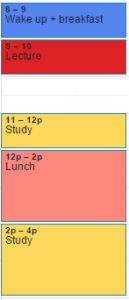
Creating the plan with the mind that you’ll have less energy means you plan to do fewer things, increase flexibility and still complete things. So the plan above might turn into this (assuming there’s a 9am start):

Capture 2

And that’d be it.

The first plan has nearly 9 hours of mentally tasking work while the second has 4 hours with large breaks in between. It’s much easier to start and I found I got more work done with the second plan overall.

  1. Copy a previous plan.

The second condition is easier to implement. If you’ve successfully created and completed a plan before, copy it and use it again.

However, it’s important to take into account new factors when doing this because your past plan might have been completed under much different conditions. For example, if you’ve caught a cold, your energy is going to be lower than it would be normally so you’ll complete less work or it’ll take longer to complete the same amount.

But remember to be reasonable. If you’ve planned an overnight stay at your library or a general rush till exams, you won’t be able to sustain it for a long period. To combat that, refer to point one.

An impromptu Q&A session

“But you’re doing so little work – you’re obviously doing a Philosophy degree this doesn’t apply to me!”

Fortunately, it still does. If you’ve ever planned anything and never completed it (although you feel you should have) then it applies. Creating unrealistic plans is normal and unless you actually have unlimited energy, it’s fine to plan less and complete more.

Dealing with chronic pain means I’ve had to change how I view plans and making my time more efficient. This is one way I’ve managed to stay with the crowd despite being in pain all the time.

“But what if I can’t plan less! I have so much more work to do than you”

That’s where the second condition comes into place.

Not every plan can work on such little energy. Deadlines and loads of work exist. If you’ve actually completed a plan that meets the demands of your current situation, mould it around that. As Scott Young says, you’re allowed to experiment.

If not, continue to assume you’ll have less energy when creating it. And stop procrastinating.

“What if I have scheduled commitments?”

If you have a variety of things you want to do (clubs, learning new things, blogging etc), reducing the amount of energy you’ll have to complete it seems ridiculous. It isn’t.

In this scenario, you have to exercise prioritising and say no to some commitments. If you don’t, there’s a good chance you won’t do them, get frustrated at the ‘little free time’ you have or burn out very quickly and blame yourself.

Admittedly, it is difficult saying no to things especially when you seem to have a lot of time for trying new things. Those things won’t disappear straight away and there’s no point in planning them if you’re too tired to complete them.

It’s alright to say no.

“Am I allowed to continue working past my smaller plan?”

Yes. A minimal plan makes it easier to start working. It doesn’t necessarily put a limit on how much you should continue working. Though, it should make you more efficient with the hours planned – reducing the need to continue working much more.

The next day, return to the minimal plan. A good plan is sustainable.

“I’m rubbish with times. What if I oversleep?”

Ignore times and focus on activities. Instead of planning the hours, aim to work on a project for an hour in the morning and an hour in the evening.

If that is too difficult, aim to do an hour of the project during the course of the day. The earlier the better of course as you don’t want tiredness to excuse you from working.

“Did you write these questions yourself?”

Some things are best kept secret.

Action Steps

The take away from this is to reduce the amount of energy you’ll need to finish a plan so it’s easier to start and easier to complete.

What can you do now?

  1. Create a plan for your ideal day
  2. Assume you’ll have less energy than normal
  3. Create a new plan.

A small amount of completed work is better than a large amount left wished to be completed.


Sign up to my fortnightly newsletter for free updates on my best posts.

If you found this helpful, share it on Facebook or Twitter!

When Your Confidence is Low

Currently, my confidence is low.

I use a walking stick and have been for a long time. My doctor said a large issue is lack of confidence rather than being solely a physical issue. So over the past few months, I’ve practised walking without it.

I’ve made progress and a few of my friends have seen me walking without it more often. A lovely feeling, I must admit.

However, over the past week, I developed a very bad limp. Suddenly, I’m so dependent on it hurts to use and I actively avoid walking if I can.

I spent some time thinking about whether I was being melancholic and concluded I wasn’t. Walking normally is bound to be very important to me.

I don’t want this hiccup to affect my future progress so I thought of a few things to help get back on the confidence train.

What is confidence?

I’ll save the philosophy for later and settle on this definition: ‘A justified demonstration of your ability’. It’s probably too simple but we can go into more depth another time. I want to focus on the ‘justified demonstration’ part.

This means that confidence can be gained. When you start something, the chances are that you won’t be great or even good. Practising will help you get better and because you’re better, your confidence in your ability increases. When I started writing, I started with the intention of becoming better. I’m not sure when I’ll say I’m good but at least my confidence is improving the more I practice.

When people lose confidence in the things they either used to enjoy or something they knew they were making progress in, it’s rarely because they’re suddenly terrible and will stay that way. They’ve lost their reasons in believing they’re good or can get better.

When I lost confidence in my walking, I kept on saying to myself that this is the beginning of the end and I’ll have to start all over again. More damning is that I’ve suddenly lost the ability to improve completely.

Rarely these things are so true to the point where we have to throw self-compassion completely out the window.

So what do we do?

Remember these 3 things:

Progress is rarely smooth

This is unfortunately easily forgotten.

It’s also too easy to believe the opposite.

Whether it’s writing an essay, losing weight, running faster or talking to more people, progress with such things have their ups and downs. That’s OK. It’s very normal.

Don’t con yourself into believing that everything needs to be moving perfectly in order to be right. As with my walking, there were always going to be times when I find it more difficult than others.

Fake it ‘til you become it

I’ve watched this Amy Cuddy talk on Body Language and confidence a number of times. The main take away for me was to fake it ‘til you become it.

At times, it can just feel false pretending to be a person who’s comfortable in with their abilities and so on but it is very helpful. It helps to justify being with happy your abilities and progress.

If you don’t know where to start, adopting what you think a confident person might do is helpful. And watch the TED talk by Amy Cuddy. Toe the line between arrogance and confidence carefully but being comfortable with yourself is valuable and worth the effort.

Keep being active

This is closely linked to the previous point.

The low confidence elephant will tell you to stop trying because you’re bad. You won’t do anything and have more reasons think you’re bad – precisely because you’re not doing anything.

The elephant wins but doesn’t give a victory speech due to lack of confidence.

It’s important to keep working towards your goal even if there’s a hit to your progress. Low confidence is a difficult circle to break out of. Forcing yourself to continue practising can feel fake. Almost like you’re always acting.

That feeling will subside and you’ll feel good about your efforts. You won’t be acting as a character you want to be. You’ll become that person.

I don’t have all the answers and this is a surprisingly difficult topic (e.g. when giving up, what’s the difference between having low confidence and being realistic?). I’m far from the most confident person in my friendship group let alone an authority on the topic. Sometimes, I feel like I’m still in the act of faking rather than being a confident person. Nonetheless, I found these reminders helpful and hopefully they will be for you too.

Why do you think confidence is valuable? How can you become more confident? I’d love to know what you think.

As always, thanks for reading.

Some other things to read:

  1. Let the Fear Pass
  2. The Highlight Reel
  3. Mindy Kaling On Confidence

Share on Facebook or Twitter


Let the Fear Pass

Fear is like a cloud.

It hovers over your head and the tasks you want to complete. But after a while, it passes and the sky becomes clear again.

When I notice myself putting something off and ask why, I tend to feel uncomfortable. Usually because there’s not much reason other than  ‘I don’t want to’. Appealing to laziness is the same thing.

Usually, the bigger the task, the greater the uncomfortable feeling. This, and generally poor energy management, is probably why students tend to leave big essays until they begin to panic about the deadlines.

I experience this feeling a lot. It often leads to potent self-criticism that only serves to make me feel bad.

One thing I’ve found helpful is to meditate on this feeling. It takes less than a minute.

What am I experiencing right now? Am I worried about what’s going to happen if I try?

More often than not, it’s fear. Either the fear of discomfort or fear of failure. Every time I catch myself experiencing these feelings, the less powerful they become.

We don’t have to fear the discomfort of trying something new because it can signal a challenge that fosters some personal growth. It’s important not to diminish this growth even if you think it’s tiny. If your challenge was to pick up dirty clothes from the floor and you surpassed it, that’s a cleaner room you didn’t have yesterday.

Neither should we fear failure to the point where it stops us from moving forward because we can only succeed at something if we try and the joy of succeeding is greater than the pain of failure.  Giving ourselves the excuse not to try is only a disservice to our abilities and passions.

Once permission is given not to be consumed by fear and not influence our actions, it passes. Just like a cloud.

As with many things, observing fear and letting it pass takes practice. I still fall victim to putting things off due to these fears as they will always pop up somewhere. It’s a normal thing and it’d be silly to expect everyone to be fearless all the time.

The goal is to move forward despite its existence.

At first, even noticing you’re afraid of something is difficult then moving past it can be a small battle. But don’t get discouraged if you notice its been victorious. Next time you’ll focus on the feeling again and it’ll become easier.

With time and practise, the fear will weaken and you will be immersed in the present moment.

***

Further Reading: 

  1. Create without expectation
  2. On Productivity and Presence
  3. What’s wrong with now?

Share on Facebook or Twitter

The Courage to be Wrong

Realising we’re wrong can be quite worrying. If we’ve erred there must be something that is wrong with us even if it’s a small thing. It is usually greeted with feelings of shame, anger, sadness or even apathy towards our development. If we get something wrong now, why bother trying again?

Even though, we understand that humans are fallible beings, it is still difficult to accept the feeling of wrongness. We may even look at various motivational quotes say things like “failure is the path to success” or “I can accept failure but I can’t accept not trying” but still close the door on being wrong.

Why does being wrong feel bad?

In light of all of the opinions we have about being wrong and how it’s okay, we’d probably expect to have different attitudes towards it.

The reason why being wrong is viewed negatively negative is due to the various cultural attitudes we have towards it. We view wrongness as harmful, unable to be salvaged or improved upon. When we hear about important mistakes and how they’re damaging to either people’s lives or finances or anything you can think of, we hope to never been in their position.

These attitudes  are also found in our education.  The person who does poorly on a test or ask really simple questions is often viewed as dumb person in the class. They hold back the smarter students from progressing, they mustn’t have studied and they may even frustrate teachers. So when someone gets something wrong they feel like they’ve failed themselves and they’re going to disrupt other people.

It results in a fear about being wrong.

Is Being Wrong OK? 

Of course it is! Failure is the path to success etcetera etcetera. We all ‘know’ this but should we really believe it and take it seriously?

I think so.

When we find we’re wrong, a few things happen. We’re given the choice to keep our false belief or accept a new one. We might fear that we’ve slipped down the ladder of knowledge and can’t climb back up.

These situations aren’t bad. They’re just difficult to handle which is why we sometimes react so negatively to being wrong. But that may not be necessary.

Being wrong about things gives us an opportunity to further knowledge rather than wallow in how little knowledge we apparently have. We have to overcome our resistance to changing our minds.

Embracing our ability to be wrong is difficult and obviously isn’t as simple as just being happy with being wrong about everything. I’m not asking we think being wrong is the best thing possible. As some people may object, getting some things wrong affect the well-being of people in drastic ways and should be chastised rather than encouraged. Here they point to a surgeon making a mistake in a surgery or a bank charging the wrong person exorbitant fees. To that I say:

1) They happen all the time and should be corrected.

2) It’s unrealistic to expect perfection in all decisions regardless of their importance. Such an expectation creates the excuse we see wrongness as inherently bad.

3) Most people can be wrong about things without any severe consequence.

Embracing our ability to be wrong means that we view it as a normal part of decision-making and belief forming. It isn’t something that should create the fear of being judged as stupid and unable to change our opinions.

Fearing wrongness paralyses our progress and prevents us from trying to improve. We’re far more likely to just stay in our comfort zone where mistakes are less frequent and echo chambers are especially loud.

It takes some courage to admit being wrong and use that experience to further ourselves rather than viewing it as an unrepairable fault.

If it offers any comfort, I could be wrong about all of this and we can continue shaming people who get things wrong and feeling bad when we make mistakes.

***

This post was inspired by Kathryn Schulz who gave a brilliant TED talk on being wrong. She also wrote a book about it called ‘Being Wrong: Adventures in the Margin of Error’. I read it last year and thought it was great and can recommend it without reservation (unless you just hate non-fiction books).

So if I write more about wrongness, blame her.


Create Without Expectation

I write a lot in my journal. As of today I’ve written over 560,000 words. I don’t expect it to make sense or answer any of the burning questions I might have had throughout the day. It’s easy to write in my journal because I don’t really care much about how sentences read or whether the whole idea is coherent.

In part, writing becomes easy because it’s done without expectation.

I don’t expect perfection. If I have an idea, it’s not a big deal if it doesn’t come out the way I imagined. It can be written and changed around a little bit. Perfection isn’t a goal and that breaks down fear I might when I want to create something.

Writing for an audience (however small or big) seems to create expectations that paralyse progress. It’s easy to have big ideas that need to be broken down into a multi-part series or might be shared with more people than ever before. Holding those expectations over your head inevitably raises questions like:

  1. What if it isn’t shared with anyone?
  2. What if it is shared and no one likes it?
  3. Will it be helpful?
  4. Will people laugh because of what I’ve written or laugh at it?

And so on.

When we think about writing and making it reality, we might fear it won’t live up to the standard we’ve set ourselves. If we write it, we’ll only prove to ourselves that we never should have started in the first place. If we write, we’ll only make a fool of ourselves.

Expectations shouldn’t be hindering our progress. Sometimes, it’s best to do without them and just see what can be created. Sometimes, that can be the most fun. My example is when I wrote The Aspiring Writer. It would have been easy to shelve the idea because no one would enjoy it or it might be confusing. That voice is in the back of my head whenever I’m writing something but it would be sad if it stopped me from creating completely.

After trying to abandon my expectations I’ve found that I’m pretty bad at judging my own work because it always tends towards the critical rather than celebratory. Which is neither balanced nor helpful. The critical voice is quieter because I let it pass rather than believing it to be 100% true.

If you have any creative project but seem to be paralysed by fear, create without expectation. Throw them into a river and watch them float away.

You see your project as it is rather than what it might be and create without paralysing fear.

***

This doesn’t mean that you can’t want things to be good.

You’re allowed to create and change it afterwards. However, it does mean your expectations shouldn’t stop your from sharing it with others. If we think we can improve it, we’re always allowed to. We don’t need to demand perfection straight away.

On Productivity and Presence

For the longest time, I was obsessed with being more productive and fell into the productivity trap.

I felt I needed to get more done in less time. My pain denied me the luxury of spending a long time on essays or problem sets, so I made it my goal to learn how to make the most of my time. Which I think is a perfectly fine goal and I still hold it. The problem I want to focus on arises when productivity is reached to the detriment of presence and being mindful.

There’s a slight divide between living with presence and productivity. The former is often lost in the latter.

What’s the point of all this productivity? Why am I so interested in the next thing rather than what I’m doing now?

We shouldn’t be so focused on what will happen next and don’t do what’s in front of us.

Nor should we be so focused on completing a task that we forget to experience it.

When I started read about self-improvement, I came across meditation and adopted the practice. Mindfulness meditation places an importance on being focused on the present moment alone. When thoughts come into our head, we let them pass like clouds moving through the sky.

We remain in the present which helps free us from anxiety about the future and regret from the past.

The difference between presence and productivity can be seen in everyday tasks.

Discarding productivity when reading means we aren’t concerned about when the book ends so we can start the next one. We’re just enjoying the dialogue, the story, and sometimes, the absurdity (I’m looking at you, Catch-22).

When we eat food, we enjoy how it tastes rather than inhaling it to get back to work.

And so on.

This divide definitely isn’t a strict one. I don’t want to mislead people into thinking that being concerned with productivity means we are unconcerned with presence and vice versa. There are a million and three qualifications one can make to this general idea of aiming to be more present than productive. For example, an employer may not care so much about how mindful you are if you’re always missing targets. But that’s a discussion for another time.

Leading a productive day can be much more fulfilling if we go through it mindfully.

It’s easy to ask how to be more productive while forgetting what it means to be productive and then forgetting why you desire productivity. When we get to that point, it’s an apt reminder for us to slow down and become aware of the present moment once more.

The moment we can be the most engaged in.

On Purposeless Walking

“As a single footstep will not make a path on the earth, so a single thought will not make a pathway in the mind. To make a deep physical path, we walk again and again. To make a deep mental path, we must think over and over the kind of thoughts we wish to dominate our lives.”

Henry David Thoreau

In the evening, when the business of the day is over, go for a walk. Walk with mindfulness and without purpose.

I remember I started walking because there was a day when I became angry and irritable. Instead of staying in the same environment that caused the anger, I went for a walk. My initial purpose was to calm down but I began doing it every night and eventually I just ended up walking for the sake of walking.

Nowadays, we don’t really go on purposeless walks any more because walking in general has become a bit of a luxury. In the UK, 25% of journeys include walking but only 17% of people landed in the ‘just to walk’ category. And that category included dog-walkers. So we can imagine that number would drop if fewer people owned dogs. Of course, some people have to or simply enjoy walking more than others but the category of just walking for the sake of it seems to be decreasing.

Most of our entertainment is in our homes, we can take transport to most places or if we do go on a walk, it tends to be in order to get somewhere else. Like school or to the shop.

I say we should go on more pointless walks.

Why?

Going for walks without purpose relieves us of the multiple distractions that plague us throughout the day. With the increasing connectedness we have with other people, walking without purpose grants us permission to spend time alone. It means we can appreciate our surroundings better because that’s all we need to focus on. No longer do we need to remain captivated by the glare of our phones.

Many famous writers like Charles Dickens and Virginia Woolf walked without purpose as it helped improve their creativity. They have time for solitude and lack of distraction. They can work through ideas in their head or just find more inspiration in the simplest of things.

The Thoreau quote at the beginning speaks an important truth. If we want to create deep mental paths in our minds, we have to do a lot of thinking. Too often I find myself giving up if I cannot express myself properly or if I’m stuck on a problem. We can’t figure out everything instantly or with minimal effort. A lot of things are difficult and embracing it rather than running from it gives us a much greater chance at overcoming them. Walking gives us a better chance at doing that.

How do I start?

  1. Go outside.
  2. Walk somewhere.

More seriously, there are a few things that help.

  • If you unfortunately have reasons to think you might be unsafe, walk with someone and during the day. If not, walk alone.
  • Don’t use your phone.
  • Be mindful.
  • Find new places but don’t map your walk.
  • Walk without listening to music or audiobooks.

***

Walking is another source of peaceful solitude. I remember many times going for a walk at night and looking forward to seeing the moon in the sky. Some days it would dominate the night like a king seated in his throne. Other days, it would be quieter and hidden behind a few clouds. Walking outside without any purpose allowed me to appreciate that properly. Instead of being preoccupied with other things, I looked up and was mindful of my surroundings.

Free from distractions and consumed with peace.

And that is the purposeless walk.


I’m 20

I’m 20

Self-review can be difficult. Especially when it feels like the negatives from the previous year have become worse and the positives more rare.

However, there is nothing wrong with this difficulty. This year has been tough but there’s little value in either trying to show a false persona (whether the portrayal is happy or sad) nor would I benefit from ignoring it completely.

I’m turned 20 a week ago and here’s the review of my past year.

What’s happened in the past year?

Writing

My journal has continued and become an even more important part of my life. I started when I was 18 and it’s still going. I’m nearly at 500 days with over half a million words. Even if it just tends to be personal rambling, it shows the usefulness of consistency. In the early days, there were times when I just didn’t want to write anything. Either because I’m too tired or I’ve had a bad day. Now, I don’t do it based on how I feel. It’s just something I do. It’d be weird if I didn’t write every day. I’m pretty sure journalling is more regular for me than eating breakfast or sleeping for 8 hours.

It’s a wonderful habit which has slowly proved itself as a much needed anchor throughout my day.

On the other side of the coin, my blog has been inactive. I will explain why later. I did have a productive month in March but I can’t explain to you why that was the case! The same thing happened last year. Maybe March is just the best month of the year.

I have a few favourites though. My post on living with chronic pain is the best explanation of my current problem. I also enjoyed writing about comparing yourself to others and why we should listen.

University

I study Philosophy for those who don’t know. I’m still at university and it’s not the worst thing in the world. I’ve kept and made new friends. I don’t actually know if I’m any better at philosophy at the moment but I have gained new interests in the field. The main one being about global justice and health.

The course is based on what can and whether anything should be done about healthcare in countries around the world. Currently, there is a great inequality of healthcare around the world and it’s something we all know. However, we are also much less likely to actively do anything about it and much less likely to claim responsibility for all the poverty-related diseases in the world. Questions such as ‘Does Aid Work?’ and ‘Are all humans moral equals?’ were central to the course. I feel the course has made me much more compassionate and at the same time, it’s made me feel like my arguments are actually increasing in relevancy instead of being dismissed as useless.

For anyone reading this who know me in real life, I’ve gone on and on about this course. I apologise for nothing.

Depression and Health

This is what I wrote last year:

“Being in pain every day for over five years has started to take its toll on my mental health. My various coping mechanisms are struggling to handle just how prominent all of these medical problems are in my life.”

Unfortunately, nothing positive has developed. My depression is much worse and my pain continues without change in intensity.

I could write for a long time about this depression but I won’t bore you with the rambling. Depression makes me feel alone in the company of my best friends and sad when I’m surrounded with happiness. It has sucked out any motivation I’ve had for the things I used to enjoy and made it difficult to just do normal things. For a while, even during my exam period, I would just lie in bed doing nothing of value. But it’s not like I would sleep either for I also have to deal with insomnia. I’m also still using a walking stick. Which clearly doesn’t help this whole situation.

As you can guess, this year has been filled with a lot of frustration which is often directed at myself. I still meditate but I’ve struggled to find any kind of peace. The days when I would walk outside and just appreciate the sounds and sights are far and few between.

Very recently, I was actually told I can’t have anti-depressants yet because I needed to test stronger painkillers! That seemed to just highlight some of the absurdity of the whole situation.

But that’s ok. Things like that happen to people all the time. I’m not alone with this depression but I don’t know how much comfort that brings to me any more.

So that helps explain why I haven’t written that much over the past year and my current difficulty with university.

I’ll get better. I haven’t lost all hope in the world. I need to get to a million words in my journal, after all.

Looking Forward

To every psychologist I’ve spoken to, they’ve asked me: What are your goals for the end of our sessions?

I have to filter out the standard “I don’t want to be depressed” answers because it isn’t that useful.

To all of them, I have said in response “I want to be ok with how I’m feeling”. That doesn’t mean that I have to feel happy all the time. It is centred on finding peace with myself and mindful of who I am. And really just being involved in my own life rather than being a passive spectator of the days that come and go.

Aside from the standard goals of becoming a better writer and developing new skills, I’d say that is the most important. If that means that I’m not on a walking stick when I’m 21, all the better. If I still have to deal with chronic pain, hopefully I’ll still be able to find some peace in my day.

And that is it. Here’s to a better future.


Why I read

A 13 year-old student asked me how he can start reading more. He said he’s had a library book in his room for the past two years and never opened it let alone made an attempt to finish it.

The question resonated with me because I’ve been in that situation before. Over the past five years or so, I’ve slowly lost the esteemed title of ‘book worm’. Reading fell out of favour and was replaced with videos, gaming and short articles. I still read a bit so it’s not like I’ve become completely illiterate otherwise I’m just getting really lucky writing all of this.

Back to the point, I didn’t significant value in reading books.

Yes, reading improves vocabulary, improves critical thinking and all sorts of wonderful things. However, these were all just nice things. I could probably find similar things to justify my gaming habit or even just watching videos all the time.

Books didn’t become less interesting. Other things were just more appealing. The issue, then, wasn’t with time or energy since I could find a lot of time to waste but none to read. The value I found in books was decreasing.

With this in mind, I didn’t recite statistics and I recalled something I was told before I started my philosophy degree.

You get to have a conversation with authors.

We write about them in the present tense because, even though many of them are long gone, their ideas are still engaged with and remain influential.

This spread into all areas of writing for me. By reading we get to have conversations with other people.

When we read fiction, we’re invited into the world the other person has created. They’re telling us a story that engages our imagination and curiosity.

When we read non-fiction, we’re informed, convinced or simply presented with a view you’re left to think about. While we may not engage directly with the authors, we’re able to think about the issues presented and come to a conclusion about it.

Sometimes, the story makes us happy or the argument makes us angry but the important thing is that we’re able to experience these things. There are billions of people on the earth with a variety of experiences and many have shared them with us through writing.

The added benefit of thinking about reading like this is that it’s opened me up to more genres. I’m granted access to millions of different worlds! Some people are trying to help me with the help of their own experiences. Some want me to experience the world of a crime lord. Others just want to make me laugh.

I’ve even started to grow an appreciation of children’s books! A lot of them are actually funny and entertaining. Some have good messages I’m sure I would have missed as a child. Authors and illustrators put in a lot of effort to talk to children and engage their imagination. Reading that while I’m a bit older is just fun. Simple, calming fun. There aren’t many other places you’ll find a bear being friends with an annoying duck and think it’s perfectly normal.

Every time I open a book, I begin a new conversation with someone else. This isn’t to say that all conversations are even good or useful. Not every conversation works like that in real life but that isn’t to say we’re better off talking to no one at all.

Reading means that I’ve opened my eyes to the world in front of me and, more importantly, to the people who live in it.