Should You Follow Your Own Advice?

The first answer seems to be yes. If you’re giving advice, you must think it’s good to follow therefore you should too.

I don’t think the answer is obvious. There are situations when you can give advice without following it yourself and still be in a good position.

Unpacking the question of whether you should follow your own advice is valuable in a few ways. The first is that it’s  interesting (to me, at least) and second, it gives us the chance to think about whether the advice we’re giving is useful.

Not following your own advice

There are a number of situations when not following your own advice is perfectly fine or even the right thing to do.

In 2005, Steve Jobs gave a commencement speech at Stanford. He said to the students ‘follow your heart’. That advice, as argued by Cal Newport, he didn’t follow. He didn’t seem to be the most passionate about technology or start-ups but ended up becoming a leading influence within technology and his effects are still felt today.

Whether or not this argument is convincing, similar things happen to other people. Leo Babauta recently admitted he’d stopped focusing on single tasks (although he wants to return) and still produces great work every day.

Despite writing Create Without Expectation, I still find it difficult to rid myself of paralysing expectations to do well.

You’ve probably given advice, not followed it, yet still achieved what you want.

In these examples, there are two themes.

In the example of Leo, he’s graduated his advice and can now handle more than the person he’s giving his advice to.

He’s no longer like the person he’s advising.

This doesn’t need to be elitist. When we start learning maths, we’re taught techniques that a teacher would no longer use. The advice is still valuable for the beginner but not for the advanced person.

If a person is sufficiently advanced enough to know the effects of following the advice, they can give advice without following it themselves. For example, fat dietitians or personal trainers can still give useful advice about losing weight and doing proper exercises.

In the example of Steve Jobs, it’s possible that the advice simply isn’t very good, too vague or unrealistic.

Who can give advice?

Anyone.

It’s easy to give advice. There are many people who give relationship advice without ever being in a relationship or people who talk about beating procrastination despite being the worst procrastinators.

The requirement for advice giving is low.

A lot of advice seems to be personal experience with a self-proclaimed detachment from the situation. Personal experience adds credibility because we then know that it’s at least worked for one person and that person has no reason to lie to us (assuming they’re trusted). Objectivity helps because they can analyse the situation a few more ways than you might have yourself.

Following advice, even if it’s good, is harder. The advice giver is nearly in opposition to the person receiving it. They are attached to the situation and the problem becomes very personal to them when the advice giver tends to be very detached.

“When we think about other people, and what might be right for them, it’s a lot easier to see them as the big picture. It’s much harder to apply that big-picture perspective to ourselves.”

Hal Hershfield

It’s when advice giving and advice reception is complementary we make progress. In order to make these two position complementary, I’ve found it helpful to reduce the importance of objectivity and practice more empathy.

How should we give advice?

Advice can still be good without the advice giver following it themselves. Different situations often demand different types of advice.

However, what seems to be more likely is that by giving advice to other people, you’re giving advice to yourself. This means you’re in similar positions. Should you follow your own advice in this situation? Yes, if you have some desire to change.

If you can’t, it might speak to the quality of advice you’re giving. Which brings us to why the question is helpful.

If you can’t follow your own advice yet give it to others, the advice could either be bad, too simplified or irrelevant.

It’s easy to give lazy or ‘just-do-it’ advice.

  • Just start working
  • Just save more
  • Just stop eating so much

Simple advice, right? Sometimes helpful but rarely does it inspire much action. It’s easy to give because it negates the problem and packages it as a helpful answer.  Most importantly, it distances us from the problem – reducing our likelihood of being empathetic when helping others.

We probably don’t aim to be dismissive when giving such advice but I’ve found it’s useful to make a greater effort to refrain from giving dismissive advice.

“Once you understand something, it is difficult to remember what it was like not to understand it”.

Peter Lipton

When we’ve overcome a problem, it’s tough to appreciate how it was to experience it.

If we’ve lost weight, it’s unlikely the only step we followed was to ‘eat less’. It probably involved reducing portion sizes, drinking more water and taking the stairs instead of the lift.

If we’ve improved our grades, it’s unlikely that we just ‘worked more’. It may have involved setting out time for the library, taking more breaks and focusing more in class.

And so on.

This just-do-it advice tends to be a label for more detailed advice that needs to be unpacked rather than the advice to be followed. It’s easy to get the two conflated because we might not even notice the small changes we make in order to achieve the bigger goal.

Not following our own advice when we think we should, helps give an insight into why other people might not either. There’s a large difference between ‘knowing’ you should do something and feeling it. It befalls many of us.

So should you follow your own advice?

Yes, if it’s good and relevant.

By asking this question we’ve discovered that good advice can be difficult to give. It requires empathy and an effort to be attentive to the problem rather than dismissive. Thankfully, asking whether we would actually follow it can be a signal towards whether it will be helpful.

It’s a good thing to try being helpful (I wouldn’t write this blog otherwise) and trying to improve how helpful you are is another goal worthy of attention.

No, if you don’t need it (or want it).

We don’t always have to follow our advice just because we’ve given it to someone else. Sometimes we don’t need it as it’s become irrelevant to our own needs or we know it’s proven to work and don’t need to apply it to our own lives.

There’s a bigger discussion about what good advice is and how to give it but I won’t start that here. I don’t know a definite answer to any of those questions.

Do you follow your own advice? Do you think you should?


Sign up to my fortnightly newsletter for free updates on my best posts.

Share this post on Facebook or Twitter!

Further Reading:

Why don’t we take our own advice?
Your Own Advice is the Hardest Pill to Swallow

Why Is It So Hard To Take Your Own Advice?

The One Phrase to Beat Procrastination

Procrastination plagues all of us.

Whether it’s a writing an essay or cleaning the house – we have tasks we want (and need) to do and put them off anyway.

To combat this, we’ve probably read a number of useful things on stopping procrastination. Break down the goal into small and manageable tasks, plan your day, set deadlines, and work without distractions and so on.

They’re all helpful but we still put things off. When we think of the task, we begin to feel uncomfortable. Let’s delve into that feeling of resistance.

What do we feel when we procrastinate?

Should we actually spend time with these feelings, we might learn a few things.  We’ll split the tasks into the classic Eisenhower matrix.

If it’s important but not urgent, we’ll find comfort in procrastination because we don’t have to do it but feel guilty because we know it will be helpful. If our thinking continues, we might feel guilty for having these feelings at all.

If it’s urgent but not important, we might feel anxious or on the other hand, apathetic towards the task. The task’s urgency means we have to think about it but since it’s unimportant, the deadline might just zoom past without consequence.

If it’s urgent and important, the feelings  of guilt, dread and discomfort are multiplied. We’ll feel trapped within the confines of our own procrastination – like slaves to distraction and quick entertainment.

Depending on how bad the procrastination is, the task will remain undone and we’ll just deal with the consequences.

There are many feelings we have while procrastinating. A lot of it stems from the fear of discomfort and results in self-criticism that makes us feel bad rather than change action in a sustainable way.

How can we combat this?

The phrase to beat procrastination

“It’ll be better after I start”

Since all of our feelings from procrastination are born of inaction, using them it’s useless to gauge how well the task will be done. We often overestimate the difficulty or underestimate our ability to try.

Stop thinking about how you might feel during the task and quieten the internal monologue convincing us to give into instant gratification. Start the task then experience how you feel.

Starting something always feels better than not starting but wanting to.

I’ve never felt worse for starting something I’ve needed to. Of course, I’ve abandoned things or disliked them for a variety of reasons but it’s better to have justified reasons and progress under your belt rather than being guided by fear.

Conclusion

When you find yourself procrastinating, say “it’ll be better after I start”.

Because it will and you’ll be OK.


If you enjoyed this article, sign up to the fortnightly newsletter HERE. I provide free updates on the best posts I’ve written and other interesting things.

Share this article on Facebook or Twitter


Other helpful reminders for procrastination:

Create without expectation

What’s wrong with now?

Why Procrastinators Procrastinate

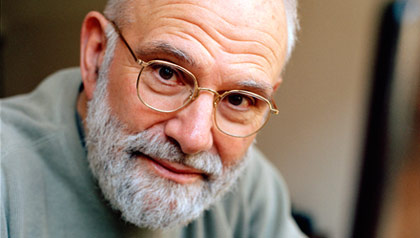
Thank You, Oliver Sacks

Above all, I have been a sentient being, a thinking animal, on this beautiful planet, and that in itself has been an enormous privilege and adventure.

Only 6 months ago Oliver Sacks wrote those words when he announced he has terminal cancer.

Now, he has passed.

It’s difficult to express my sadness for an inspiration of this magnitude. The Man Who Mistook His Wife for a Hat was special in many ways. For one, it was penned by the brilliant hand of Mr Sacks so its prose was impeccable and rhythmic. More importantly, he focused on the humanity of his patients more than any one I’ve ever read or spoken too. I felt a connection with many of them and their condition somehow became less important the more I read.

They weren’t freak-shows, idiot savants or the terribly unlucky who society can do nothing for. They were people with interests, motivations and personality. Sacks spent time with the person rather than just their condition.

In his announcement of terminal cancer, he wrote that he feels intensely alive and feels sudden focus and clarity. The distractions have fallen away as he hopes to focus on himself, his friends and his work. An amazing thing for some one who is face to face with death.

Now he is gone, I want to say thank you once more. Thank you for your writings. Thank you for your crystal clear humanity. Thank you for giving your readers strength during your most difficult time.

Thank you, Oliver Sacks. It’s been an enormous privilege.


My Own Life – Oliver Sacks on Learning he has terminal cancer 

Oliver Sacks dies aged 82


When Your Confidence is Low

Currently, my confidence is low.

I use a walking stick and have been for a long time. My doctor said a large issue is lack of confidence rather than being solely a physical issue. So over the past few months, I’ve practised walking without it.

I’ve made progress and a few of my friends have seen me walking without it more often. A lovely feeling, I must admit.

However, over the past week, I developed a very bad limp. Suddenly, I’m so dependent on it hurts to use and I actively avoid walking if I can.

I spent some time thinking about whether I was being melancholic and concluded I wasn’t. Walking normally is bound to be very important to me.

I don’t want this hiccup to affect my future progress so I thought of a few things to help get back on the confidence train.

What is confidence?

I’ll save the philosophy for later and settle on this definition: ‘A justified demonstration of your ability’. It’s probably too simple but we can go into more depth another time. I want to focus on the ‘justified demonstration’ part.

This means that confidence can be gained. When you start something, the chances are that you won’t be great or even good. Practising will help you get better and because you’re better, your confidence in your ability increases. When I started writing, I started with the intention of becoming better. I’m not sure when I’ll say I’m good but at least my confidence is improving the more I practice.

When people lose confidence in the things they either used to enjoy or something they knew they were making progress in, it’s rarely because they’re suddenly terrible and will stay that way. They’ve lost their reasons in believing they’re good or can get better.

When I lost confidence in my walking, I kept on saying to myself that this is the beginning of the end and I’ll have to start all over again. More damning is that I’ve suddenly lost the ability to improve completely.

Rarely these things are so true to the point where we have to throw self-compassion completely out the window.

So what do we do?

Remember these 3 things:

Progress is rarely smooth

This is unfortunately easily forgotten.

It’s also too easy to believe the opposite.

Whether it’s writing an essay, losing weight, running faster or talking to more people, progress with such things have their ups and downs. That’s OK. It’s very normal.

Don’t con yourself into believing that everything needs to be moving perfectly in order to be right. As with my walking, there were always going to be times when I find it more difficult than others.

Fake it ‘til you become it

I’ve watched this Amy Cuddy talk on Body Language and confidence a number of times. The main take away for me was to fake it ‘til you become it.

At times, it can just feel false pretending to be a person who’s comfortable in with their abilities and so on but it is very helpful. It helps to justify being with happy your abilities and progress.

If you don’t know where to start, adopting what you think a confident person might do is helpful. And watch the TED talk by Amy Cuddy. Toe the line between arrogance and confidence carefully but being comfortable with yourself is valuable and worth the effort.

Keep being active

This is closely linked to the previous point.

The low confidence elephant will tell you to stop trying because you’re bad. You won’t do anything and have more reasons think you’re bad – precisely because you’re not doing anything.

The elephant wins but doesn’t give a victory speech due to lack of confidence.

It’s important to keep working towards your goal even if there’s a hit to your progress. Low confidence is a difficult circle to break out of. Forcing yourself to continue practising can feel fake. Almost like you’re always acting.

That feeling will subside and you’ll feel good about your efforts. You won’t be acting as a character you want to be. You’ll become that person.

I don’t have all the answers and this is a surprisingly difficult topic (e.g. when giving up, what’s the difference between having low confidence and being realistic?). I’m far from the most confident person in my friendship group let alone an authority on the topic. Sometimes, I feel like I’m still in the act of faking rather than being a confident person. Nonetheless, I found these reminders helpful and hopefully they will be for you too.

Why do you think confidence is valuable? How can you become more confident? I’d love to know what you think.

As always, thanks for reading.

Some other things to read:

  1. Let the Fear Pass
  2. The Highlight Reel
  3. Mindy Kaling On Confidence

Share on Facebook or Twitter


Black Authors Don’t Exist

I was looking through my reading list and saw there were no black or ethnic minority authors. But more importantly, there was no reason for there to be any. Why would they be if they just don’t pop up anywhere unless I look for them specifically?

Maybe they don’t exist.

Of course, that initial thought has to be false. Maybe they’re just very rare.

I did some research to find out whether I’m mistaken and simply haven’t been exposed to them. Perhaps they are much more visible than I thought.

I used two sources – Brainpickings.org and the New York Best seller list. There are brief notes on my method and the strength of possible conclusions at the end. For now, we’ll look at the demographic breakdown from these sites.

Before I continue: I’m definitely not calling anyone racist. Again: I’m not calling anyone racist.

We move on.

Brainpickings.org

One of my favourite sites ever. Maria Popova, the author, can be described as the ‘discovery engine for interestingness’. She focuses on things related to creativity, how to live the good life and much more from the large wealth of books she reads and writes about on a daily basis.

She’s probably one of the most well-read people in the world, and has a close eye to include female authors to combat what she calls “male intellectuals’ tendency to extoll almost exclusively the work of other male intellectuals”. Given this, I thought she’d offer the best chance at seeing authors who are black or ethnic minorities.

Fortunately I was correct. From the brief research done, she did provide the best chance.

Unfortunately, the number was still very low.

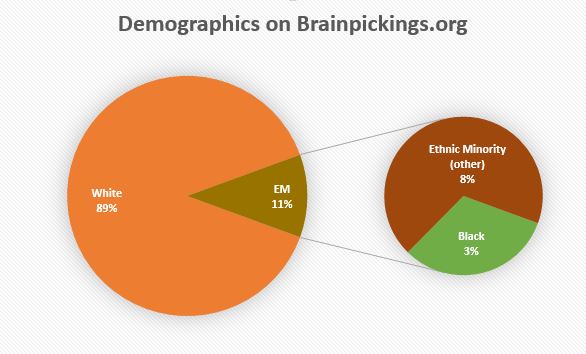
brainpickings demographic

Of 197 unique authors, illustrators and a few other professions, I found over 30 articles from 14th August (a very small sample size given how much she produces!), there were 21 ethnic minorities. Included in that were 7 black authors.

Those authors were: Elizabeth Alexander, China Keitetsi, Angélique Kidjo, Nikki Giovanni, Toni Morrison, Chinua Achebe, and David Blair.

The male/female divide fared slightly better with 138 males and 59 females. This may seem very unequal but if you’re a regular reader of her work, you’ll find that she writes about female authors with admirable frequency. You’ll also know that she’s a great fan of Susan Sontag’s work as she came up with the most repeated mentions at 5.

Before we continue, can we sit and awe at the number of authors mentioned?

New York Best Seller List

This was more disheartening.

It is important to note it’s a simple list of books that sell the best over the course of the week. There could be 1000 black authors who sell 1 copy each and 15 non-black authors that sell 3 copies each and they’d dominate the best seller list.

The scope was from the 12th July to 23rd August.

With that being said, here are the results.

In the fiction list, there were 64 authors with 41 females and 23 males. No black authors. I broadened it to ethnic minorities and the result was still zero.

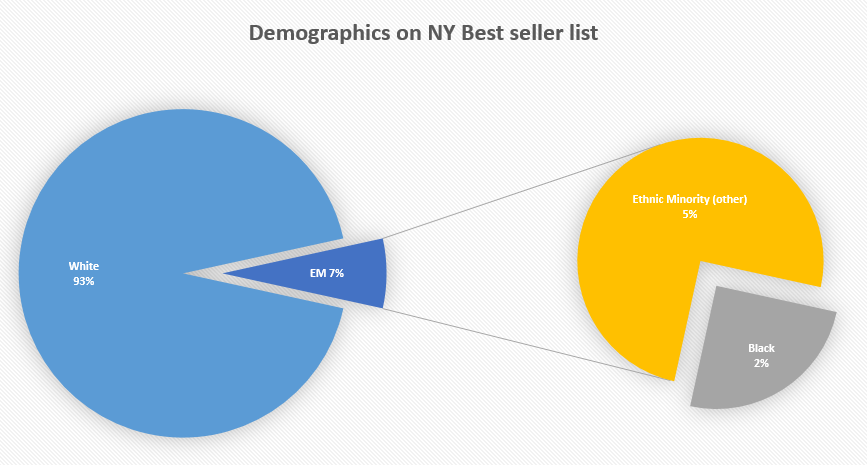
Non-fiction was slightly better. From 53 authors there were 31 males, 22 females, 8 ethnic minorities and from that 2 black authors (Ta-Nehisi Coates and Ishmael Beah).

Here is the total breakdown:

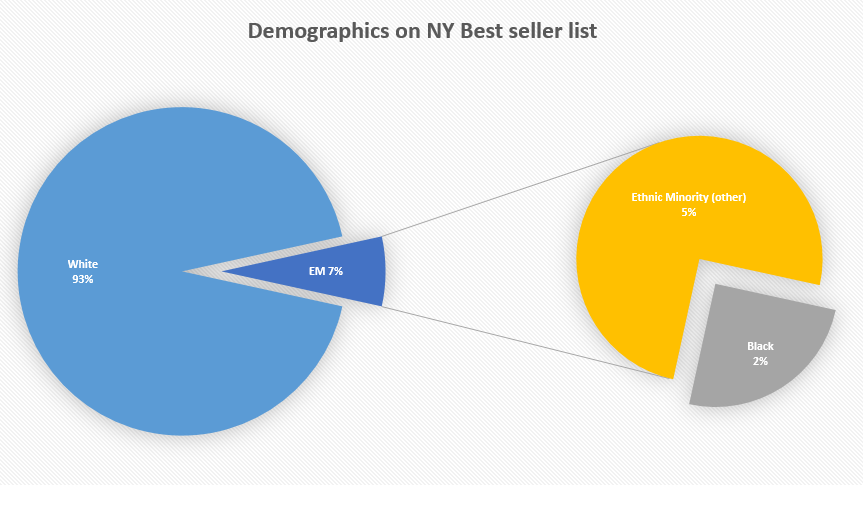
NY list demographics


From over 300 authors there were 29 ethnic minorities and 9 black authors.

Can’t I read whatever I want?

Yes.

I think it’s important to rid ourselves of the stigma of having to read certain types of books. Although helpful at times, I dislike lists of the type, “10 books every intelligent/smart/successful person should read” because if a person simply doesn’t want to read those books, they needn’t be deemed stupid in any sense.

I read children’s books from time to time and that doesn’t mean I’m childish. If it did, so what?

So I don’t want this to be construed as an article demanding you read black authors because they’re pushed to the side but as an invitation to extend your reading list. Some standard suggestions are:

The Colour Purple by Alice Walker

Things fall apart by Chinua Achebe

I Know Why the Caged Bird Sings by Maya Angelou

If you’ve read these books in secondary school and found you disliked them, it might be helpful to try again without the pressure of having to analyse the fun out of them.

What can I conclude?

Given the scope of the research, small sample size and great complexity surrounding issues behind race, the answer is ‘not much’. Though, it does lead to useful points of discussion.

Firstly, it’s clear that black authors don’t tend to be in regular reading lists and because of that, it’s very difficult for their work to spread further compounding the problem. Black authors are definitely not in any kind of limelight when it comes to published writing. I feel this is enough to confirm suspicions that you could easily go many years without picking up a book written by an author of ethnic minority without having to look for one specifically.

When I decided to start this small amount of research, I was inspired by my own reading list. So you can ask yourself two questions:

  1. Have you read or plan to read a book by an author of any ethnic minority?
  2. Of those books, how many do not contain a theme about race?

The second question leads to more speculative territory. That being we tend to read such authors, not because they’re just regular writers but because they write important things about race. Whether that’s good or bad, I’m unsure but I’d rather it wasn’t the only reason we were drawn to them.

From the evidence here, I can’t conclude anything about why there is such a great imbalance nor can I say anything about how it can be changed or whether it needs to be. So I won’t.

What I do want from this is to draw attention to the imbalance as I think it’s worthy of discussion.

A few notes on the method.

This is the boring part.

My method wasn’t particularly precise or efficient but after reviewing it, I don’t think it takes away from my core point. Both lists were so heavily dominated by white authors that a few mistakes won’t weaken my point.

  1. Ethnic minority was modelled around the US and UK so Non-hispanic whites and White British were classed as majorities with 63.7% (2012) and 87.2% (2011) respectively.
  2. I’m not sure what I did with the Jewish population. It’s confusing as proved by this great answer on Quora.

There are bound to have been a few mistakes and there were also a few people I wasn’t sure to include as an ethnic minority. I decided to include them anyway.

Finally…

What do you think about black and ethnic minority authors? Is the lack of publicity a problem? Is there any problem here?

I’ll return to my normal personal development-esque writing later.


Share on Facebook or Twitter

Who Would I Be?

‘Suppose you could take away the tics,’ he said. ‘What would be left? I consist of tics – there’d be nothing left.’

Witty Ticcy Ray

Who would I be without my disability?

Perhaps an odd question to ask. The answer should be ‘a better and happier person’.

Unfortunately, it is not that simple. I found myself resonating with Witty Ticcy Ray – I might be nothing without it.

For most of my teens, I’ve had to deal with pain, walking problems, and more recently, the resultant emotional fallout. In the most developmental stages of my life, I’ve grown up with it and lived my life around it.

To some, it’s the same as growing up with a favourite sports team or book series. A lot of the conversations you have with friends and family are around this favourite thing. For me, my habits and motivations have been moulded around my disability.

It’s difficult enough to answer the question of who I am right now let alone who I would be without a life-changing event.

A simpler question to ask is: Would I be a better person?

At first, I thought the answer should be a resounding ‘YES!’ I’d be pain-free. I’d read more. I’d have more fun with friends. I’d live without needless discomfort. I’d still be able to play sports. I wouldn’t have had operations 2 operation in a year. I wouldn’t even have to grapple with this question.

Yet, there was some resistance to my answer. I don’t know if I would be a better person.

I tend to view my disability as a negative thing and wish it gone every day. I have never thanked fate for my problem. Still, my answer to the question was not confident.

My hesitation came from the good things that have happened as a result of my disability.

I probably wouldn’t have become interested in personal development as early as I did. One of my motivations for starting a blog was to see how I could improve life despite my problems. In fact, none of my readers knew I had a disability until I wrote Living with Chronic Pain.

It’s unlikely I’d be as concerned about the welfare of other disabled students. In turn, that’s probably affected how I treat people more generally.

Would I be interested in meditation and mindfulness? These are two things I am forever grateful I started.

My disability has shaped me in some good ways. Would I still have those good qualities without it?

If I say I wouldn’t be a better person, does that mean my disability is a good thing? How can I reconcile that with my efforts to get rid of it?

If my disability is a good thing, why name it a disability?[1] Surely everyone faces some discomfort and this is just my personal one.

If I can’t call it a disability, what has been the source of all my discomfort and frustration?

Currently, I’ve asked many questions and given few answers. When I started thinking about these questions, I thought about what I’d be admitting with my answers.

Despite my attempts to steer clear of this, perhaps my disability is integral to my identity rather than just an addition onto the core ‘me’.

Maybe I can’t complain about my discomfort if I cannot imagine a better future.

Now I know that I have a lot more to consider. I have more questions and uncertainty to live with. I have a difficult dance with self-honesty and awareness.

To take a further step towards honesty, I’ll say it’s really scary. It’s like existential angst all over again. Unfortunately, I don’t think Albert Camus wrote a disabled version of The Stranger or The Myth of Sisyphus.

However, I’m glad Witty Ticcy Ray inspired the question. Given the length of the problem and the uncertainty surrounding the end, it was going to pop up eventually.

As always, thanks for reading.

***

1. The quote at the beginning is from The Man Who Mistook His Wife for a Hat by Oliver Sacks. Put it on your reading list if it isn’t there already. Witty Ticcy Ray was a man who had Tourette’s and was given Haldol to stop them. He became angry because he it took away his wit and quick reflexes. However, he still faced the problem of not being able to live a normal life with them.

2. When I wrote and shared Living with Chronic Pain, I was surprised at how well it was received. To everyone who read it, thanks for giving me the confidence to write more about disability. Hopefully, it’ll not only help me but other people who have disabilities, and those who are simply interested in it.

3. Here’s some more stuff to read:

The last two are positive articles about disability. I’m not sure if I share their enthusiasm but it’s also important to consider that mine is much less severe than theirs. It’s always good to have differing opinions about this subject rather than an echo chamber.

4. There have been a lot of end notes. Here’s another one.

***

[1] Julian Savulescu and Guy Kahane offer a definition of disability in The Moral Obligation to Create Children with The Best Chance of the Best Life. I think I satisfy it but it doesn’t take away from the question.

A stable physical or psychological property of subject S that,

(1) leads to a significant reduction in S’s level of well-being in circumstances C, when contrasted with realistic alternatives,

(2) where that is achieved by making it impossible or hard for S to exercise some ability or capacity, and

(3) where the effect on well-being in question excludes the effect due to prejudice against S by members of S’s society.

Or more simply, had x condition not existed then the person’s well-being would be higher. But it excludes things like not being able to fly as a disability… so far.

The Courage to be Wrong

Realising we’re wrong can be quite worrying. If we’ve erred there must be something that is wrong with us even if it’s a small thing. It is usually greeted with feelings of shame, anger, sadness or even apathy towards our development. If we get something wrong now, why bother trying again?

Even though, we understand that humans are fallible beings, it is still difficult to accept the feeling of wrongness. We may even look at various motivational quotes say things like “failure is the path to success” or “I can accept failure but I can’t accept not trying” but still close the door on being wrong.

Why does being wrong feel bad?

In light of all of the opinions we have about being wrong and how it’s okay, we’d probably expect to have different attitudes towards it.

The reason why being wrong is viewed negatively negative is due to the various cultural attitudes we have towards it. We view wrongness as harmful, unable to be salvaged or improved upon. When we hear about important mistakes and how they’re damaging to either people’s lives or finances or anything you can think of, we hope to never been in their position.

These attitudes  are also found in our education.  The person who does poorly on a test or ask really simple questions is often viewed as dumb person in the class. They hold back the smarter students from progressing, they mustn’t have studied and they may even frustrate teachers. So when someone gets something wrong they feel like they’ve failed themselves and they’re going to disrupt other people.

It results in a fear about being wrong.

Is Being Wrong OK? 

Of course it is! Failure is the path to success etcetera etcetera. We all ‘know’ this but should we really believe it and take it seriously?

I think so.

When we find we’re wrong, a few things happen. We’re given the choice to keep our false belief or accept a new one. We might fear that we’ve slipped down the ladder of knowledge and can’t climb back up.

These situations aren’t bad. They’re just difficult to handle which is why we sometimes react so negatively to being wrong. But that may not be necessary.

Being wrong about things gives us an opportunity to further knowledge rather than wallow in how little knowledge we apparently have. We have to overcome our resistance to changing our minds.

Embracing our ability to be wrong is difficult and obviously isn’t as simple as just being happy with being wrong about everything. I’m not asking we think being wrong is the best thing possible. As some people may object, getting some things wrong affect the well-being of people in drastic ways and should be chastised rather than encouraged. Here they point to a surgeon making a mistake in a surgery or a bank charging the wrong person exorbitant fees. To that I say:

1) They happen all the time and should be corrected.

2) It’s unrealistic to expect perfection in all decisions regardless of their importance. Such an expectation creates the excuse we see wrongness as inherently bad.

3) Most people can be wrong about things without any severe consequence.

Embracing our ability to be wrong means that we view it as a normal part of decision-making and belief forming. It isn’t something that should create the fear of being judged as stupid and unable to change our opinions.

Fearing wrongness paralyses our progress and prevents us from trying to improve. We’re far more likely to just stay in our comfort zone where mistakes are less frequent and echo chambers are especially loud.

It takes some courage to admit being wrong and use that experience to further ourselves rather than viewing it as an unrepairable fault.

If it offers any comfort, I could be wrong about all of this and we can continue shaming people who get things wrong and feeling bad when we make mistakes.

***

This post was inspired by Kathryn Schulz who gave a brilliant TED talk on being wrong. She also wrote a book about it called ‘Being Wrong: Adventures in the Margin of Error’. I read it last year and thought it was great and can recommend it without reservation (unless you just hate non-fiction books).

So if I write more about wrongness, blame her.


Create Without Expectation

I write a lot in my journal. As of today I’ve written over 560,000 words. I don’t expect it to make sense or answer any of the burning questions I might have had throughout the day. It’s easy to write in my journal because I don’t really care much about how sentences read or whether the whole idea is coherent.

In part, writing becomes easy because it’s done without expectation.

I don’t expect perfection. If I have an idea, it’s not a big deal if it doesn’t come out the way I imagined. It can be written and changed around a little bit. Perfection isn’t a goal and that breaks down fear I might when I want to create something.

Writing for an audience (however small or big) seems to create expectations that paralyse progress. It’s easy to have big ideas that need to be broken down into a multi-part series or might be shared with more people than ever before. Holding those expectations over your head inevitably raises questions like:

  1. What if it isn’t shared with anyone?
  2. What if it is shared and no one likes it?
  3. Will it be helpful?
  4. Will people laugh because of what I’ve written or laugh at it?

And so on.

When we think about writing and making it reality, we might fear it won’t live up to the standard we’ve set ourselves. If we write it, we’ll only prove to ourselves that we never should have started in the first place. If we write, we’ll only make a fool of ourselves.

Expectations shouldn’t be hindering our progress. Sometimes, it’s best to do without them and just see what can be created. Sometimes, that can be the most fun. My example is when I wrote The Aspiring Writer. It would have been easy to shelve the idea because no one would enjoy it or it might be confusing. That voice is in the back of my head whenever I’m writing something but it would be sad if it stopped me from creating completely.

After trying to abandon my expectations I’ve found that I’m pretty bad at judging my own work because it always tends towards the critical rather than celebratory. Which is neither balanced nor helpful. The critical voice is quieter because I let it pass rather than believing it to be 100% true.

If you have any creative project but seem to be paralysed by fear, create without expectation. Throw them into a river and watch them float away.

You see your project as it is rather than what it might be and create without paralysing fear.

***

This doesn’t mean that you can’t want things to be good.

You’re allowed to create and change it afterwards. However, it does mean your expectations shouldn’t stop your from sharing it with others. If we think we can improve it, we’re always allowed to. We don’t need to demand perfection straight away.

Live with Questions

Big questions. The type of question that apparently has no answer. Questions that result in debates which devolve into shouting matches. Questions that are discussed with friends in a park without noticing how serious the conversation has become.

Such questions have unfortunately been met with quick dismissal because they lack an easy answer. And the statement ‘We can’t figure it out! Stop asking about it!’ is uttered by the frustrated.

This attitude is often damaging and unhelpful. Some questions demand vigorous thought and conversation. They test patience and sanity. However, what they’re unlikely to do, is make life drastically worse for existing.

I say this because they have another function beyond being in an introductory philosophy book.

They foster powerful conversation between friends, give us a chance to exercise freedom of thought and help us learn more about ourselves, the world and the people we share it with.

They force us to live with uncertainty and find peace in it.

Take the question ‘What is the good life?’

Thinking about this question for only a few minutes opens us up to the huge possible answers you could give. To this question alone the answers have ranged from serving God to finding peace in a secular place to being virtuous to living with as much pleasure as possible. Some great minds have been trying to answer this and solve our contradictory yet equally appealing opinions for thousands of years. However, the lack of a definitive answer does not signal towards its insignificance.

In part, the value of the question comes from the process of trying to answer it, not just the answer settled on. Engaging with the questions opens us up to personal beliefs previously hidden to us which are then challenged and defended or dismissed. They can potentially change our lives simply because they’ve given us a new perspective on problems that we may never have taken seriously.

For example, we all know about avoidable poverty that persists in the world and tend to think it’s a bad thing but asking whether we’re all morally equal humans can change our opinions on whether we should give to charity. If we decide not to give to charity we can begin to develop our answer beyond a stutter and a hurry to change the topic.

Thinking about the questions, we might come closer to a satisfying answer that we may never have realised was in our grasp. But only by grappling with it for a while (or for some, their whole lives) can we do this. Everyone can be told answers to questions without any personal engagement but refusing to do some of the work ourselves stifles our gift for curiosity that should be grown instead of stifled.

If we find an answer we like, then all the better. If not, we can still enjoy the discussion. We then find that saying ‘I don’t know’ shouldn’t make us anxious. It’s a normal part of dealing with difficulty and practising some humility in the process.

It is important to note that I’m not demanding we live with every question in the world. There are many I currently have little interest in (No, I don’t know what an object is Mr van Inwagen.*) and some I have lived with for so long they aren’t invited for dinner any more. We all have different interests and some are more central to our everyday lives than others but we mustn’t dismiss them simply because of their difficulty.

To live with a question means we sometimes invite it over for some food and drinks, chat for a short while, crack a few jokes, realise you’re personifying a question for the sake of a metaphor and then, when the night is over, thank Ms Big Question for the enriching conversation. Maybe afterwards you’ll call Mr and Mrs 300-page-book for some help.

Live with questions and embrace the complexity they bring.

Live with questions and allow them to enrich your thinking.

Live with questions instead of wishing for their death.

If the questions die then the answer goes along with it and more importantly so does our thought.

***

* Peter Van Inwagen is a philosopher who has written about what objects are and determined they’re either elementary particles or living organisms.

Some other stuff:

Keeping Alive The Big Questions

Why I read

On Productivity and Presence

For the longest time, I was obsessed with being more productive and fell into the productivity trap.

I felt I needed to get more done in less time. My pain denied me the luxury of spending a long time on essays or problem sets, so I made it my goal to learn how to make the most of my time. Which I think is a perfectly fine goal and I still hold it. The problem I want to focus on arises when productivity is reached to the detriment of presence and being mindful.

There’s a slight divide between living with presence and productivity. The former is often lost in the latter.

What’s the point of all this productivity? Why am I so interested in the next thing rather than what I’m doing now?

We shouldn’t be so focused on what will happen next and don’t do what’s in front of us.

Nor should we be so focused on completing a task that we forget to experience it.

When I started read about self-improvement, I came across meditation and adopted the practice. Mindfulness meditation places an importance on being focused on the present moment alone. When thoughts come into our head, we let them pass like clouds moving through the sky.

We remain in the present which helps free us from anxiety about the future and regret from the past.

The difference between presence and productivity can be seen in everyday tasks.

Discarding productivity when reading means we aren’t concerned about when the book ends so we can start the next one. We’re just enjoying the dialogue, the story, and sometimes, the absurdity (I’m looking at you, Catch-22).

When we eat food, we enjoy how it tastes rather than inhaling it to get back to work.

And so on.

This divide definitely isn’t a strict one. I don’t want to mislead people into thinking that being concerned with productivity means we are unconcerned with presence and vice versa. There are a million and three qualifications one can make to this general idea of aiming to be more present than productive. For example, an employer may not care so much about how mindful you are if you’re always missing targets. But that’s a discussion for another time.

Leading a productive day can be much more fulfilling if we go through it mindfully.

It’s easy to ask how to be more productive while forgetting what it means to be productive and then forgetting why you desire productivity. When we get to that point, it’s an apt reminder for us to slow down and become aware of the present moment once more.

The moment we can be the most engaged in.