Should You Follow Your Own Advice?

The first answer seems to be yes. If you’re giving advice, you must think it’s good to follow therefore you should too.

I don’t think the answer is obvious. There are situations when you can give advice without following it yourself and still be in a good position.

Unpacking the question of whether you should follow your own advice is valuable in a few ways. The first is that it’s  interesting (to me, at least) and second, it gives us the chance to think about whether the advice we’re giving is useful.

Not following your own advice

There are a number of situations when not following your own advice is perfectly fine or even the right thing to do.

In 2005, Steve Jobs gave a commencement speech at Stanford. He said to the students ‘follow your heart’. That advice, as argued by Cal Newport, he didn’t follow. He didn’t seem to be the most passionate about technology or start-ups but ended up becoming a leading influence within technology and his effects are still felt today.

Whether or not this argument is convincing, similar things happen to other people. Leo Babauta recently admitted he’d stopped focusing on single tasks (although he wants to return) and still produces great work every day.

Despite writing Create Without Expectation, I still find it difficult to rid myself of paralysing expectations to do well.

You’ve probably given advice, not followed it, yet still achieved what you want.

In these examples, there are two themes.

In the example of Leo, he’s graduated his advice and can now handle more than the person he’s giving his advice to.

He’s no longer like the person he’s advising.

This doesn’t need to be elitist. When we start learning maths, we’re taught techniques that a teacher would no longer use. The advice is still valuable for the beginner but not for the advanced person.

If a person is sufficiently advanced enough to know the effects of following the advice, they can give advice without following it themselves. For example, fat dietitians or personal trainers can still give useful advice about losing weight and doing proper exercises.

In the example of Steve Jobs, it’s possible that the advice simply isn’t very good, too vague or unrealistic.

Who can give advice?

Anyone.

It’s easy to give advice. There are many people who give relationship advice without ever being in a relationship or people who talk about beating procrastination despite being the worst procrastinators.

The requirement for advice giving is low.

A lot of advice seems to be personal experience with a self-proclaimed detachment from the situation. Personal experience adds credibility because we then know that it’s at least worked for one person and that person has no reason to lie to us (assuming they’re trusted). Objectivity helps because they can analyse the situation a few more ways than you might have yourself.

Following advice, even if it’s good, is harder. The advice giver is nearly in opposition to the person receiving it. They are attached to the situation and the problem becomes very personal to them when the advice giver tends to be very detached.

“When we think about other people, and what might be right for them, it’s a lot easier to see them as the big picture. It’s much harder to apply that big-picture perspective to ourselves.”

Hal Hershfield

It’s when advice giving and advice reception is complementary we make progress. In order to make these two position complementary, I’ve found it helpful to reduce the importance of objectivity and practice more empathy.

How should we give advice?

Advice can still be good without the advice giver following it themselves. Different situations often demand different types of advice.

However, what seems to be more likely is that by giving advice to other people, you’re giving advice to yourself. This means you’re in similar positions. Should you follow your own advice in this situation? Yes, if you have some desire to change.

If you can’t, it might speak to the quality of advice you’re giving. Which brings us to why the question is helpful.

If you can’t follow your own advice yet give it to others, the advice could either be bad, too simplified or irrelevant.

It’s easy to give lazy or ‘just-do-it’ advice.

  • Just start working
  • Just save more
  • Just stop eating so much

Simple advice, right? Sometimes helpful but rarely does it inspire much action. It’s easy to give because it negates the problem and packages it as a helpful answer.  Most importantly, it distances us from the problem – reducing our likelihood of being empathetic when helping others.

We probably don’t aim to be dismissive when giving such advice but I’ve found it’s useful to make a greater effort to refrain from giving dismissive advice.

“Once you understand something, it is difficult to remember what it was like not to understand it”.

Peter Lipton

When we’ve overcome a problem, it’s tough to appreciate how it was to experience it.

If we’ve lost weight, it’s unlikely the only step we followed was to ‘eat less’. It probably involved reducing portion sizes, drinking more water and taking the stairs instead of the lift.

If we’ve improved our grades, it’s unlikely that we just ‘worked more’. It may have involved setting out time for the library, taking more breaks and focusing more in class.

And so on.

This just-do-it advice tends to be a label for more detailed advice that needs to be unpacked rather than the advice to be followed. It’s easy to get the two conflated because we might not even notice the small changes we make in order to achieve the bigger goal.

Not following our own advice when we think we should, helps give an insight into why other people might not either. There’s a large difference between ‘knowing’ you should do something and feeling it. It befalls many of us.

So should you follow your own advice?

Yes, if it’s good and relevant.

By asking this question we’ve discovered that good advice can be difficult to give. It requires empathy and an effort to be attentive to the problem rather than dismissive. Thankfully, asking whether we would actually follow it can be a signal towards whether it will be helpful.

It’s a good thing to try being helpful (I wouldn’t write this blog otherwise) and trying to improve how helpful you are is another goal worthy of attention.

No, if you don’t need it (or want it).

We don’t always have to follow our advice just because we’ve given it to someone else. Sometimes we don’t need it as it’s become irrelevant to our own needs or we know it’s proven to work and don’t need to apply it to our own lives.

There’s a bigger discussion about what good advice is and how to give it but I won’t start that here. I don’t know a definite answer to any of those questions.

Do you follow your own advice? Do you think you should?


Sign up to my fortnightly newsletter for free updates on my best posts.

Share this post on Facebook or Twitter!

Further Reading:

Why don’t we take our own advice?

Your Own Advice is the Hardest Pill to Swallow

Why Is It So Hard To Take Your Own Advice?

How to Create Plans You’ll Stick To

There are two easy ways to create feasible plans:

  1. Pretend you have 30% the energy you usually have
  2. Copy a plan you’ve completed successfully before

Note that I’ve left out the most obvious way – looking at a calendar and the things you have to do then filling up the hours.

Why don’t we stick to plans?

I’m probably one of the biggest culprit of this which is what led me to figure out how to stop this from happening again as it was becoming a huge source of frustration.

It’s simply too difficult

For some reason, if we imagine a free day we imagine a lot of time. But we also assume our energy levels will match that. It often doesn’t.

Cramming the day with loads of activities is only going to make you tired quickly and far more likely to stop doing them even in the middle of the day. If it’s a long term plan it’s even less likely to continue.

We get distracted

Distractions are a huge problem. As research shows, after a distraction, it takes about 25 minutes to get back into work.

It makes our work far less efficient and moves everything in the plan forward. Therefore we work longer, become more tired and start putting things off.

We don’t give ourselves enough time

We might assume that we can get an essay done in 3 hours but sometimes we might get stuck which means we have to take a longer break. Or we can’t find the book we want.

Same with side projects you might want to do after work/studying. If we expect to do all of them in a minimal time then we’re either going to drop them completely or reduce them drastically and feel guilty about it.

We procrastinate

Looking at a large plan for the day can be intimidating and cause us to procrastinate. Therefore we don’t do anything we aim to. Here’s one simple way to stop it.

Making plans work

  1. Assume less energy than normal

This point relies on assuming you have less energy than your plan assumes

If we try being superhuman then get intimidated or worn out by our plan, it’s not a useful. On the other hand, if we’re more modest, we have a much easier starting point, procrastination is less likely and we will complete things.

Let’s take one of the plans I’ve had in the past (and I’ve had many):

Capture 4 Capture 3 Capture 1

This is actually a simplified version of a plan I had at one point in my first year of university.

Looking back on it, it’s surprising to think that I considered it then even more surprising is that I was annoyed when I couldn’t complete it! Nearly 9 hours of difficult (and unnecessary!) work I had planned. That’s on top of being social, dealing with chronic pain and you know, trying to not hate books after my first week.

The plan didn’t work for a variety of reasons:

  • I didn’t have the energy to complete them
  • I ignored other factors (like having friends and going outside)
  • It was boring
  • It wasn’t flexible

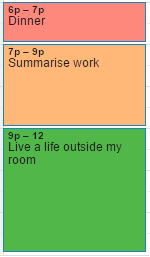
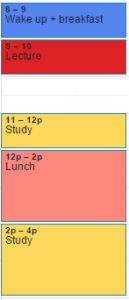
Creating the plan with the mind that you’ll have less energy means you plan to do fewer things, increase flexibility and still complete things. So the plan above might turn into this (assuming there’s a 9am start):

Capture 2

And that’d be it.

The first plan has nearly 9 hours of mentally tasking work while the second has 4 hours with large breaks in between. It’s much easier to start and I found I got more work done with the second plan overall.

  1. Copy a previous plan.

The second condition is easier to implement. If you’ve successfully created and completed a plan before, copy it and use it again.

However, it’s important to take into account new factors when doing this because your past plan might have been completed under much different conditions. For example, if you’ve caught a cold, your energy is going to be lower than it would be normally so you’ll complete less work or it’ll take longer to complete the same amount.

But remember to be reasonable. If you’ve planned an overnight stay at your library or a general rush till exams, you won’t be able to sustain it for a long period. To combat that, refer to point one.

An impromptu Q&A session

“But you’re doing so little work – you’re obviously doing a Philosophy degree this doesn’t apply to me!”

Fortunately, it still does. If you’ve ever planned anything and never completed it (although you feel you should have) then it applies. Creating unrealistic plans is normal and unless you actually have unlimited energy, it’s fine to plan less and complete more.

Dealing with chronic pain means I’ve had to change how I view plans and making my time more efficient. This is one way I’ve managed to stay with the crowd despite being in pain all the time.

“But what if I can’t plan less! I have so much more work to do than you”

That’s where the second condition comes into place.

Not every plan can work on such little energy. Deadlines and loads of work exist. If you’ve actually completed a plan that meets the demands of your current situation, mould it around that. As Scott Young says, you’re allowed to experiment.

If not, continue to assume you’ll have less energy when creating it. And stop procrastinating.

“What if I have scheduled commitments?”

If you have a variety of things you want to do (clubs, learning new things, blogging etc), reducing the amount of energy you’ll have to complete it seems ridiculous. It isn’t.

In this scenario, you have to exercise prioritising and say no to some commitments. If you don’t, there’s a good chance you won’t do them, get frustrated at the ‘little free time’ you have or burn out very quickly and blame yourself.

Admittedly, it is difficult saying no to things especially when you seem to have a lot of time for trying new things. Those things won’t disappear straight away and there’s no point in planning them if you’re too tired to complete them.

It’s alright to say no.

“Am I allowed to continue working past my smaller plan?”

Yes. A minimal plan makes it easier to start working. It doesn’t necessarily put a limit on how much you should continue working. Though, it should make you more efficient with the hours planned – reducing the need to continue working much more.

The next day, return to the minimal plan. A good plan is sustainable.

“I’m rubbish with times. What if I oversleep?”

Ignore times and focus on activities. Instead of planning the hours, aim to work on a project for an hour in the morning and an hour in the evening.

If that is too difficult, aim to do an hour of the project during the course of the day. The earlier the better of course as you don’t want tiredness to excuse you from working.

“Did you write these questions yourself?”

Some things are best kept secret.

Action Steps

The take away from this is to reduce the amount of energy you’ll need to finish a plan so it’s easier to start and easier to complete.

What can you do now?

  1. Create a plan for your ideal day
  2. Assume you’ll have less energy than normal
  3. Create a new plan.

A small amount of completed work is better than a large amount left wished to be completed.


Sign up to my fortnightly newsletter for free updates on my best posts.

If you found this helpful, share it on Facebook or Twitter!

The One Phrase to Beat Procrastination

Procrastination plagues all of us.

Whether it’s a writing an essay or cleaning the house – we have tasks we want (and need) to do and put them off anyway.

To combat this, we’ve probably read a number of useful things on stopping procrastination. Break down the goal into small and manageable tasks, plan your day, set deadlines, and work without distractions and so on.

They’re all helpful but we still put things off. When we think of the task, we begin to feel uncomfortable. Let’s delve into that feeling of resistance.

What do we feel when we procrastinate?

Should we actually spend time with these feelings, we might learn a few things.  We’ll split the tasks into the classic Eisenhower matrix.

If it’s important but not urgent, we’ll find comfort in procrastination because we don’t have to do it but feel guilty because we know it will be helpful. If our thinking continues, we might feel guilty for having these feelings at all.

If it’s urgent but not important, we might feel anxious or on the other hand, apathetic towards the task. The task’s urgency means we have to think about it but since it’s unimportant, the deadline might just zoom past without consequence.

If it’s urgent and important, the feelings  of guilt, dread and discomfort are multiplied. We’ll feel trapped within the confines of our own procrastination – like slaves to distraction and quick entertainment.

Depending on how bad the procrastination is, the task will remain undone and we’ll just deal with the consequences.

There are many feelings we have while procrastinating. A lot of it stems from the fear of discomfort and results in self-criticism that makes us feel bad rather than change action in a sustainable way.

How can we combat this?

The phrase to beat procrastination

“It’ll be better after I start”

Since all of our feelings from procrastination are born of inaction, using them it’s useless to gauge how well the task will be done. We often overestimate the difficulty or underestimate our ability to try.

Stop thinking about how you might feel during the task and quieten the internal monologue convincing us to give into instant gratification. Start the task then experience how you feel.

Starting something always feels better than not starting but wanting to.

I’ve never felt worse for starting something I’ve needed to. Of course, I’ve abandoned things or disliked them for a variety of reasons but it’s better to have justified reasons and progress under your belt rather than being guided by fear.

Conclusion

When you find yourself procrastinating, say “it’ll be better after I start”.

Because it will and you’ll be OK.


If you enjoyed this article, sign up to the fortnightly newsletter HERE. I provide free updates on the best posts I’ve written and other interesting things.

Share this article on Facebook or Twitter


Other helpful reminders for procrastination:

Create without expectation

What’s wrong with now?

Why Procrastinators Procrastinate

Make Your Bed

If you want to change the world, start off by making your bed

Admiral McRaven

Start the day with a simple and easy task – make your bed.

When I was younger, I ignored the command “make your bed” as many times as I was told to do it. I didn’t need to because I’m going to sleep in it later anyway. It was pointless.

But the point isn’t to prepare you for sleep at night. It’s to prepare you for the rest of the day.

Making your bed is easy. It takes a minute to do, it can be done every day and you’ll always have a reason to do it.

It is the perfect way to get started with changing bad habits and encouraging good ones.

I say this because it teaches us a lot about how habits are created and maintained. Habits require a trigger (a messy bed), a routine (making the bed) and a reward (first task of the day accomplished and a neater room).

It also gives us a small sense of pride. You can say ‘I’ve accomplished something today’ before you’ve brushed your teeth. Since it was so easy, you might be encouraged to complete other tasks such as cleaning your desk or open the book you’ve been meaning to read.

Should you have a bad day, a made bed can offer some calmness. Maybe you haven’t accomplished the things you wanted or something has bothered you. You’ve made your bed. It’s a small victory but one you can appreciate.

If we don’t appreciate the small things in our day, the bigger moments may pass by unnoticed.

Start the day simply and make your bed.

Sign up for fortnightly updates HERE

If you enjoyed this article, share it on Facebook or Twitter.

Stop Watching Motivational Videos (and what to do instead)

They fade from black with one person as the focal point. The music is starts calm but it’ll build up to something. It’s a Hans Zimmer score, after all.

You see a fit person running up some stairs or someone boxing. If you’re lucky, you get to see scenes from The Pursuit of Happiness again with a speech from Rocky Balboa layered over the top.

As the video progress, more stuff about getting up after a fall and dreaming big is shown. You’re told you’re worth it and can do anything you want if you put your mind to it. You’re reminded of all the rags-to-riches stories that exist like J. K. Rowling living in a council estate to earning millions a day and getting rejected a number of times before finally being accepted.

You feel good.

You’re motivated.

But motivated to do what? Finally start on your goals? But only after one more video…

Stop watching motivational videos

They’re akin to depending on sugary energy drinks rather than a good night’s sleep to combat tiredness.

Motivational videos (and images) feed procrastination in a special way.

They make us feel productive without all the work required in between. They might lift our mood temporarily but do nothing to combat the problem. The problem might be perfectionism. It could be that you’re simply trying too much and the goals need to be broken down. Or a number of other things that continues procrastination.

Motivational videos do nothing to solve these problems. It’s far too easy to continue doing nothing at all to further progress.

Hell, there’s even a chance you’ll feel guilty because you still haven’t done anything.

Since the improvement in mood is temporary, we always need to be motivated to even consider working. That in itself is unsustainable. After a while, they lose their desired effectiveness and become boring like any other entertainment.

It leads to only doing work when we feel like it and waiting for magical inspiration to strike us on the head. Such things don’t happen. To work consistently towards something, you’ll have to do it when you don’t feel like it.

Depending on how we feel in order to start working is a poor strategy. With all the quick entertainment and instant gratification at our fingertips, when will we ever feel like working if we haven’t already become disciplined enough to make it a habit?

In this case, dependence on motivational videos is actually detrimental.

Clichés, clichés and more clichés.

If you’ve watched many motivational videos, you’ll hear many of the same things over and over again. You might repeat them a few times but if it doesn’t result in any action, it’s literally just an empty chant. For example: “When you breathe as bad as you want to succeed, then you’ll be successful” is a reasonably new phrase that’s creeped its way into motivational diction.

I don’t want to say it’s useless but it is somewhat unhelpful. It hides the work actually needed to be done in order to achieve those levels of hard work.

Let’s say you want to exercise and embodied that phrase.

Does it inspire feelings of moderation or extremes?

After hearing that, do you want to aim for a huge personal best every gym session? Or do you want to start running for a few minutes and try a few more the next day?

The first choice is inspired by these motivational videos. It’s unrealistic for a beginner and unsustainable. The second is achievable but doesn’t fit too well in a catchy phrase.

Small starts and consistent work isn’t shown in such videos because their nature isn’t to show you the hard work. They show the end result and say ‘just do it’.

Small starts and consistent progress is how we actually achieve our goals.

But of course, that isn’t as romantic. Discipline is rarely romantic. But it works.

What should I do instead?

Start small – Make the goal so small you can’t say no. Or work for 3 minutes and decide if you want to stop afterwards. For example, this article was started by simply writing the title.

Be kind – Don’t berate yourself with hatred and negative thoughts for not doing something. It only serves to make you feel bad and does nothing to further progress. It actually makes you less likely to do anything. If you feel like you’re worthless, why bother starting anything?

Be specific – A huge reason why we procrastinate is because we don’t know what to do. Saying ‘get fit’, ‘read more’ or ‘write essay’ doesn’t mean much. Saying you want to write 500 words by the end of the day or lose 10kg in 3 months makes the goal much more real and attainable.

Conclusion

Motivational videos aren’t helpful unless what we’re looking for is to feel good for a few minutes. If that’s the case, we should admit we watch them for entertainment rather than their life-changing abilities.

We simply don’t need to be intensely motivated for everything. It’s fine to just go for a run or write some words without becoming your own personal cheerleader in the process. It’s called being normal.

Consistent progress will beat motivational videos every time. That’s what self-discipline grants us.

Sign up for the fortnightly newsletter HERE.

Do you find motivational videos helpful? If so, how often do you watch them?

If you enjoyed the article, share it on Facebook or Twitter.


The Excuse not to Try

An excuse not to try is needlessly self-limiting.

It takes a desire, bathes it in fear and tells you ‘no, don’t bother. Your efforts will be wasted’. Evidence is non-existent but your belief in it is high.

What is an excuse not to try?

It’s a weak rationalisation for not doing something you want to do. They usually take a very general form that can be applied to anything rather than specific to your personal situation.

For example:

“I don’t have time…”

“I’m going to do poorly…”

“I haven’t planned anything yet…”

There are many others of this form and there’s a reason for that. They are quite lazy and don’t assess the situation properly.

Here’s an example:

Emily wants to join her university’s football society but chooses not to because she’s never played before and doesn’t want to make a fool of herself.

We have some facts: she wants to join and she’s new to football.

However, she’s made some suspicions that are wrongly taken as fact.

Firstly, that she’ll make a fool of herself. Secondly, that making a fool of yourself is going to be bad. Nothing says she can’t continue to enjoy it. Thirdly, other people won’t be in a similar situation.

The reasons for believing these things are powerful. The image of herself running, falling and getting hit on the head with the ball are potent. They replay in her head many times becoming more powerful each time. She’s already embarrassed before even looking at the sign-up sheet.

If these things aren’t true, what other reason does she have to not try for something she wants?

None.

She can try, overcome the fear and hopefully have fun. If it doesn’t turn out the way she desires, at least she knows why rather than living with ‘what ifs’.

Excuses and Reasons

If we take these excuses seriously and put pressure on them, we find out two things.

  1. They shouldn’t stop us from trying; or
  2. They are justified as actual reasons rather than excuses

Both can be very valuable.

The first is liberating. It gives us the power to follow the things we want rather than being crippled with fear.

To end the excuses we can do a few things:

  1. Find a solution

Want to write more? Set aside 10 minutes every day.

Eat too many biscuits? Simply stop buying them.

  1. Be aware of the excuse

Knowing you’re making an excuse rather than giving a valid reason is useful. Excuses can be so automatic we never put pressure on them.

  1. Ignore the excuse and do it regardless

Put the excuse in a bubble, label it as an annoying pest and do it. There have been times when I’m writing while telling myself I don’t have the energy. Then I realise how silly that sounds.

The second is useful. It puts us in the position to assess our priorities and admit that some things are more important than others. We then put our attention towards fewer things and do a better job in the process. If your justification for not doing it becomes more specific, then it becomes a valid reason rather than an excuse thrown at a problem to avoid slight discomfort.

In short, we actually think about whether we’re being honest to ourselves.

Excuses not to try stop us from achieving things we actually want.

Thankfully, it doesn’t need to be that way.

We can rid ourselves of the excuse not to try and finally start making some progress.

Is there a big difference between an excuse and a reason? Are you making an excuses not to try something?

Share this on Facebook or Twitter.


This shouldn’t be taken as a manifesto to do everything.

There are good reasons for not doing things. For example, not wanting to smoke because of the poor health implications is not a flimsy excuse. Finding these reasons can even start us on the path to actually achieving the things we want. Being unable to travel because of money problems gives us the opportunity to start saving for it in the future.

Excuses in general are a slightly different problem. The excuse not to try prevent us from doing things we want. Excuses can also cover things we should probably do but want to avoid (like exercise). I’ll get to that another time.


In other news, I’ve rid myself of the excuse not to try a newsletter. So I made one.

You can subscribe HERE.

To start with, it’ll be about once a fortnight if I keep up my writing. I hate spam too, don’t worry.


Other stuff to read:

99 reasons for NOT making ideas happen

Let the Fear Pass

How to Kill your Excuses

Again, newsletter subscription HERE.

When Your Confidence is Low

Currently, my confidence is low.

I use a walking stick and have been for a long time. My doctor said a large issue is lack of confidence rather than being solely a physical issue. So over the past few months, I’ve practised walking without it.

I’ve made progress and a few of my friends have seen me walking without it more often. A lovely feeling, I must admit.

However, over the past week, I developed a very bad limp. Suddenly, I’m so dependent on it hurts to use and I actively avoid walking if I can.

I spent some time thinking about whether I was being melancholic and concluded I wasn’t. Walking normally is bound to be very important to me.

I don’t want this hiccup to affect my future progress so I thought of a few things to help get back on the confidence train.

What is confidence?

I’ll save the philosophy for later and settle on this definition: ‘A justified demonstration of your ability’. It’s probably too simple but we can go into more depth another time. I want to focus on the ‘justified demonstration’ part.

This means that confidence can be gained. When you start something, the chances are that you won’t be great or even good. Practising will help you get better and because you’re better, your confidence in your ability increases. When I started writing, I started with the intention of becoming better. I’m not sure when I’ll say I’m good but at least my confidence is improving the more I practice.

When people lose confidence in the things they either used to enjoy or something they knew they were making progress in, it’s rarely because they’re suddenly terrible and will stay that way. They’ve lost their reasons in believing they’re good or can get better.

When I lost confidence in my walking, I kept on saying to myself that this is the beginning of the end and I’ll have to start all over again. More damning is that I’ve suddenly lost the ability to improve completely.

Rarely these things are so true to the point where we have to throw self-compassion completely out the window.

So what do we do?

Remember these 3 things:

Progress is rarely smooth

This is unfortunately easily forgotten.

It’s also too easy to believe the opposite.

Whether it’s writing an essay, losing weight, running faster or talking to more people, progress with such things have their ups and downs. That’s OK. It’s very normal.

Don’t con yourself into believing that everything needs to be moving perfectly in order to be right. As with my walking, there were always going to be times when I find it more difficult than others.

Fake it ‘til you become it

I’ve watched this Amy Cuddy talk on Body Language and confidence a number of times. The main take away for me was to fake it ‘til you become it.

At times, it can just feel false pretending to be a person who’s comfortable in with their abilities and so on but it is very helpful. It helps to justify being with happy your abilities and progress.

If you don’t know where to start, adopting what you think a confident person might do is helpful. And watch the TED talk by Amy Cuddy. Toe the line between arrogance and confidence carefully but being comfortable with yourself is valuable and worth the effort.

Keep being active

This is closely linked to the previous point.

The low confidence elephant will tell you to stop trying because you’re bad. You won’t do anything and have more reasons think you’re bad – precisely because you’re not doing anything.

The elephant wins but doesn’t give a victory speech due to lack of confidence.

It’s important to keep working towards your goal even if there’s a hit to your progress. Low confidence is a difficult circle to break out of. Forcing yourself to continue practising can feel fake. Almost like you’re always acting.

That feeling will subside and you’ll feel good about your efforts. You won’t be acting as a character you want to be. You’ll become that person.

I don’t have all the answers and this is a surprisingly difficult topic (e.g. when giving up, what’s the difference between having low confidence and being realistic?). I’m far from the most confident person in my friendship group let alone an authority on the topic. Sometimes, I feel like I’m still in the act of faking rather than being a confident person. Nonetheless, I found these reminders helpful and hopefully they will be for you too.

Why do you think confidence is valuable? How can you become more confident? I’d love to know what you think.

As always, thanks for reading.

Some other things to read:

  1. Let the Fear Pass
  2. The Highlight Reel
  3. Mindy Kaling On Confidence

Share on Facebook or Twitter


Let the Fear Pass

Fear is like a cloud.

It hovers over your head and the tasks you want to complete. But after a while, it passes and the sky becomes clear again.

When I notice myself putting something off and ask why, I tend to feel uncomfortable. Usually because there’s not much reason other than  ‘I don’t want to’. Appealing to laziness is the same thing.

Usually, the bigger the task, the greater the uncomfortable feeling. This, and generally poor energy management, is probably why students tend to leave big essays until they begin to panic about the deadlines.

I experience this feeling a lot. It often leads to potent self-criticism that only serves to make me feel bad.

One thing I’ve found helpful is to meditate on this feeling. It takes less than a minute.

What am I experiencing right now? Am I worried about what’s going to happen if I try?

More often than not, it’s fear. Either the fear of discomfort or fear of failure. Every time I catch myself experiencing these feelings, the less powerful they become.

We don’t have to fear the discomfort of trying something new because it can signal a challenge that fosters some personal growth. It’s important not to diminish this growth even if you think it’s tiny. If your challenge was to pick up dirty clothes from the floor and you surpassed it, that’s a cleaner room you didn’t have yesterday.

Neither should we fear failure to the point where it stops us from moving forward because we can only succeed at something if we try and the joy of succeeding is greater than the pain of failure.  Giving ourselves the excuse not to try is only a disservice to our abilities and passions.

Once permission is given not to be consumed by fear and not influence our actions, it passes. Just like a cloud.

As with many things, observing fear and letting it pass takes practice. I still fall victim to putting things off due to these fears as they will always pop up somewhere. It’s a normal thing and it’d be silly to expect everyone to be fearless all the time.

The goal is to move forward despite its existence.

At first, even noticing you’re afraid of something is difficult then moving past it can be a small battle. But don’t get discouraged if you notice its been victorious. Next time you’ll focus on the feeling again and it’ll become easier.

With time and practise, the fear will weaken and you will be immersed in the present moment.

***

Further Reading: 

  1. Create without expectation
  2. On Productivity and Presence
  3. What’s wrong with now?

Share on Facebook or Twitter

Don’t Break the Chain

One of the most helpful ideas in habit creation is making and keeping streaks.

It’s as simple as it sounds. Start something, do it every day and you’ll see the benefits.

I’ve tried holding a number streaks and there are a few I’ve kept for a very long time. They’ve ended up becoming quite special because they literally happen every day. Here are some of my most significant streaks:

  1. Written at least 750 words every day for 561 days.
  2. Meditated for 303 days.

These streaks might look difficult to keep up but it becomes automatic and turns into a normal part of the day that doesn’t feel like a significant effort. How so?

For three reasons.

  1. They’re easy to start
  2. It’s done daily
  3. They’re important

I’ll discuss them separately.

They’re easy to start

Changing behaviour big steps at a time is difficult because comfort zones are really easy to stay in.

Right now, your bed is a comfort zone because it’s warm and …for lack of a better word, comfortable.  It’s even more comfortable when it’s cold and raining. The cold wind is meant to represent new behaviours like going to the gym or writing in a journal every day.

Hopefully you see what I’m going for here. In order to make leaving your bed easier, you need to start with a small step instead of jumping out and dancing in the rain.

Writing every day actually started with jotting a few sentences down in a paper journal. I later started writing on 750words which might have taken me 30 minutes to write. After a year, I now average over 1000 words a day.

Meditating every day started with 1 minute every day. Then 2. Then 3 and so on. It capped at around 20 but I’ve settled down to 5 to 10 minutes every day.

Some other examples:

If you want to start exercising, commit to running for one minute.

If you want to eat healthy, commit to buying apples instead of chocolate bars.

It you want to meditate, meditate for one minute.

You might think that these are too easy and they should be more significant. What’s the point in running for one minute? They’re meant to be easy to start and keep up. A big mistake is to overestimate what we can maintain over a few days and weeks. Lifestyle changes never happen overnight.

It’s done every day

A habit is essentially a behaviour that’s near enough automatic. Like brushing your teeth or checking Twitter in the morning.

Doing something every day is more likely to change an occasional action to a habit because you’re used to doing it and being a part of a positive feedback loop more often. If you choose to do something once a week and miss it, it’s very easy to dismiss it and say you’ll do it the next week. If you choose to do it every day, it’s always on the list of things to do and harder to ignore. If you do manage to miss it, to get back on the routine, you pick it up the next day. It stops you from losing track of your habits due to a simple mistake.

If you want to write, try to write a small amount every day instead of a big amount at the end of the week.

If you’re starting the gym, go every day instead of twice a week. [1]

If you want to wake up earlier, commit to it every day including the weekends.

It’s important

In the beginning stages of habit creation, we need reminders before they become more automatic and easier to do. This is why importance helps.

I’ve experimented with waking up at 6:30 every morning and realised I didn’t care about it. I didn’t do it so I could meditate for longer or write more. I tried to wake up at that time simply because I read that successful people did it. That justification ignored why it was done and the need to continue disappeared.

The value of the tasks will grow and change the longer you do them but the initial desire to start a new habit should be found through research rather than doing something without understanding the potential benefits. Meditating is important to me because it helps me find peace during my day and has made me more mindful. Waking up early just to wake up early (and spend the extra hours doing nothing at all) is a much more likely to end in failure and feel like a waste of time.

With this being said, feel free to experiment with different habits. If you don’t want to keep one up, don’t. Sometimes the benefit of the task takes a while to be realised but research helps with picking some habits you might want to start with. I can recommend reading for 10 minutes and meditating for 2 minutes a day.

Keeping streaks going is great. They’re an interesting test of dedication as you begin to make time for them rather than find time. All to continue a streak you created for yourself.

I’m a space bird and I’m going to graduate to a space monkey eventually.

If you have any streaks going, what are they? Is there anything you’d like to start?

***

If you found the post helpful/amazing/super amazing or any other adjective, use the links at the end to share it with the whole world (or a few friends. That’s cool too.)

Some stuff to read:

  1. One step at a time
  2. Stop doing so much
  3. 5 Reasons to start meditating
  4. A Very Short Guide to Meditation

[1] I mentioned going to the gym every day and can already hear the cries of ‘but rest days!!1!’

In the initial stages, going to the gym every day isn’t a bad thing. You don’t need to do an intense workout daily since it can vary from heavy weights one day to mobility work the next.

You can still measure streaks without making them daily. Count towards the streak on dedicated days (e.g. Monday, Wednesday and Friday) and if you miss those it’s broken. I advocate working on the habit every day because it makes it automatic quicker.

Create Without Expectation

I write a lot in my journal. As of today I’ve written over 560,000 words. I don’t expect it to make sense or answer any of the burning questions I might have had throughout the day. It’s easy to write in my journal because I don’t really care much about how sentences read or whether the whole idea is coherent.

In part, writing becomes easy because it’s done without expectation.

I don’t expect perfection. If I have an idea, it’s not a big deal if it doesn’t come out the way I imagined. It can be written and changed around a little bit. Perfection isn’t a goal and that breaks down fear I might when I want to create something.

Writing for an audience (however small or big) seems to create expectations that paralyse progress. It’s easy to have big ideas that need to be broken down into a multi-part series or might be shared with more people than ever before. Holding those expectations over your head inevitably raises questions like:

  1. What if it isn’t shared with anyone?
  2. What if it is shared and no one likes it?
  3. Will it be helpful?
  4. Will people laugh because of what I’ve written or laugh at it?

And so on.

When we think about writing and making it reality, we might fear it won’t live up to the standard we’ve set ourselves. If we write it, we’ll only prove to ourselves that we never should have started in the first place. If we write, we’ll only make a fool of ourselves.

Expectations shouldn’t be hindering our progress. Sometimes, it’s best to do without them and just see what can be created. Sometimes, that can be the most fun. My example is when I wrote The Aspiring Writer. It would have been easy to shelve the idea because no one would enjoy it or it might be confusing. That voice is in the back of my head whenever I’m writing something but it would be sad if it stopped me from creating completely.

After trying to abandon my expectations I’ve found that I’m pretty bad at judging my own work because it always tends towards the critical rather than celebratory. Which is neither balanced nor helpful. The critical voice is quieter because I let it pass rather than believing it to be 100% true.

If you have any creative project but seem to be paralysed by fear, create without expectation. Throw them into a river and watch them float away.

You see your project as it is rather than what it might be and create without paralysing fear.

***

This doesn’t mean that you can’t want things to be good.

You’re allowed to create and change it afterwards. However, it does mean your expectations shouldn’t stop your from sharing it with others. If we think we can improve it, we’re always allowed to. We don’t need to demand perfection straight away.